Quick Answer
If you only have 30 seconds, here’s what really matters:
- Size your chiller based on peak heat load, not average
- Always design for maximum ambient temperature, not nominal conditions
- For most industrial applications, screw-type air-cooled chillers are the safest choice
- Evaluate based on total cost of ownership (TCO), not initial price
If any of these are wrong, your system will likely underperform—or fail in real operation.
Let me be honest with you
If you’re reading this, you’re probably comparing suppliers or preparing for a project.
Most clients I talk to start with:
- “What’s the price?”
- “How fast can you deliver?”
But after working on dozens of industrial projects, I can tell you:
The biggest risk is not overpaying. It’s choosing the wrong system.
I’ve seen projects where:
- The chiller was too small
- The system couldn’t handle summer peaks
- Production had to stop
And fixing that later is always more expensive than doing it right at the beginning.
How Do You Calculate the Right Chiller Capacity?
This is the foundation of everything.
And honestly, this is where most mistakes happen.
What you actually need to calculate
| Factor | What it means |
|---|---|
| Base load | Continuous heat generated by your process |
| Peak load | Maximum short-term demand |
| Safety margin | Typically 10–30% extra |
| Redundancy | N+1 for critical systems |
A common mistake I see
Many systems are designed like this:
👉 Based on average load
But real systems behave like this:
👉 Fluctuating + unpredictable
👉 My advice:
Always design for peak + margin. Never design for average.
Why Ambient Temperature Can Break Your System
This is the most underestimated factor in air-cooled chiller selection.
What clients usually tell us
“Ambient temperature: 35°C”
What actually happens in real projects
- Daytime peak: 45–52°C
- Equipment operates under worst-case conditions
Impact on performance
| Ambient Temperature | Cooling Capacity | Energy Consumption |
|---|---|---|
| 35°C | 100% | Standard |
| 45°C | ↓10–15% | ↑10–20% |
| 50°C+ | ↓20–30% | ↑20–30% |
What we do differently in real projects
- Oversize condenser surface
- Select high-temperature compressors
- Optimize airflow system
👉 My direct advice:
If your system is not designed for peak temperature, it will fail when you need it most.
Which Type of Air-Cooled Chiller Should You Choose?
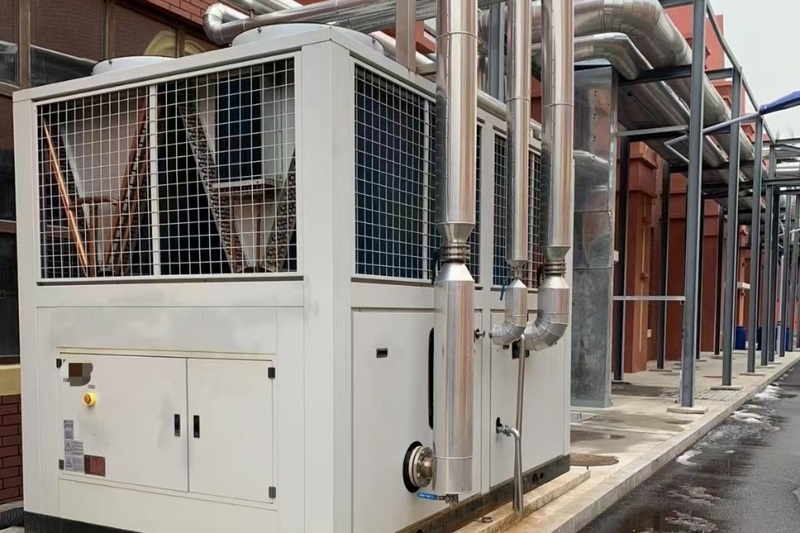
Not all air-cooled chillers are equal—and this decision matters more than most people think.
Comparison of common configurations
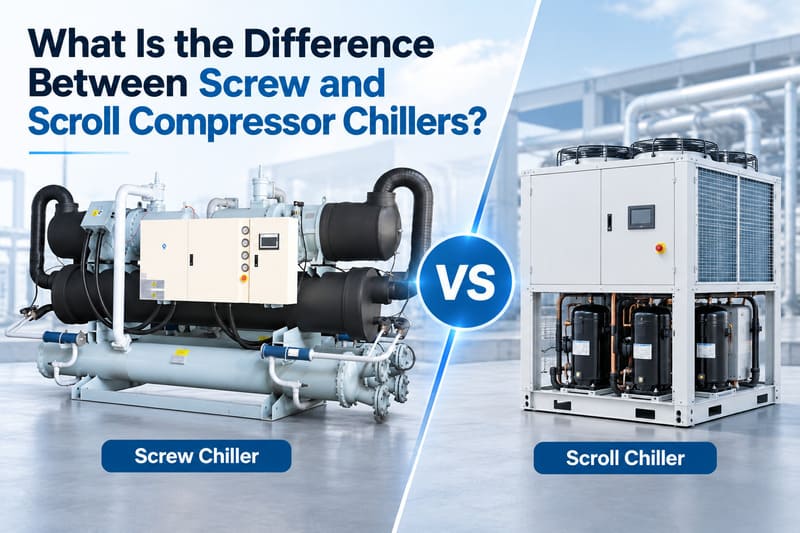
| Type | Best For | Recommendation |
|---|---|---|
| Screw Chiller | Medium to large industrial systems | ✅ Best choice |
| Scroll Chiller | Small/light-duty applications | ⚠️ Limited use |
| Modular Chiller | Flexible expansion projects | ✅ Situational |
My recommendation (based on real projects)
For industries like:
- Chemical
- Lithium battery
- Food processing
👉 Screw-type air-cooled chillers are usually the most reliable option
Because they offer:
- Better stability under fluctuating loads
- Continuous operation capability
- Easier system optimization
Air-Cooled vs Water-Cooled: How Do You Decide?
This is one of the most important decisions in system design.
Quick comparison
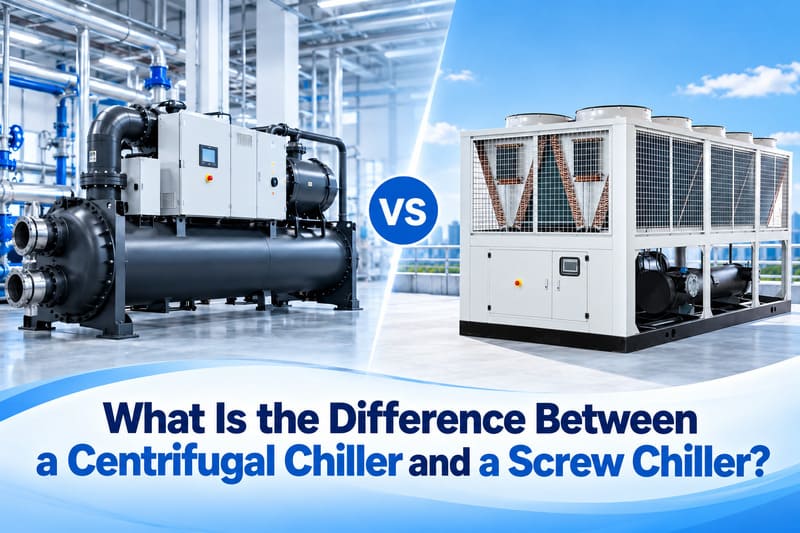
| Factor | Air-Cooled | Water-Cooled |
|---|---|---|
| Installation | Simple | Complex |
| Water requirement | None | High |
| Efficiency | Medium | High |
| Maintenance | Low | Moderate |
| Best use case | Distributed systems | Large centralized plants |
My practical guideline
- Limited water / overseas projects → Air-cooled
- Large industrial plants / energy-sensitive → Water-cooled
👉 Key takeaway:
There is no “better system”—only the one that fits your constraints.
Are You Optimizing Cost—or Just Reducing Price?
This is where smart buyers think differently.
Real cost comparison
| Cost Type | Low-Cost Chiller | Optimized System |
|---|---|---|
| Initial investment | Lower | Slightly higher |
| Energy cost | High | Lower |
| Maintenance | Frequent | Stable |
| 5-year total cost | Higher | Lower |
What I’ve seen in real projects
- Saving 10% upfront
- Losing 30% in energy cost
👉 My honest advice:
Don’t ask “Which one is cheaper?”
Ask “Which one costs less over 5 years?”
What Should You Ask a Chiller Supplier Before Buying?
If you’re comparing suppliers, this is critical.
Ask these 5 questions
- Do you design based on maximum ambient temperature?
- Can you customize the system based on my process?
- What compressor and control system do you use?
- Do you provide system-level solutions or only equipment?
- Do you have experience in similar industries?
👉 If the answers are unclear:
That’s already your answer.
When Is Air-Cooled Chiller the Right Choice?
Let me simplify it for you.
Best-fit scenarios
- Limited water availability
- Overseas or remote projects
- Need for simple installation
- Limited maintenance resources
Be cautious if
- Ambient temperature >50°C
- Very large centralized cooling demand
- Extremely high energy efficiency requirements
👉 One sentence summary:
Air-cooled chillers are not better—they are simply more suitable for certain conditions.
Final Advice (From Real Engineering Experience)
After working on so many projects, I’ve learned one thing:
You’re not buying a chiller. You’re buying system stability.
If the selection is right:
- Your system runs smoothly
- Your energy cost stays under control
- Your production is stable
If it’s wrong:
- Everything becomes a problem
👉 If you’re still at the selection stage, just prepare these:
- Cooling capacity (kW / TR)
- Water temperature (in/out)
- Maximum ambient temperature
That’s enough to make a much smarter decision.
Advanced FAQ
Q1: How do I calculate chiller capacity for fluctuating industrial loads?
A:
You should calculate:
- Base load + peak load margin (10–30%)
- Consider batch vs continuous processes
- Include redundancy (N+1 for critical systems)
Designing only for average load is a major cause of system instability.
Q2: At what ambient temperature does an air-cooled chiller lose efficiency significantly?
A:
Efficiency starts dropping above 40–45°C.
At 50°C+, you can expect:
- 20–30% capacity loss
- 20–30% higher energy consumption
System design must compensate for this.
Q3: How do I choose between air-cooled and water-cooled systems?
A:
| Factor | Recommendation |
|---|---|
| Water availability | Limited → Air-cooled |
| System size | Large → Water-cooled |
| Energy sensitivity | High → Water-cooled |
Q4: What are the hidden costs of choosing a cheaper chiller?
A:
- Higher electricity consumption
- More frequent maintenance
- Shorter lifespan
Over time, total cost is often much higher.
Q5: What design features are critical for high-temperature environments?
A:
- Larger condenser area
- High-efficiency fans
- High-temperature compressors
- Smart control systems