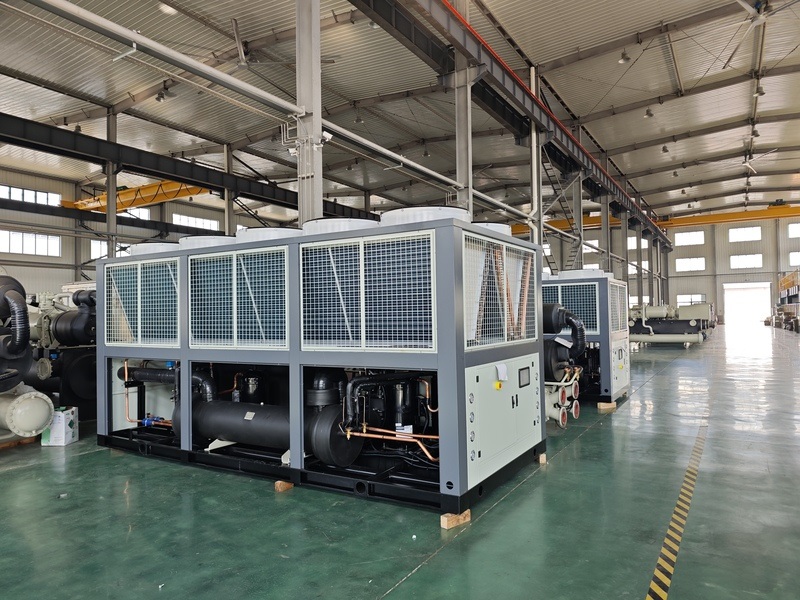
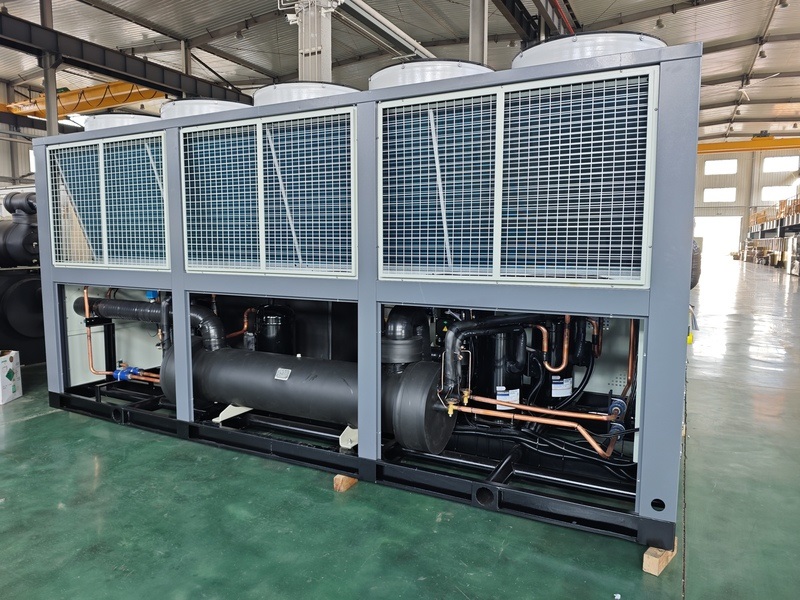
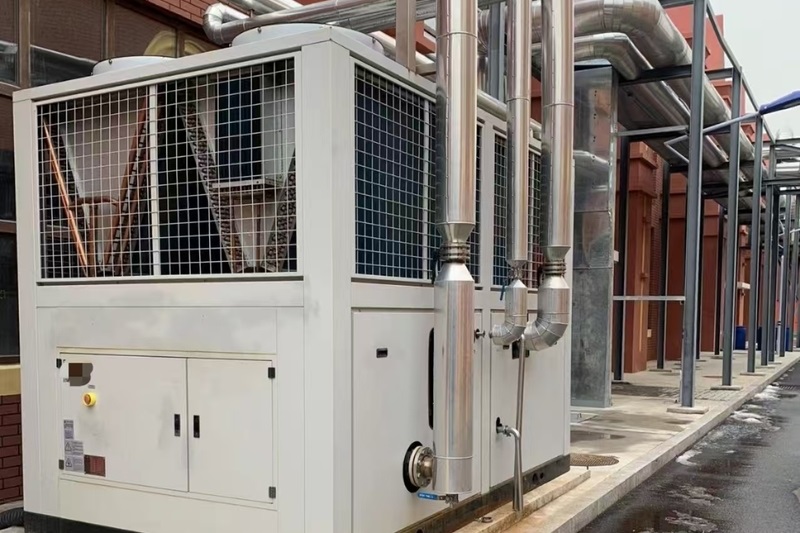
Different countries require different configurations
Custom engineering
Process-specific design changes overall system complexity
Example from real projects
A chiller designed for:
Europe at 35°C ambient and
Middle East at 50°C ambient
…may look similar externally.
But internally, the engineering requirements can be completely different.
That difference affects:
Condenser sizing
Fan performance
Compressor operating range
Control logic
And ultimately:
Reliability
Efficiency
Equipment lifespan
Why Are Some Air-Cooled Chillers Much Cheaper Than Others?
This is a question buyers rarely ask—but absolutely should.
Because in this industry, some suppliers reduce price by reducing engineering quality.
Common cost-cutting approaches
Cost Reduction Method
Long-Term Impact
Smaller condenser
Poor high-temperature performance
Lower-grade compressor
Reduced lifespan
Basic control system
Poor stability
Thin heat exchanger materials
Faster corrosion and leakage
Lower energy efficiency design
Higher electricity bills
👉 The problem is:
At the quotation stage, these differences are often invisible.
But after installation?
That’s when the real cost appears.
One thing I always tell clients
A low-priced chiller may save money on Day 1. But a poorly designed system can cost far more over the next 5 years.
Initial Price vs Total Cost of Ownership (TCO)
This is where experienced buyers think differently.
Because the true cost of a chiller is not the purchase price.
It’s the total cost of:
Ownership
Operation
Maintenance
Downtime risk
Simple comparison
Cost Category
Lower-Cost Chiller
Optimized Industrial System
Initial investment
Lower
Higher
Energy consumption
Higher
Lower
Maintenance frequency
More frequent
Lower
System stability
Moderate
High
Expected lifespan
Shorter
Longer
5-year total cost
Often higher
Often lower
What happens in real industrial plants
I’ve seen clients:
Save 10% upfront
Then spend 30–40% more in electricity and maintenance later
Especially in:
Chemical plants
Battery factories
Continuous production lines
…where systems operate 24/7.
👉 In these cases:
Energy efficiency becomes more important than purchase price very quickly.
The Hidden Cost Most Buyers Ignore: Electricity Consumption
This is probably the single biggest hidden expense in industrial cooling.
Example
A poorly optimized air-cooled chiller may consume:
10–25% more electricity than a properly engineered system.
Now multiply that by:
24 hours/day
365 days/year
5–10 years
That difference becomes enormous.
Why efficiency matters more in hot climates
In high ambient regions:
Middle East
Africa
Southeast Asia
…the efficiency gap becomes even larger.
Because air-cooled chillers work harder under high ambient temperatures.
Real engineering matters here
Good system design may include:
Larger condenser area
High-efficiency EC or axial fans
Intelligent capacity control
Optimized refrigerant circuit
These things increase initial cost slightly.
But they reduce operating cost significantly.
How to Reduce Cooling Cost Without Sacrificing Reliability
This is where smart engineering creates real value.
What we usually recommend
Strategy
Benefit
Proper load calculation
Prevents oversizing or undersizing
High-efficiency compressor selection
Lower power consumption
Intelligent control system
Better part-load efficiency
Correct ambient temperature design
Stable operation in summer
System-level optimization
Lower lifetime operating cost
👉 One important point:
Oversimplified systems are not always economical systems.
What Type of Buyer Usually Chooses Higher-Efficiency Systems?
Interestingly, the answer is usually not “bigger companies.”
It’s companies with:
Long-term operational thinking
High electricity cost
Continuous production processes
Strong maintenance awareness
Because they understand:
Every hour of unstable cooling can affect production, product quality, and profit.
What Should You Ask Before Comparing Chiller Prices?
Before you compare quotations, make sure suppliers clarify these points:
Important questions
What ambient temperature is the system designed for?
What compressor brand is used?
What is the expected power consumption?
Is the quotation based on actual process conditions?
How is part-load efficiency handled?
What protections are included in the control system?
Is the system optimized for long-term operation?
👉 If a supplier only talks about price and avoids these questions:
That is usually a warning sign.
So… Should You Buy the Cheapest Chiller?
My honest opinion?
Usually not.
Because industrial cooling is different from consumer products
When a home appliance fails:
It’s inconvenient.
When an industrial cooling system fails:
Production may stop
Product quality may suffer
Entire processes may be affected
👉 That’s why experienced buyers evaluate:
Reliability
Efficiency
Lifecycle cost
Engineering capability
—not just equipment price.
Final Thoughts
After years of industrial cooling projects, one thing has become very clear to us:
The real value of a chiller is not measured by its quotation price. It is measured by how reliably and efficiently it performs over time.
A lower initial price may look attractive.
But in many industrial environments, the real winners are systems that:
Run stably
Consume less energy
Require less maintenance
Protect production continuity
Because in the end:
A chiller is not just equipment. It is part of your production stability and operating cost structure.
And that deserves careful engineering—not just a low quotation.
Advanced FAQ
Why do air-cooled chillers with the same capacity have very different prices?
Because capacity alone does not determine quality or performance. Compressor brand, condenser design, control system, ambient temperature design, and energy efficiency all significantly affect system cost and long-term reliability.
What is the biggest hidden cost in industrial chillers?
In most industrial applications, electricity consumption becomes the largest long-term cost—often exceeding the initial equipment price over the system’s lifetime.
Is a higher-efficiency chiller always worth the extra investment?
For systems operating continuously or under high electricity costs, higher-efficiency systems often provide better ROI through lower operating expenses and improved stability.
How does ambient temperature affect chiller cost?
Designing for high ambient conditions (such as 45–50°C) requires stronger engineering, including larger condensers and optimized components, which increases system cost but improves reliability.
What should buyers focus on besides equipment price?
Industrial buyers should evaluate:
Lifecycle cost
Energy consumption
System reliability
Maintenance complexity
Supplier engineering capability
—not just initial quotation price.
Facebook
Twitter
LinkedIn
WhatsApp
Newsletter
Get free tips and resources right in your inbox, along with 10,000+ others