When clients first come to us, one of the most common questions we hear is simple:
“Which one is better: air-cooled or water-cooled chiller?”
It sounds like a straightforward comparison, but in real industrial projects, the answer is rarely that simple.
I’ve seen clients choose an air-cooled chiller because the installation looked easier, only to find that their long-term power cost was much higher than expected. I’ve also seen clients insist on a water-cooled system because it looked more efficient on paper, only to run into problems with cooling towers, water treatment, and maintenance that they had not fully considered at the beginning.
So if you ask me honestly, I would not start with “which one is better.” I would start with a different question:
Which one is better for your actual project conditions?
That is the question that saves money, reduces risk, and leads to a system that works the way you need it to.
A Quick Answer Before We Go Deeper
If you want the short version first, here it is:
- Air-cooled chillers are usually the better choice when you want a simpler system, faster installation, lower maintenance complexity, and no dependence on cooling water.
- Water-cooled chillers are usually the better choice when you need higher efficiency, lower long-term operating cost, and you have the infrastructure to support cooling towers and water treatment.
In other words:
| If your priority is… | The better fit is usually… |
|---|---|
| Simpler installation | Air-cooled chiller |
| No water dependency | Air-cooled chiller |
| Lower maintenance burden | Air-cooled chiller |
| Higher energy efficiency | Water-cooled chiller |
| Lower operating cost over time | Water-cooled chiller |
| Large centralized cooling capacity | Water-cooled chiller |
That said, the real decision deserves a closer look.
The Core Difference: How They Reject Heat
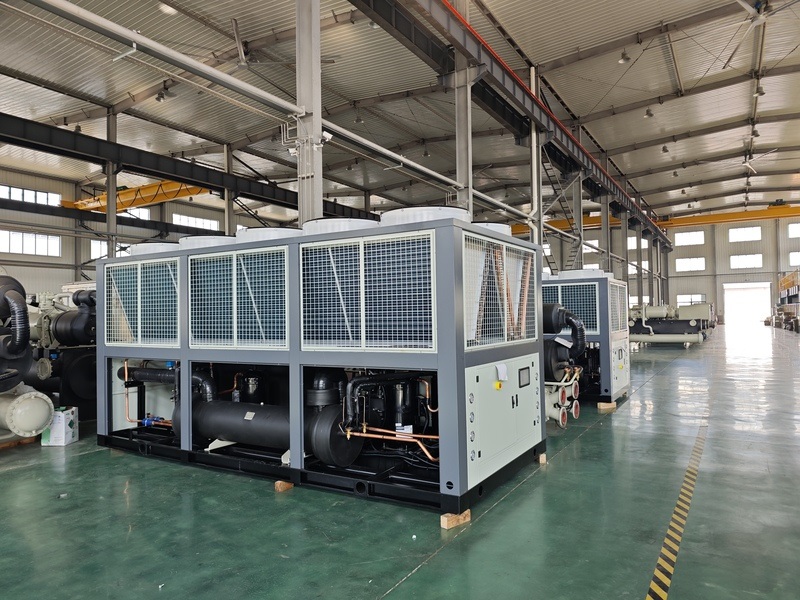
At the most basic level, the difference comes down to how the system removes heat.
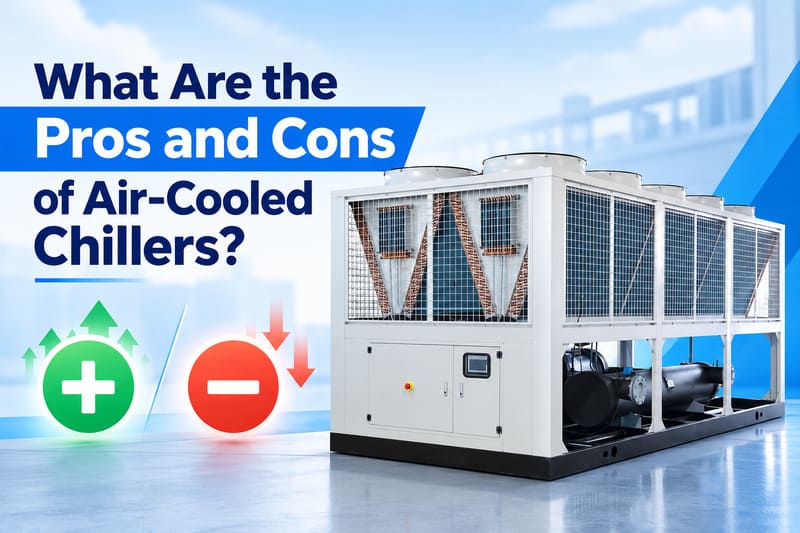
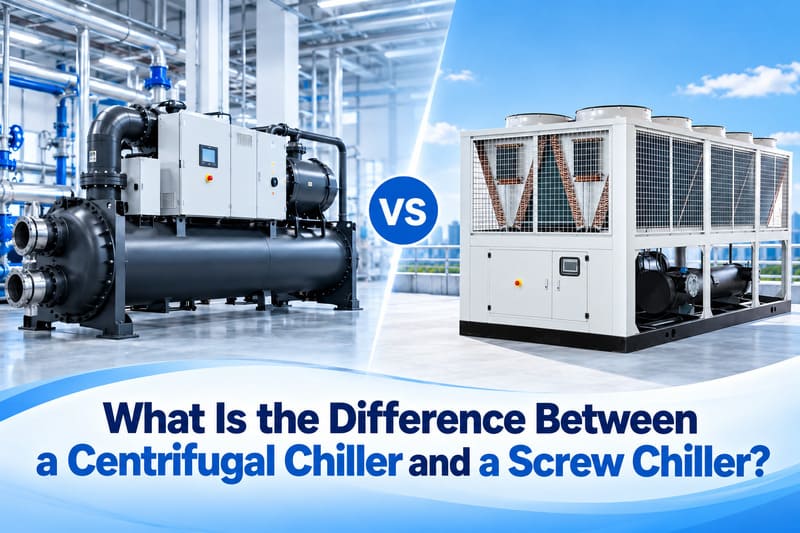
An air-cooled chiller rejects heat directly to the ambient air through its condenser.
A water-cooled chiller rejects heat through water, which then transfers that heat through a cooling tower.
That one difference affects almost everything else: installation, efficiency, maintenance, operating cost, and project complexity.
| System Type | Heat Rejection Method | Typical System Complexity |
|---|---|---|
| Air-cooled chiller | Ambient air | Lower |
| Water-cooled chiller | Water + cooling tower | Higher |
This is why air-cooled systems often feel more straightforward, while water-cooled systems often perform better in large, long-term industrial operations.
Installation: Where Many Decisions Are Made
In practice, installation conditions rule out a lot of “ideal” choices.
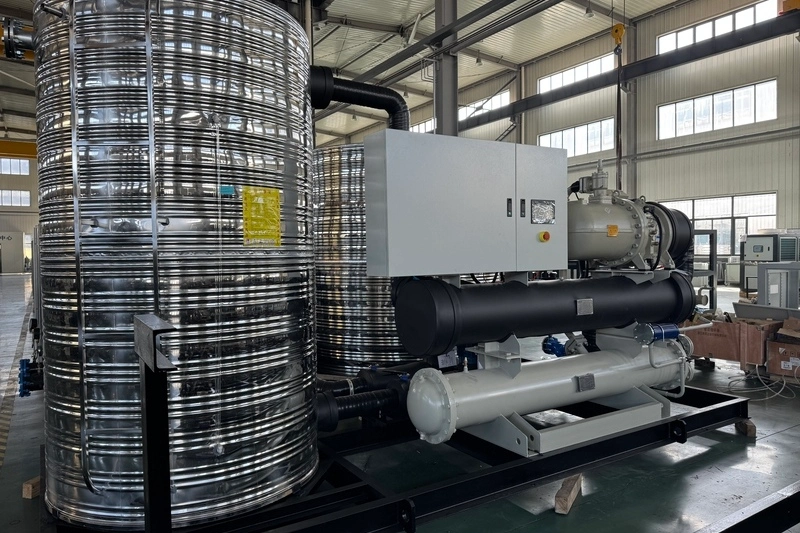
If your site has limited space, a tight construction schedule, or no desire to add cooling towers, pumps, and water piping, an air-cooled chiller becomes very attractive very quickly.
That is one reason why air-cooled chillers are popular in overseas projects, remote sites, retrofits, and plants that want a self-contained cooling solution.
A water-cooled system, by contrast, usually requires more planning and more supporting infrastructure. You are not just buying a chiller. You are building a cooling system around it.
| Installation Factor | Air-Cooled Chiller | Water-Cooled Chiller |
|---|---|---|
| Cooling tower required | No | Yes |
| Condenser water piping | No | Yes |
| Installation complexity | Lower | Higher |
| Startup coordination | Easier | More involved |
| Suitability for remote projects | Strong | More challenging |
If your team wants something faster to deploy and easier to manage, air-cooled often wins on practicality alone.
Energy Efficiency: Where Water-Cooled Systems Usually Win
Now let’s talk about the part that matters most over the life of the system: energy use.
This is where water-cooled chillers often have a clear advantage.
Because water is more effective at transferring heat than air, water-cooled chillers generally operate more efficiently, especially in larger systems and longer operating cycles. If your plant runs many hours a day, every day, that efficiency difference becomes more meaningful over time.
| Performance Factor | Air-Cooled Chiller | Water-Cooled Chiller |
|---|---|---|
| Energy efficiency | Good | Better |
| Performance under heavy continuous load | Moderate to strong | Strong |
| Suitability for very large cooling demand | Moderate | Excellent |
| Long-term operating cost | Higher | Lower |
This is why large industrial facilities often favor water-cooled systems. The upfront investment may be higher, but the lower energy cost can create a better return over the system’s life.
Still, efficiency on paper is not the full story.
Ambient Temperature: Why It Matters More Than Many Buyers Realize
Here is something I always tell clients: an air-cooled chiller should never be selected based only on “normal” temperature.
If your project is in the Middle East, Africa, South Asia, or any area with very hot summers, peak ambient temperature matters a lot. When ambient air temperature rises, the air-cooled chiller has a harder time rejecting heat. That affects capacity and energy consumption.
| Ambient Condition | Air-Cooled Chiller Impact | Water-Cooled Chiller Impact |
|---|---|---|
| Mild climate | Stable | Stable |
| Hot climate | More affected | Less affected |
| Extreme summer peaks | Capacity may drop | Usually more stable |
This does not mean air-cooled chillers are a bad choice in hot climates. It means they must be designed properly for those conditions. In real projects, that may involve larger condenser surfaces, better fan configuration, stronger controls, and careful capacity selection.
If a supplier sizes an air-cooled chiller based only on average temperature, that is a red flag.
Water Availability: Sometimes This Decides Everything
There are projects where water-cooled chillers look better in theory but make no sense in reality.
If water is scarce, expensive, or inconsistent, a water-cooled system can become a burden. A water-cooled plant depends not only on the chiller itself, but also on water quality, cooling tower performance, treatment chemicals, and the maintenance discipline of the team operating it.
That is why many clients in water-sensitive regions eventually decide that the simplicity of an air-cooled system is worth more than the theoretical efficiency advantage of water-cooled equipment.
If your site cannot support reliable water supply and water treatment, the “more efficient” option may actually become the less practical one.
Maintenance: What Happens After the Chiller Is Installed
This is the part many buyers underestimate.
An air-cooled chiller is generally easier to maintain. There is no cooling tower, no condenser water loop, and no ongoing concern about scaling or fouling in the same way you see with water systems.
A water-cooled chiller, while efficient, comes with more maintenance responsibility. Cooling towers need attention. Water quality must be controlled. Heat transfer surfaces must be kept clean. If this side of the system is neglected, the efficiency you thought you were buying can disappear very quickly.
| Maintenance Item | Air-Cooled Chiller | Water-Cooled Chiller |
|---|---|---|
| Cooling tower maintenance | No | Yes |
| Water treatment | No | Yes |
| Scaling/fouling risk | Low | Higher |
| Maintenance complexity | Lower | Higher |
From a practical point of view, if your maintenance team is limited, or if you are supporting a project in a remote market, air-cooled can be the safer and more manageable choice.
Initial Cost vs Total Cost: The Real Business Decision
This is where smart buyers separate themselves from reactive buyers.
If you look only at initial purchase cost, air-cooled systems often seem attractive. The system is simpler, installation is easier, and the supporting infrastructure is lighter.
But if you look at total cost over five or ten years, the picture changes.
Water-cooled systems often cost more to install, but can save money through lower power consumption over time, especially in large and continuously running plants.
| Cost Category | Air-Cooled Chiller | Water-Cooled Chiller |
|---|---|---|
| Initial equipment cost | Often lower | Often higher |
| Installation cost | Lower | Higher |
| Energy cost over time | Higher | Lower |
| Maintenance burden | Lower | Higher |
| Best value for short-term horizon | Strong | Moderate |
| Best value for long-term heavy-duty use | Moderate | Strong |
This is why I usually tell clients not to ask, “Which one is cheaper?”
The better question is:
Which one gives you the better outcome over the life of the project?
So Which One Should You Choose?
If you want my practical recommendation, here it is.
Choose an air-cooled chiller if you value:
- Simpler installation
- Faster project execution
- No cooling tower
- Lower maintenance complexity
- Better suitability for remote or overseas sites
- Less dependence on water conditions
Choose a water-cooled chiller if you value:
- Higher energy efficiency
- Better performance in large-scale centralized systems
- Lower long-term operating cost
- Stable performance under heavy continuous loads
- Strong plant infrastructure and maintenance support
And if you are still unsure, that usually means the decision should not be made from a catalog page alone. It should be made from real project data.
The Biggest Mistake Buyers Make
If I had to name the one mistake I see most often, it would be this:
Choosing based on equipment comparison instead of project reality.
A chiller is not a standalone purchase. It is part of a working industrial system.
The wrong choice can lead to:
- Higher energy bills
- Unstable performance
- More downtime
- More maintenance headaches
- More money spent fixing a decision that looked cheaper at the start
The right choice feels less dramatic. The system just works, year after year.
Our View from Real Industrial Projects
At IceStar, we do not see this as a simple “air vs water” debate.
We look at:
- Your cooling load
- Your ambient conditions
- Your water availability
- Your installation limitations
- Your operating hours
- Your maintenance capability
- Your long-term cost priorities
Because in the end, you are not buying a chiller for a brochure. You are buying performance for a real production environment.
And real projects deserve real engineering judgment.
Final Thoughts
If you ask me for one honest conclusion, it is this:
Air-cooled chillers win on simplicity. Water-cooled chillers win on efficiency. The better choice depends on which advantage matters more in your project.
If your project is constrained by water, installation complexity, or maintenance resources, air-cooled is often the smarter choice.
If your project runs continuously at large scale and you want to optimize lifetime operating cost, water-cooled may deliver better long-term value.
The best decision is not the most popular one.
It is the one that fits your site, your process, and your business goals.
Advanced FAQ
Which chiller is more suitable for high ambient temperature environments?
In general, water-cooled chillers are less sensitive to ambient air temperature and can maintain more stable performance in very hot regions. Air-cooled chillers can still work well in these markets, but they must be designed specifically for high ambient conditions.
Is an air-cooled chiller always cheaper than a water-cooled chiller?
Not necessarily. The initial system cost is often lower, but long-term electricity consumption may be higher. For some plants, the total life-cycle cost of an air-cooled system can exceed that of a water-cooled solution.
When does a water-cooled chiller become a better investment?
Water-cooled chillers tend to become more attractive in larger-capacity, long-running industrial projects where energy savings can justify the higher initial investment and additional system complexity.
What is the biggest risk when selecting between air-cooled and water-cooled?
The biggest risk is selecting based on price or general preference instead of actual site conditions. Water availability, ambient temperature, installation constraints, and maintenance capability should all be evaluated before a decision is made.
Which system is better for overseas or remote projects?
In many cases, air-cooled chillers are better suited for overseas or remote projects because they are simpler to install, easier to maintain, and less dependent on local water infrastructure.