Cooling towers and chillers can work together, but an incorrect match can reduce capacity, raise energy use, and cause unexpected shutdowns. I often see buyers focus only on nominal cooling tonnage while overlooking water temperatures, flow rates, and local climate. A proper condenser-side assessment helps prevent these risks before procurement or retrofit work begins.
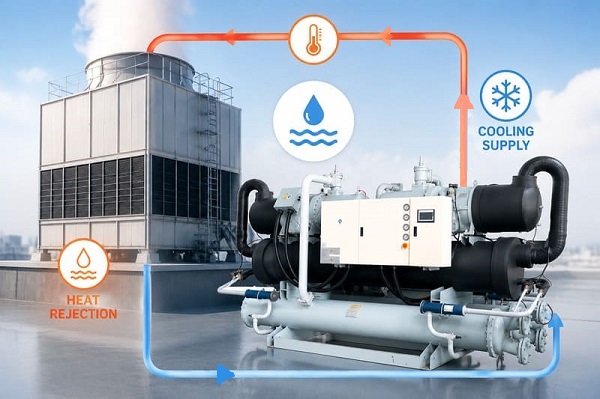
Cooling towers and chillers work together in water-cooled systems. The chiller transfers process or building heat into a condenser-water loop, and the cooling tower rejects that heat into the atmosphere. Air-cooled chillers use their own air-cooled condensers, so they generally do not require a separate cooling tower.1
The basic relationship is simple, but compatibility is not. From our engineering and customer-support perspective at IceStar, I recommend evaluating the chiller, tower, pumps, piping, controls, water quality, and site conditions as one system. Each component affects the reliability of the others.
How Do Cooling Towers and Chillers Work Together?
Many buyers understand that both machines remove heat, but they may not know where each unit operates in the system. This confusion can lead to incorrect piping concepts or equipment specifications. I start every discussion by separating the two water loops and defining the heat-transfer path.
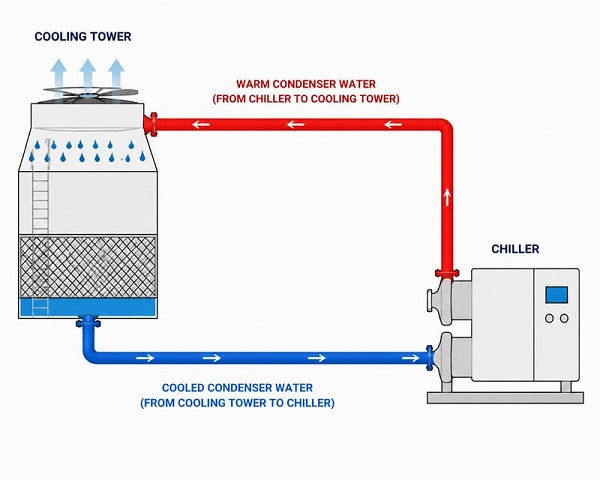
Cooling towers and chillers work together through the condenser-water circuit. The water-cooled chiller removes heat from the chilled-water circuit and transfers it to condenser water. A pump sends the warmer condenser water to the cooling tower, where heat is released before the water returns to the chiller.
The System Usually Has Two Separate Water Loops
A water-cooled chiller system typically includes a chilled-water loop and a condenser-water loop.2 I consider this distinction essential during initial technical discussions.
-
The chilled-water loop serves the load.
The chiller produces chilled water for an industrial process, production machine, air-handling system, or other cooling demand. -
The condenser-water loop rejects heat.
The condenser water absorbs heat from the chiller’s refrigerant circuit and carries that heat to the cooling tower. -
The cooling tower releases heat outdoors.
The tower uses air movement and evaporative heat transfer to cool the condenser water before it returns to the chiller.
The cooling tower does not normally send chilled water directly to the process. It supports the chiller’s condenser side.
How Heat Moves Through the System
I explain the heat path in four stages:
- The process transfers heat into the chilled water.
- The chiller’s evaporator transfers that heat into the refrigerant.
- The compressor adds energy while circulating and compressing the refrigerant.
- The condenser transfers the combined heat into the condenser-water loop, which carries it to the tower.
This relationship means that the cooling tower must reject more than the process cooling load alone. In simplified terms:
Condenser heat rejection = evaporator cooling load + compressor input3
However, I do not recommend applying a generic sizing multiplier without checking the selected chiller’s technical data. Compressor efficiency, operating temperatures, part-load conditions, refrigerant design, and site conditions all influence the required heat-rejection capacity.
What Each Component Does
| Component | Main function | Water circuit | Key buyer checks |
|---|---|---|---|
| Water-cooled chiller | Produces chilled water and transfers heat to condenser water | Both chilled-water and condenser-water sides | Capacity, efficiency, temperatures, pressure drop, flow |
| Cooling tower | Rejects condenser heat to outdoor air | Condenser-water side | Heat rejection, wet-bulb basis, water flow, approach |
| Chilled-water pump | Circulates water through the process and evaporator | Chilled-water side | Flow, head, materials, control method |
| Condenser-water pump | Circulates water between the chiller and tower | Condenser-water side | Flow, head, pressure drop, operating range |
| Controls | Coordinates equipment operation | Entire system | Interlocks, sensors, staging, alarms |
| Water-treatment system | Controls scaling, corrosion, and biological growth | Primarily open condenser-water circuit | Water chemistry, filtration, monitoring |
In customer and EPC selection discussions, I often ask for a simple system diagram before reviewing individual equipment. A diagram can reveal loop confusion, missing pumps, incorrect control points, or an assumption that the cooling tower directly produces process chilled water.
Do All Cooling Towers and Chillers Need to Be Connected?
A buyer may assume that a cooling tower is a standard accessory for every industrial chiller. That assumption can add unnecessary cost and complexity. I first confirm the condenser type because it determines whether the chiller needs an external heat-rejection circuit.
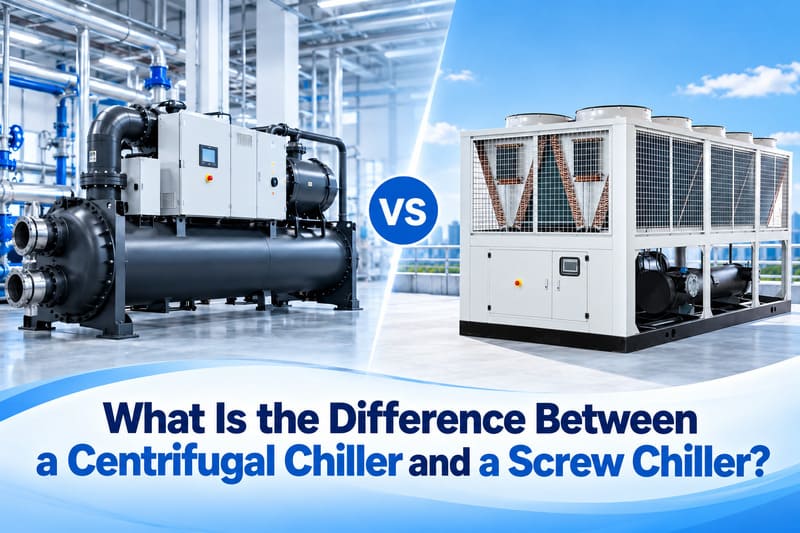
No, not all chillers require cooling towers. Water-cooled chillers typically connect to a cooling tower or another suitable heat-rejection source. Air-cooled chillers reject heat through an integrated outdoor coil and fans. The appropriate configuration depends on capacity, climate, water availability, maintenance resources, noise limits, and lifecycle cost.
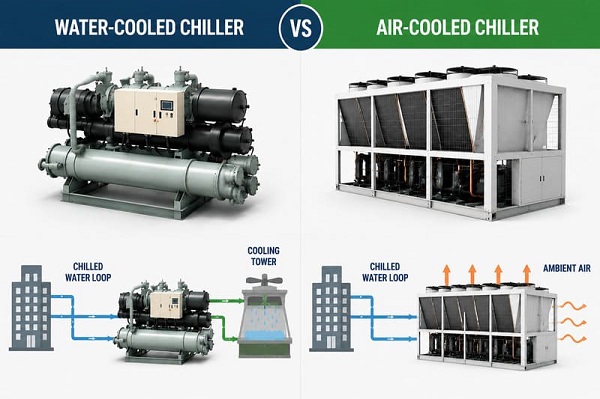
Water-Cooled Chiller Systems
A water-cooled chiller uses a water-cooled condenser. Condenser water passes through this heat exchanger, absorbs heat from the refrigerant, and then flows to the tower.
I generally expect a complete water-cooled arrangement to include:
- One or more water-cooled chillers
- One or more cooling towers
- Condenser-water pumps
- Chilled-water pumps
- Piping, valves, strainers, and balancing devices
- Expansion and make-up water arrangements
- Water-treatment equipment
- Temperature, pressure, and flow sensors
- Control interlocks and safety logic
These systems can offer strong efficiency and capacity advantages in suitable applications. However, they create additional requirements for water management, tower maintenance, pump energy, piping, and controls.
Air-Cooled Chiller Systems
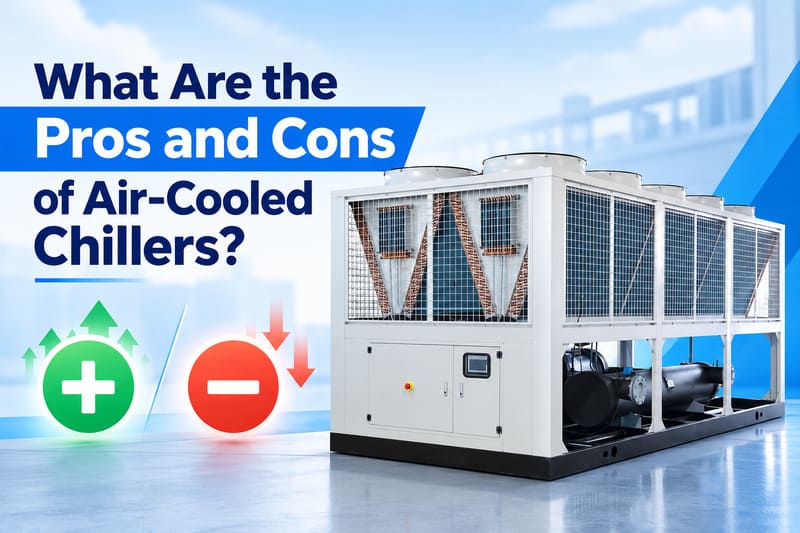
An air-cooled chiller uses fans to move ambient air across its condenser coils. It therefore does not normally need a cooling tower or condenser-water pump.
Air-cooled equipment may be attractive when:
- Water is scarce or expensive.
- The site wants simpler installation.
- Cooling-tower maintenance is difficult.
- Water treatment resources are limited.
- The project requires a packaged, outdoor installation.
- The cooling load or operating schedule favors air-cooled equipment.
High ambient temperature requires careful attention. For projects in the Middle East, Africa, or other hot regions, I recommend verifying the selected air-cooled chiller’s capacity at the actual design ambient temperature, rather than relying on a nominal catalog condition. A high-ambient design may require larger condenser surfaces, suitable controls, and properly selected components.
Basic Procurement Comparison
| Evaluation point | Water-cooled chiller with tower | Air-cooled chiller |
|---|---|---|
| External cooling tower | Typically required | Generally not required |
| Condenser-water pump | Required | Not normally required |
| Water treatment | Important for long-term reliability | No open condenser-water loop |
| Installation complexity | Higher | Usually lower |
| Water consumption | Includes evaporation and water-management losses | No cooling-tower water use |
| Maintenance scope | Chiller, tower, pumps, and water circuit | Chiller, fans, and condenser coils |
| Climate sensitivity | Strongly affected by wet-bulb temperature | Strongly affected by dry-bulb temperature |
| Project suitability | Requires system-level assessment | Requires ambient and airflow assessment |
I do not treat either arrangement as universally better. A procurement team should compare total cost of ownership, including power, water, maintenance, installation, expected operating hours, equipment life, and downtime risk.
Can an Existing Cooling Tower Work With a New Chiller?
An existing tower may look large enough for a replacement chiller, but physical size and nominal tonnage do not confirm compatibility. I have reviewed matching questions in which the most important information was missing from the first request. A disciplined data check is necessary before anyone approves the connection.
An existing cooling tower can work with a new water-cooled chiller if it can meet the chiller’s required condenser-water flow and temperature conditions at the site’s design wet-bulb condition. Engineers must also verify pump capacity, piping pressure drop, water quality, tower condition, controls, and heat-rejection capacity.
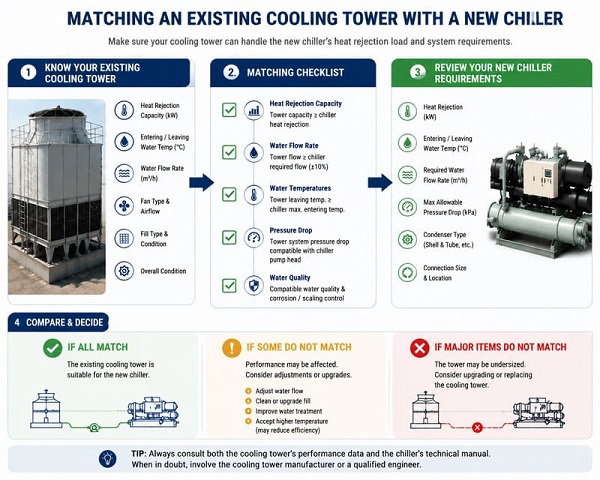
Start With the Chiller’s Condenser-Side Requirements
In a real cooling-tower and new-chiller matching assessment, I would not provide a compatibility judgment from the model names or nominal capacities alone. I would first request the new chiller’s selection data and the existing system information.
The chiller data should include:
- Required condenser-water flow
- Design condenser-water entering temperature
- Design condenser-water leaving temperature
- Condenser pressure drop
- Cooling capacity at the stated condition
- Total heat rejection
- Compressor power at the design point
- Minimum and maximum allowable water conditions
- Water-side material and quality requirements
- Part-load operating information, where available
The tower data should include:
- Tower manufacturer and model
- Rated heat-rejection capacity
- Rated water flow
- Entering and leaving water temperatures
- Design wet-bulb temperature
- Fan quantity, motor rating, and control method
- Current fill, nozzle, basin, and fan condition
- Water losses and make-up arrangement
- Any available performance or maintenance records
Why Nominal Tonnage Is Not Enough
A tower marked with the same nominal tonnage as a chiller may still be unsuitable. Cooling-tower ratings depend on a specific combination of water flow, hot-water temperature, cold-water temperature, and entering-air wet-bulb temperature.4 A different combination can change the tower’s practical heat-rejection performance.
I pay particular attention to these variables:
| Matching variable | Why it matters | Risk if mismatched |
|---|---|---|
| Total heat rejection | Includes cooling load and compressor input | High condensing pressure or reduced capacity |
| Condenser-water flow | Controls heat transfer through the condenser | Poor heat transfer, erosion, or flow alarms |
| Tower leaving-water temperature | Becomes the chiller’s entering condenser water | Higher compressor power or unstable operation |
| Wet-bulb temperature | Limits evaporative cooling potential | Tower may not reach the target water temperature |
| Condenser pressure drop | Affects pump head requirement | Insufficient flow or excessive pump energy |
| Piping condition | Influences resistance and water quality | Low flow, leaks, fouling, or corrosion |
| Tower condition | Determines actual rather than catalog performance | Reduced heat rejection and unreliable operation |
Inspect the Existing Equipment
Catalog data describes expected performance under stated conditions. It does not show the current condition of an older tower. I recommend a qualified site inspection before final procurement approval.
The inspection should check:
- Fill fouling, damage, or blockage
- Spray nozzles and water distribution
- Fan blades, belts, gearboxes, and motors
- Basin cleanliness and corrosion
- Drift eliminators
- Strainers and filters
- Pump condition and operating point
- Valve positions and balancing
- Pipe diameter and internal condition
- Sensor location and calibration
- Water-treatment history
A pump nameplate alone also does not confirm usable flow. The engineer should compare the pump curve with the actual system resistance and required operating point. Flow measurement or suitable commissioning tests may be necessary.
Which Conditions Affect Cooling Towers and Chillers Most?
A system may appear compatible under mild weather but struggle during peak production and the hottest, most humid period. This gap creates a serious procurement risk. I therefore evaluate equipment against target operating conditions instead of relying only on standard catalog ratings.
The performance of cooling towers and chillers depends on wet-bulb temperature, condenser-water flow, entering-water temperature, process load, fouling, water quality, and control strategy. Engineers should verify these factors at both design and part-load conditions because an acceptable nominal selection may still perform poorly in actual service.
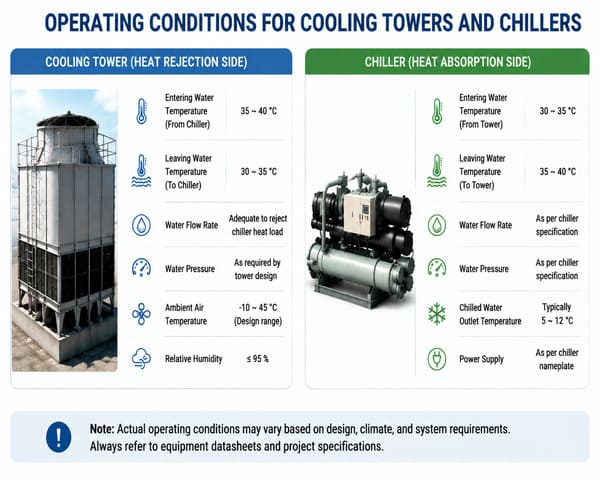
Local Wet-Bulb Temperature
Cooling-tower performance is closely related to the ambient wet-bulb temperature.5 Dry-bulb temperature alone does not provide enough information because evaporative cooling depends on air temperature and moisture content.
Two useful cooling-tower terms are:
- Range: The difference between the hot water entering the tower and the cooler water leaving it.
- Approach: The difference between the tower’s leaving-water temperature and the entering-air wet-bulb temperature.
A smaller approach generally requires more tower capability, but the practical selection depends on tower design, airflow, water flow, climate, and cost. I recommend using recognized project weather data and confirming the design basis with the tower supplier.
Flow and Temperature Stability
Insufficient condenser-water flow can reduce heat transfer and cause high condensing pressure.6 Excessive flow can increase pumping energy and may exceed the condenser’s acceptable water velocity or pressure-drop limits. The chiller manufacturer should define the permitted operating range.
Water temperature also needs control. Very warm entering condenser water may reduce cooling capacity and increase compressor demand. Very cold condenser water can also create control problems in some systems if the chiller and tower controls are not designed for low-temperature operation.
Project-specific control options may include:
- Variable-speed tower fans
- Multiple fan or cell staging
- Condenser-water bypass valves
- Variable-speed pumps
- Temperature reset logic
- Minimum-flow protection
- Chiller and pump interlocks
- Automatic alarms and shutdown protection
The controls should follow the selected chiller’s operating envelope. I avoid recommending a universal setpoint because equipment designs and applications differ.
Process Load and Seasonal Operation
Industrial loads do not always behave like comfort-cooling loads. A plastics line, chemical process, food-production system, or battery-manufacturing process may operate continuously or change quickly with production.
I ask buyers to define:
- The normal load
- The peak load
- The minimum stable load
- The operating schedule
- The required supply-water temperature
- The allowable temperature variation
- Any planned production expansion
- The consequence of a cooling interruption
These details affect chiller staging, tower cell selection, water volume, redundancy, and controls. When downtime has a high cost, buyers may also need to evaluate standby pumps, multiple compressors, spare tower cells, or an N+1 system arrangement. A qualified engineer should confirm the appropriate redundancy level.
How Do Water Treatment and Maintenance Protect Cooling Towers and Chillers?
A correctly sized system can still lose performance when scaling, corrosion, or biological growth develops. I have seen troubleshooting discussions focus on the compressor while the condenser-water circuit receives little attention. A reliable procurement plan must include water management and maintainable system design from the start.
Water treatment and preventive maintenance protect cooling towers and chillers by keeping heat-transfer surfaces, piping, basins, and water-distribution components clean. The treatment program should control scale, corrosion, suspended solids, and biological activity according to local water chemistry, equipment materials, and applicable health and environmental requirements.
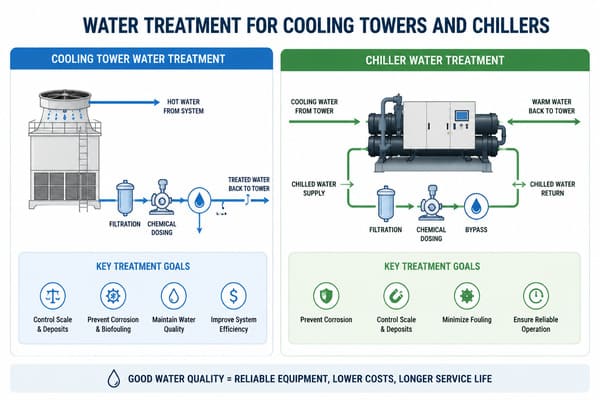
Why Open Tower Water Requires Attention
A cooling tower exposes circulating water to outdoor air. The system can collect dust, airborne particles, and organic material. Evaporation also concentrates dissolved minerals in the remaining water.
These conditions can contribute to:
- Scale, which insulates heat-transfer surfaces
- Corrosion, which damages piping and equipment
- Biological growth, which can restrict flow and create health risks
- Sediment, which can block strainers, nozzles, and heat exchangers
- Fouling, which reduces tower and condenser performance
A site-specific program may use filtration, chemical treatment, blowdown control, conductivity monitoring, and scheduled cleaning. A qualified water-treatment specialist should develop and monitor the program. Local regulations and health requirements also need professional review.
Maintenance Information to Request From a Supplier
Procurement teams should ask for more than an equipment price. I recommend requesting:
- Maintenance schedules
- Water-quality limits
- Condenser cleaning procedures
- Recommended spare-parts lists
- Sensor and control documentation
- Alarm descriptions
- Pump and fan service requirements
- Remote-support arrangements
- Commissioning checklists
- Operator training scope
- Warranty conditions and exclusions
If a supplier presents certifications, test reports, or component-brand claims, buyers should verify the documents, model coverage, issuing body, and validity. Certifications do not replace a project-specific engineering review or factory quality-control inspection.
Commissioning Checks
During commissioning, the responsible team should confirm that the installed system matches the approved design. Typical checks include:
- Actual chilled-water and condenser-water flow
- Entering and leaving water temperatures
- Pump rotation and operating pressure
- Tower fan rotation and staging
- Valve position and balancing
- Control interlocks
- Alarm and safety functions
- Sensor accuracy
- Refrigeration operating parameters
- Water-treatment readiness
- Leaks, vibration, and unusual noise
I also recommend recording a baseline operating condition after stable commissioning. That record can help the owner compare future temperatures, pressures, flow rates, and power use during preventive maintenance or troubleshooting.
Frequently Asked Questions
Can a chiller operate without a cooling tower?
A water-cooled chiller requires a suitable condenser heat-rejection source, which is typically a cooling tower. An air-cooled chiller uses its integrated condenser coils and fans, so it generally operates without a tower. The condenser type should be confirmed before the buyer plans the system.
Does a cooling tower make chilled water?
No. A cooling tower typically cools condenser water, not the chilled water supplied to an industrial process or building. The chiller produces chilled water through its refrigeration cycle. The two water circuits remain separate under normal system design.
Can I match a tower and chiller by cooling tonnage alone?
No. Nominal tonnage does not confirm compatibility. I recommend checking total heat rejection, condenser-water flow, entering and leaving water temperatures, wet-bulb design conditions, pump head, piping resistance, controls, and the tower’s present physical condition.
What information should I provide when requesting a chiller quotation?
You should provide the required cooling capacity, chilled-water temperatures, process fluid, flow rate, ambient conditions, power supply, operating hours, installation location, and redundancy needs. For an existing tower, you should also provide its rating data, design temperatures, water flow, wet-bulb basis, pump information, and maintenance condition.
Can a larger cooling tower cause problems?
A larger tower is not automatically a problem, but the complete system still needs suitable flow, temperature control, fan staging, pump selection, and minimum condenser-water temperature management. An engineer should verify the tower’s operation across peak and part-load conditions rather than approving it from nameplate capacity alone.
Conclusion
Cooling towers and chillers work together effectively when a water-cooled chiller’s condenser requirements match the tower, pumps, piping, controls, water treatment, and local climate. I recommend checking total heat rejection, water flow, temperature conditions, wet-bulb data, pressure drop, and existing equipment condition before approving a retrofit. Nominal tonnage alone is not enough. If you are evaluating an existing cooling tower for a new industrial chiller, contact IceStar with your system data so our engineering team can support a project-specific selection and compatibility review.
"Integrated Chiller System Reduce Building Operation and ...", https://digitalcommons.unl.edu/cgi/viewcontent.cgi?article=1028&context=archengfacpub. Air-cooled chillers reject condenser heat directly to outdoor air through finned coils and fans, eliminating the separate condenser-water loop and cooling tower used by conventional water-cooled configurations. Evidence role: definition; source type: education. Supports: A source should define an air-cooled chiller as equipment that rejects condenser heat directly to ambient air through coils and fans.. ↩
"Integrated Chiller System Reduce Building Operation and ...", https://digitalcommons.unl.edu/cgi/viewcontent.cgi?article=1028&context=archengfacpub. Standard water-cooled chiller schematics distinguish a chilled-water loop serving building or process loads from a condenser-water loop that transports rejected heat from the chiller to the cooling tower. Evidence role: definition; source type: education. Supports: A system reference should distinguish the chilled-water circuit serving the load from the condenser-water circuit carrying heat to the cooling tower.. ↩
"Chapter SM 6 Compressors and Expansion Devices", https://www.purdue.edu/freeform/me418/wp-content/uploads/sites/30/2024/09/Chapter-SM-6-Ref-Compressors.pdf. For a steady-state vapor-compression refrigeration cycle, conservation of energy gives condenser heat rejection as the sum of evaporator heat absorption and compressor work input, subject to the usual neglect of minor auxiliary heat transfers. Evidence role: mechanism; source type: education. Supports: A thermodynamics source should establish the steady-state energy balance in which condenser heat rejection equals evaporator heat absorption plus compressor work.. Scope note: The simplified balance does not by itself account for pump, fan, motor, piping, or other system-level heat gains. ↩
"Cooling Tower: General Description and Uses", https://hvacresourcemap.nlr.gov/laboratories/central-plant/cooling-tower. Cooling-tower performance standards characterize capacity at stated water flow, entering- and leaving-water temperatures, and entering-air wet-bulb conditions; a nominal capacity therefore cannot be transferred to different conditions without additional performance evaluation. Evidence role: general_support; source type: institution. Supports: A recognized technical standard or institutional guide should identify the thermal conditions required to state or test cooling-tower performance.. ↩
"Performance Evaluation of an Indirect Evaporative Cooler", https://docs.lib.purdue.edu/cgi/viewcontent.cgi?article=3387&context=iracc. Because cooling towers rely primarily on evaporation, entering-air wet-bulb temperature is the relevant climatic reference and establishes a practical lower bound for the temperature of water leaving the tower. Evidence role: mechanism; source type: education. Supports: A source should explain that evaporation and air moisture content establish a wet-bulb-related lower limit for cooling-tower outlet-water temperature.. Scope note: Actual leaving-water temperature remains above the wet-bulb temperature and also depends on tower design, airflow, water loading, condition, and control. ↩
"Specifications: Air-Cooled Scroll Water Chiller", https://www.eastms.edu/about/policies/bids/waterchiller/doc4-specificationsforaircooledscrollwaterchiller.pdf. Studies of water-cooled condensers show that inadequate water flow can reduce water-side heat-transfer effectiveness, increase refrigerant condensing temperature and pressure, and degrade chiller capacity or efficiency. Evidence role: mechanism; source type: paper. Supports: A source should demonstrate that reduced condenser-water flow can lower water-side heat-transfer performance and increase condensing temperature or pressure.. Scope note: The threshold for unacceptable flow is equipment-specific and must be interpreted using the condenser's rated flow range and pressure-drop limits. ↩