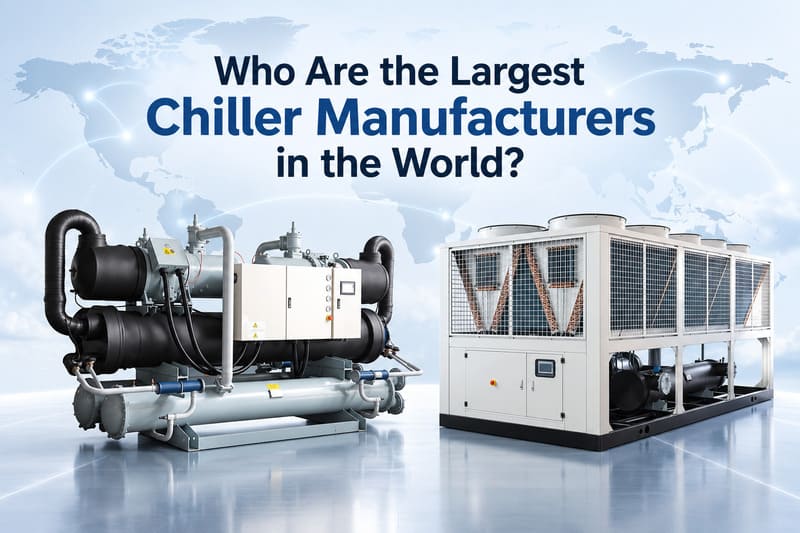
The largest chiller manufacturers often appear to be the safest choice, but a famous name cannot solve an unsuitable process design. I have seen buyers compare brands before confirming cooling capacity, leaving-water temperature, ambient conditions, or service support. I believe a careful shortlist should combine manufacturer scale with application fit, project capability, and long-term operating risk.
There is no single reliable ranking of the largest chiller manufacturers because “largest” can mean global revenue, total HVAC sales, chiller sales, commercial market share, or industrial project experience. Major names commonly considered include Carrier, Trane, Johnson Controls–YORK, Daikin, Mitsubishi Heavy Industries, and other regional specialists. Buyers should verify current company data and then compare complete systems, support, and process suitability.
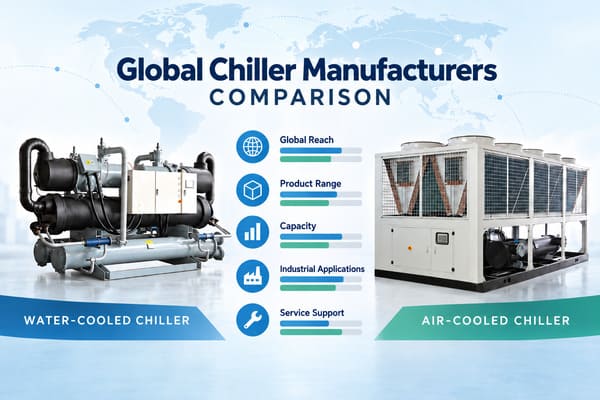
I use global manufacturer lists as a starting point, not as a final purchasing decision. In my work with industrial customers and EPC partners, the most useful comparison usually begins after the brand list is created. The key questions involve process conditions, system design, delivery, commissioning, and the supplier’s ability to respond when production depends on stable cooling.
How should buyers define the largest chiller manufacturers?
A vague definition can make a manufacturer ranking look more precise than it really is. Buyers may compare a diversified HVAC corporation with a specialist industrial supplier without checking whether the reported figures cover the same products. This can create a shortlist that is impressive on paper but weak for the actual project.
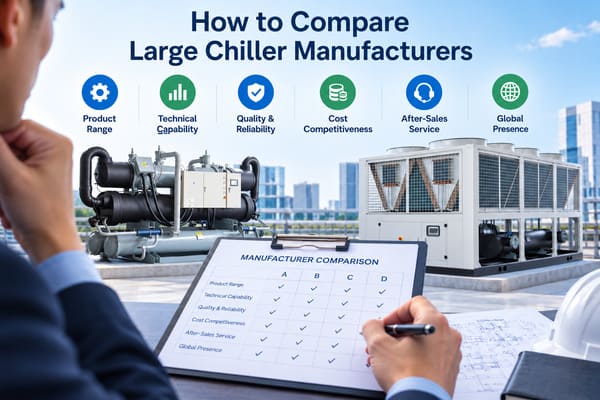
I define the largest chiller manufacturers by the measurement being used: overall company size, HVAC revenue, chiller revenue, regional sales, installed base, or industrial project experience. A useful comparison states the date, market scope, product category, and source before naming market leaders.
Why company size can be misleading
Large manufacturers may report revenue from many activities, including:
- Air-conditioning equipment
- Building automation
- Heating systems
- Refrigeration
- Service contracts
- Controls and electrical products
- Construction or other industrial divisions
Those figures do not necessarily show the company’s strength in industrial chillers. A buyer evaluating a chemical plant, plastic extrusion line, or pharmaceutical process needs more specific evidence.
I recommend asking what the available ranking actually measures:
| Ranking basis | What it may indicate | What it does not prove |
|---|---|---|
| Total corporate revenue | Overall business scale | Chiller design quality |
| HVAC revenue | Strength in climate-control markets | Industrial process experience |
| Chiller sales | Product-market presence | Local service capability |
| Installed base | Field exposure and references | Suitability for a new process |
| Industrial project references | Application experience | Lowest total cost |
| Regional market share | Local commercial strength | Global delivery performance |
A current, verifiable source also matters. Company websites, annual reports, independent market research, customs data, and project references may use different definitions. I would not treat an unsourced “top ten” article as a technical procurement document.
Commonly recognized global names
Depending on the market and product category, buyers may encounter Carrier, Trane, Johnson Controls–YORK, Daikin, Mitsubishi Heavy Industries, and other established manufacturers. Several Chinese, European, Japanese, Korean, and regional suppliers also serve industrial applications. I do not present these names as a fixed global ranking because market position changes by region, product type, reporting year, and methodology.
I also distinguish between a company that sells many standard building chillers and a manufacturer that regularly designs customized systems. A supplier may have a smaller global corporate profile but strong experience with high ambient temperatures, low-temperature glycol systems, explosion-risk areas, special power supplies, or continuous industrial production.
For procurement teams, a better approach is to create two lists:
- Market visibility: recognized brands with credible references and stable operations.
- Application capability: suppliers that can meet the project’s actual technical and service requirements.
The best candidates appear in both lists, but they do not always come from the same type of company.
Are the largest chiller manufacturers always suitable for industrial applications?
A globally recognized commercial HVAC brand may have excellent engineering resources, but commercial building experience does not automatically equal industrial process experience. Industrial systems often run continuously, face dust or high ambient temperatures, and require closer control of water temperature and flow. I always test brand reputation against the process specification.
The largest chiller manufacturers are not automatically the best industrial choice. Buyers should verify experience with the required cooling duty, operating schedule, temperature range, fluid, environmental conditions, controls, safety requirements, and integration with the production line.
Industrial conditions change the selection
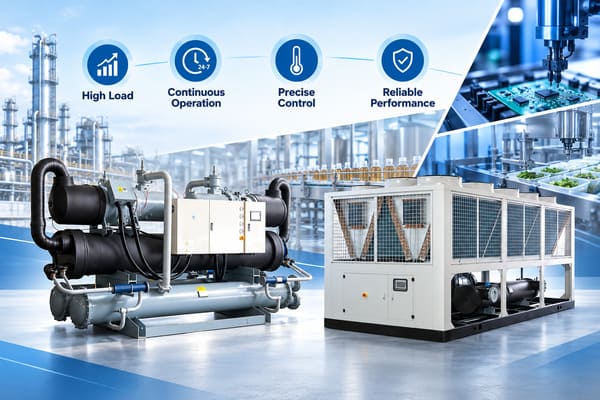
A comfort-cooling project may focus on indoor temperature and seasonal efficiency. An industrial project may depend on stable process temperature every hour of the year. A small temperature deviation can affect product quality, cycle time, viscosity, crystallization, or equipment safety.
I normally ask for the following information before comparing a proposal:
- Required cooling capacity in kW or refrigeration tons
- Process inlet and outlet temperatures
- Design flow rate and allowable pressure drop
- Fluid type and glycol concentration
- Minimum and maximum ambient temperature
- Operating hours and load profile
- Required redundancy
- Available voltage, frequency, and starting limitations
- Installation altitude and environmental conditions
- Noise, emissions, and hazardous-area requirements
- Communication protocol and control philosophy
Commercial and industrial suitability
The following examples show why the application matters:
| Requirement | Potential design implication |
|---|---|
| High ambient temperature | Larger condenser, stronger airflow, or special controls |
| Low leaving-water temperature | Suitable refrigerant circuit and heat exchanger design |
| Continuous production | Redundancy, service access, alarms, and spare parts |
| Variable process load | Variable-speed compressors or staged capacity control |
| Flammable atmosphere | Explosion-protection measures and certified components |
| Corrosive environment | Material selection and protective treatment |
| Special process fluid | Compatible seals, piping, and heat exchanger materials |
| Remote site | Local service plan and stocked critical parts |
I have seen procurement discussions focus heavily on compressor brand. A compressor from Hanbell, Bitzer, Emerson, or another recognized supplier can be an important factor, but it is only one part of the machine. The compressor must work with the evaporator, condenser, expansion device, oil system, controls, piping, and operating envelope.
I also avoid assuming that a large Western, Japanese, Chinese, or regional manufacturer is automatically superior. Every supplier has strong and weak application areas. Some companies offer extensive standardization and global service networks. Others provide faster customization, competitive lead times, and practical engineering for non-standard conditions. I ask for evidence rather than relying on nationality or reputation.
How should buyers compare chiller manufacturers beyond brand name?
A chiller is a system rather than a single component. A strong compressor cannot compensate for incorrect heat exchanger selection, poor control logic, insufficient water flow, or inadequate commissioning. I therefore compare the technical offer, project process, and support model together.
Buyers should compare chiller manufacturers using a weighted evaluation that covers capacity, efficiency, operating range, component quality, controls, compliance documents, delivery, commissioning, spare parts, and lifecycle support. The weight assigned to each criterion should reflect the cost of production downtime and the project’s technical risk.
A practical supplier scorecard
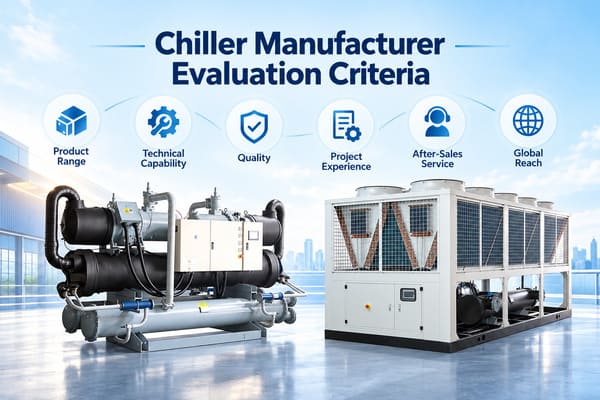
I often recommend a scorecard with technical and commercial categories. A sample structure is:
| Category | Suggested questions |
|---|---|
| Process fit | Does the unit meet capacity and temperature conditions at the design point? |
| Part-load operation | How does efficiency change under typical, not only full-load, conditions? |
| Mechanical design | Are heat exchangers, pumps, fans, piping, and controls correctly selected? |
| Quality control | What factory tests, inspection records, and traceability are available? |
| Documentation | Are drawings, manuals, certificates, and test reports complete? |
| Delivery | Is the lead time realistic, and are milestones contractually clear? |
| Commissioning | Who starts the unit and verifies performance on site? |
| Service | Who answers technical questions after delivery? |
| Spare parts | Are critical components locally available or quickly exportable? |
| Lifecycle cost | What are expected energy, maintenance, and downtime costs? |
I do not assign every category the same weight. For a remote mine or petrochemical plant, service response and spare parts may be more important than a small difference in purchase price. For a facility with strict energy targets, part-load efficiency and controls may receive greater weight.
Documents I would request
I would ask each shortlisted supplier for:
- A duty-point selection sheet.
- Full operating limits and derating information.
- Electrical load and starting data.
- Pump, tank, cooling tower, and heat exchanger specifications where applicable.
- Factory acceptance test procedures and records.
- Quality-control and inspection plans.
- Relevant certificates and declarations.
- Reference projects with comparable conditions.
- Recommended spare-parts list.
- Warranty, commissioning, and response commitments.
Certifications should be treated as documents to verify, not as general marketing statements. I would check the certificate number, issuing body, product scope, validity, and whether the document applies to the exact model. I would also confirm which party is responsible for local approvals and site compliance.
Why commissioning affects performance
A correctly selected chiller can still underperform if the system is installed poorly. Incorrect water flow, air in the circuit, dirty strainers, wrong sensor placement, inadequate ventilation, or incorrect control settings can reduce capacity and increase failures.
For that reason, I consider commissioning part of the equipment purchase. The contract should identify:
- Site responsibilities
- Pre-start inspection
- Refrigerant and electrical checks
- Flow verification
- Control calibration
- Performance testing
- Operator training
- Final documentation
In my technical discussions, I find that this system-level approach reveals differences between suppliers more clearly than a brand comparison alone.
What support should I expect from a large chiller manufacturer?
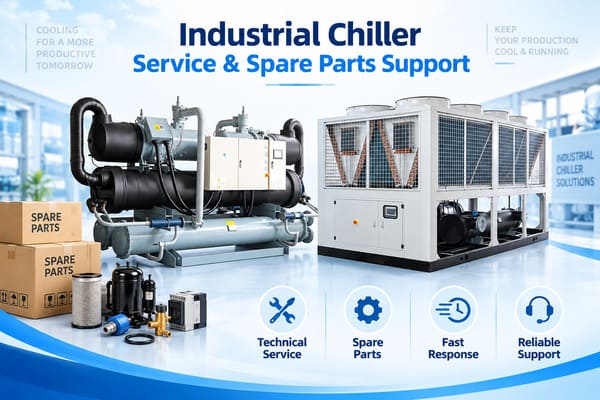
A supplier’s support model becomes most visible when the equipment does not perform as expected. Production losses can exceed the original price difference between two chillers. I therefore treat technical response, spare-parts planning, and commissioning capability as part of the machine’s practical value.
I expect a capable chiller manufacturer to provide clear technical clarification, realistic delivery commitments, complete documentation, commissioning support, warranty procedures, and access to critical spare parts. Buyers should verify the actual local support arrangement instead of assuming that a global brand guarantees fast service.
Questions about supplier capability
I ask suppliers questions that expose the difference between a sales office and an engineering organization:
- Who will approve the final technical selection?
- Where will the unit be manufactured and tested?
- Who will support installation and startup?
- Does the supplier have technicians in the project region?
- What is the normal response time for urgent faults?
- Which spare parts are stocked locally?
- Can the supplier support remote troubleshooting?
- What happens if the original component becomes unavailable?
- Which documents will be supplied in the required language?
- Can the supplier coordinate with the EPC contractor and other packages?
These questions do not favor one country or brand category. They help me understand how the supplier manages risk.
Delivery and quality control
A manufacturer with strong production capacity may still face delays if the design is not frozen early. I recommend a clear document schedule covering approval drawings, electrical diagrams, control logic, factory testing, packing, and shipment.
I also look for evidence of manufacturing discipline, such as:
- Incoming inspection for critical components
- Pressure and leak testing
- Electrical testing
- Refrigerant charging records
- Functional control testing
- Nameplate and serial-number traceability
- Packaging suitable for the transport route
- Inspection hold points for the buyer or EPC contractor
A supplier’s quality system is more useful when it connects directly to the delivered unit. Generic certificates provide context, but project-specific inspection records provide stronger evidence.
Supplier types and trade-offs
I see three broad supplier groups in procurement:
| Supplier type | Typical strength | Possible concern |
|---|---|---|
| Global diversified brand | Brand recognition and broad service network | Less flexibility for unusual requirements |
| Regional industrial specialist | Strong local knowledge and application focus | Smaller international support network |
| Export-oriented customized manufacturer | Flexible design, pricing, and delivery options | Buyers must verify documentation and service coverage |
These are general patterns, not universal rules. A qualified Chinese manufacturer may offer international-brand components, customized engineering, and export project experience. A large global brand may provide excellent customization in one region but limited local support in another. I compare the actual proposal, references, and contractual commitments.
For industrial end users, EPC firms, integrators, and distributors, I recommend involving the technical supplier early. Early clarification often prevents a low-price offer from becoming an expensive change order.
Frequently Asked Questions
Who are the largest chiller manufacturers in the world?
Commonly recognized names include Carrier, Trane, Johnson Controls–YORK, Daikin, and Mitsubishi Heavy Industries, along with other major regional and industrial suppliers. However, the answer depends on whether the ranking measures corporate revenue, HVAC sales, chiller sales, installed base, or industrial project experience.
Is a famous chiller brand always the best option?
No. Brand recognition can indicate resources and market experience, but it does not prove process suitability. I would verify cooling capacity, temperature conditions, efficiency, controls, commissioning, spare parts, and local technical support before selecting any manufacturer.
Which chiller manufacturer is best for industrial applications?
The best manufacturer depends on the process and project location. I would shortlist suppliers with comparable references, suitable operating ranges, strong engineering support, clear documentation, and reliable after-sales service. A qualified professional should confirm the final selection for application-specific conditions.
Should I choose the cheapest chiller manufacturer?
I would not choose solely on purchase price. Energy consumption, maintenance, downtime, commissioning, spare parts, and delayed production can dominate lifecycle cost1. A total-cost comparison usually provides a better procurement decision than comparing quotations alone.
What documents should I verify before buying an industrial chiller?
I would verify the technical selection sheet, performance data, operating limits, drawings, factory test records, certificates, warranty terms, commissioning scope, and spare-parts plan. I would also confirm that certifications apply to the exact model and required market.
Conclusion
The largest chiller manufacturers can provide valuable benchmarks, but global size does not automatically prove industrial suitability. I recommend defining “largest” clearly, separating commercial HVAC strength from process-cooling experience, and evaluating the complete system rather than only the compressor or brand. Cooling conditions, controls, quality documentation, delivery, commissioning, and service support should all influence the shortlist. If you are planning an industrial cooling project, contact IceStar Energy Technology for a technical discussion based on your process data, site conditions, and project requirements.
"Preventive spare parts supply strategy for large-scale ... - PMC", https://pmc.ncbi.nlm.nih.gov/articles/PMC13274871/. Life-cycle-cost methods for industrial equipment include acquisition, energy, maintenance, repair, downtime, and other operating consequences when comparing alternatives over the service life. Evidence role: general_support; source type: research. Supports: The source should support including energy, maintenance, downtime, commissioning, spare parts, and production effects in a lifecycle-cost assessment.. Scope note: The relative importance of each cost category varies with load profile, electricity prices, maintenance arrangements, and the economic value of production. ↩