Air-cooled chillers can simplify industrial cooling, but they can also create capacity and energy problems when buyers overlook site conditions. I have seen project teams focus on purchase price or the absence of a cooling tower, then discover that high ambient temperatures, limited airflow, or rising process loads affect performance. A site-based comparison helps buyers reduce those risks.
Air-cooled chillers remove the need for a cooling tower and condenser-water circuit1, which can simplify installation, water management, and routine maintenance. However, they usually depend more heavily on outdoor temperature, available heat-rejection space, fan operation, and surface cleanliness. I recommend selecting them only after comparing actual peak ambient conditions, cooling load, leaving-water temperature, operating hours, noise limits, lifecycle cost, and maintenance requirements against a water-cooled alternative.
The main question is not whether air-cooled equipment is universally good or bad. I ask whether the technology matches the project’s climate, process requirements, utilities, and operating pattern. The following advantages, limitations, and selection checks provide a practical framework for industrial users, EPC contractors, and system integrators.
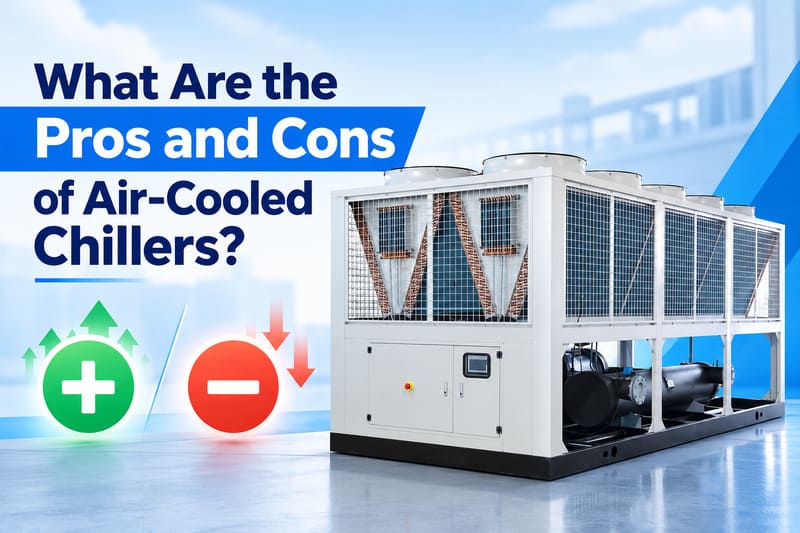
What Are the Main Pros of Air-Cooled Chillers?
Industrial buyers often need dependable cooling without adding a cooling tower, condenser pumps, or a large water-treatment system. I understand why air-cooled chillers attract attention during early procurement. They can reduce infrastructure complexity, especially when a site has limited water availability or when the project schedule is tight.
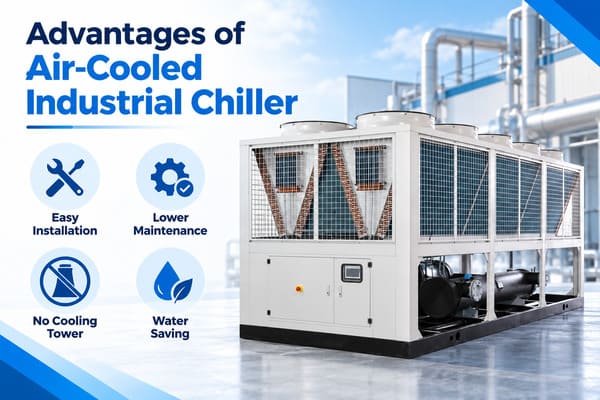
Air-cooled chillers can offer simpler installation, lower water consumption, easier initial planning, and flexible deployment. Their value becomes stronger when the project has moderate cooling loads, sufficient outdoor space, and acceptable ambient temperatures. However, I still verify the complete system rather than treating these benefits as automatic savings.
1. Simpler supporting infrastructure
An air-cooled system rejects heat directly to outdoor air. It normally does not require:
- A cooling tower
- Condenser-water pumps
- Cooling-tower make-up water
- Water-treatment dosing equipment
- Blowdown management
- Condenser-water piping
This arrangement can reduce mechanical-room complexity. It can also help EPC teams coordinate projects where water infrastructure is unavailable or expensive. In remote industrial areas, this feature may support faster installation, although the project still needs suitable electrical distribution, chilled-water piping, foundations, controls, and service access.
2. Lower dependence on industrial water
Water scarcity affects many projects in the Middle East, Africa, Central Asia, and other dry regions2. An air-cooled chiller does not consume condenser water through evaporation. That benefit can simplify operating permits and reduce concerns about water quality, biological growth, scaling, and corrosion in a cooling tower system.
I still remind buyers that the chilled-water side requires proper water treatment. The system may also need a buffer tank, pumps, strainers, expansion equipment, and filtration depending on the process design.
3. Easier installation for some applications
Manufacturers can often deliver packaged air-cooled units with integrated fans, compressors, condensers, controls, and safety devices. This configuration may reduce field assembly compared with a separated chiller-and-tower arrangement. A packaged design can also suit factories that need additional cooling capacity in stages.
The benefit depends on the equipment size. Large industrial systems may require multiple modules, lifting plans, service clearances, vibration control, and carefully designed airflow paths. I do not treat “packaged” as meaning “installation-free.”
4. Flexible application range
Air-cooled equipment can serve process cooling, plastic machinery, food and beverage production, electronics, chemical equipment, and HVAC-related industrial loads. Variable-speed compressors, multiple refrigeration circuits, and modular capacity control can improve part-load operation3 when properly selected.
The buyer should match the configuration to the process. A high-temperature environment, low leaving-water temperature, corrosive atmosphere, or continuous production schedule may require non-standard design and a detailed performance review.
What Are the Main Cons of Air-Cooled Chillers?
The main disadvantage of air-cooled chillers is their dependence on outdoor heat-rejection conditions. As ambient temperature rises, the refrigeration system generally works harder and may deliver less capacity or consume more power. I therefore recommend checking performance at the project’s maximum design ambient temperature, not only at a standard catalog condition.
Air-cooled systems also require outdoor space, good airflow, coil cleaning, fan maintenance, and noise control. These requirements can increase lifecycle risk when the installation environment is dusty, hot, crowded, or sensitive to sound.
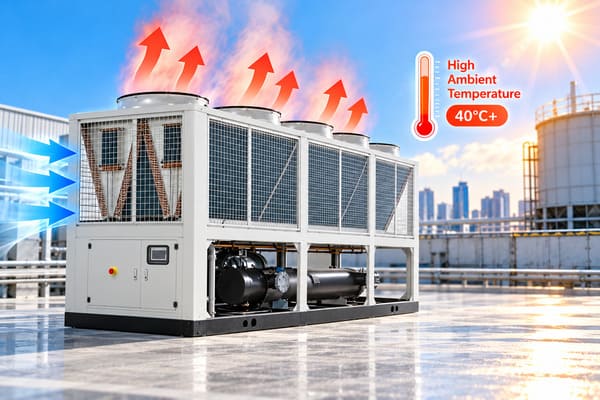
1. High ambient temperatures can affect capacity
The condenser must reject process heat plus compressor input power to the surrounding air. When outdoor air becomes hotter, the temperature difference between the refrigerant and ambient air becomes less favorable. The compressor may operate at a higher condensing pressure, and the unit may require more electrical power.
This issue is important for industrial facilities in desert climates, tropical regions, and high-temperature production areas. I ask suppliers to provide:
- Cooling capacity at the maximum design ambient temperature
- Input power at that condition
- Leaving-water temperature and flow rate
- Refrigerant operating limits
- Unit control and unloading behavior
- Any capacity derating or high-pressure protection limits
A nominal rating at 35°C may not represent performance at 45°C or higher. I never approve a selection using nominal capacity alone when the plant operates continuously at elevated temperatures.
2. Outdoor space and airflow become design factors
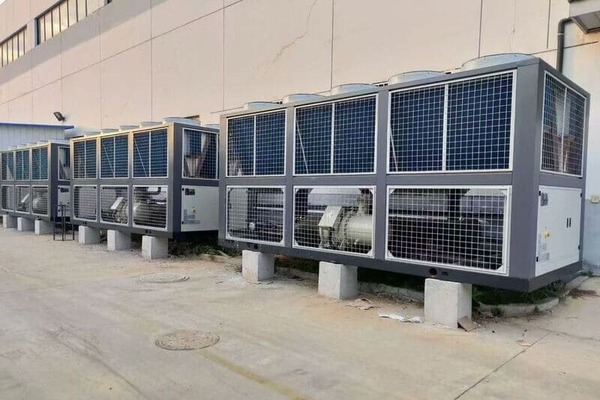
Air-cooled condensers need adequate clearance for air intake and discharge. Poor placement can cause hot-air recirculation, which raises entering-air temperature and reduces heat-rejection performance. Walls, roof structures, nearby equipment, and multiple chillers can all affect airflow.
The layout should consider:
- Manufacturer-recommended clearances
- Prevailing wind direction
- Exhaust-air discharge
- Maintenance access
- Crane or lifting access
- Noise-sensitive areas
- Dust and chemical exposure
- Future capacity expansion
A compact equipment area may appear suitable during a site visit but become problematic after other utilities and process equipment are installed.
3. Noise and fan maintenance require attention
Fans create aerodynamic and mechanical noise. Large units may affect nearby offices, laboratories, residential areas, or worker comfort. Buyers should request sound data and confirm whether the figures apply to sound power or sound pressure at a specific distance.
Coils and filters, where installed, also collect dust and debris. Fouling increases airflow resistance and reduces heat transfer4. Maintenance teams may need regular coil cleaning, fan inspection, bearing checks, electrical testing, and control verification. “No cooling tower” does not mean “no maintenance.”
4. Energy performance is not automatically better
Some buyers assume that removing condenser pumps and tower fans guarantees lower energy consumption. I consider that assumption incomplete. Air-cooled chillers may avoid tower-related auxiliary power, but their compressors and condenser fans can work harder in warm weather.
A fair lifecycle comparison should include:
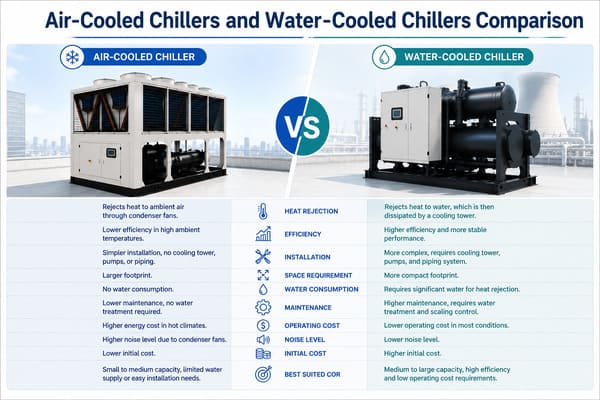
| Cost or performance factor | Air-cooled system | Water-cooled system |
|---|---|---|
| Cooling tower | Usually not required | Usually required |
| Condenser-water pumps | Not required | Required |
| Water consumption | Very low on heat-rejection side | Evaporation, blowdown, and make-up water |
| Hot-weather efficiency | May decline significantly | May remain favorable if tower conditions are suitable |
| Outdoor space | Often substantial | Chiller and tower space both required |
| Water treatment | Chilled-water side still needs control | Condenser and chilled-water sides require control |
| Noise sources | Compressor and condenser fans | Chiller, pumps, and cooling tower |
| Maintenance focus | Coils, fans, compressors, controls | Tower, pumps, tubes, water quality, compressors |
I recommend using verified annual operating data or an engineering model rather than relying on a general claim about efficiency.
How Should Buyers Compare Air-Cooled Chillers With Water-Cooled Systems?
Buyers should compare air-cooled chillers and water-cooled systems against the actual project conditions. I begin with the process load, then review ambient temperature, leaving-water requirements, operating hours, utility availability, space, noise, maintenance capability, and lifecycle cost.
A suitable selection must provide enough capacity at the worst expected operating condition. The final decision should include documented performance, a realistic installation layout, service planning, and qualified engineering review for the application.
Start with the process duty
I first confirm the required chilled-water flow, entering-water temperature, leaving-water temperature, heat load, and load variation. A process that needs 7°C water has a different selection basis from one requiring 0°C, -10°C, or lower temperatures. Low-temperature applications can require special refrigerant, compressor, insulation, and control considerations5.
I also check whether the load is steady or intermittent. Continuous production may justify redundancy, multiple refrigeration circuits, or modular units. A single large chiller can have a lower equipment count, but several smaller units may provide better maintenance flexibility.
Verify the worst-case ambient condition
The supplier’s quotation should clearly state the design ambient temperature. I compare that figure with:
- Historical site weather data
- The plant’s expected operating season
- Roof-level temperatures
- Heat from nearby equipment
- Future climate and production changes
- Emergency or temporary operating conditions
I ask for a performance table at several ambient temperatures when the project is sensitive to summer derating. The buyer should also confirm whether the stated capacity includes pump heat, fouled coils, glycol concentration, and actual fluid properties.
Evaluate lifecycle cost
The purchase price is only one part of the decision. I use a lifecycle checklist covering:
- Equipment purchase and shipping
- Foundation, piping, electrical, and controls
- Cooling tower and water-treatment costs, if applicable
- Expected annual electricity consumption
- Water, chemicals, and wastewater costs
- Preventive maintenance and spare parts
- Downtime exposure
- Replacement and expansion requirements
I avoid unsupported payback claims because electricity prices, operating hours, climate, and maintenance quality vary widely. Buyers should request a transparent calculation based on documented assumptions.
Review suppliers and technical documentation
A capable supplier should answer practical questions without hiding behind a nominal model number. I typically review:
- Performance data at the required operating points
- Compressor, fan, controller, and heat-exchanger specifications
- Electrical requirements and starting method
- Refrigerant information
- Factory testing procedures
- Installation and maintenance manuals
- Spare-parts availability
- Warranty scope and response process
- References for comparable operating conditions
Brands such as Hanbell, Bitzer, Siemens, Schneider, Emerson, and Carel may be specified in some projects, but the buyer should verify the exact component selection and compatibility. Certifications should also be treated as documents to review, including their scope, issuing body, validity, and applicability to the destination market.
For difficult applications, I prefer a technical clarification meeting before commercial comparison. At IceStar, our role is to discuss options such as air-cooled, water-cooled, screw, scroll, centrifugal, low-temperature, explosion-protected, or variable-frequency configurations according to the process. I still recommend that the buyer’s qualified engineer approve the final design.
My practical rule: If a supplier cannot show how the proposed capacity changes at the site’s maximum ambient temperature, I do not consider the selection complete.
Frequently Asked Questions
Are air-cooled chillers cheaper than water-cooled chillers?
Air-cooled chillers may reduce infrastructure costs because they normally do not need cooling towers, condenser pumps, or condenser-water treatment. However, higher hot-weather energy use, larger outdoor space requirements, and fan maintenance can change the total cost. I recommend a project-specific lifecycle comparison.
Are air-cooled chillers suitable for high-temperature climates?
They can be suitable when the equipment is specifically selected for the site’s maximum ambient temperature. I would not rely on standard catalog capacity in a desert or tropical environment. The buyer should verify derated cooling capacity, power input, high-pressure protection, airflow, and operating limits at the actual design condition.
Do air-cooled chillers require less maintenance?
They may require less water-system maintenance because they do not use a cooling tower. They still need coil cleaning, fan inspection, compressor servicing, electrical checks, refrigerant-system evaluation, and control maintenance. Dusty or corrosive environments may increase service frequency.
Which system is more energy-efficient?
Neither technology is automatically more efficient in every project. Water-cooled systems may perform well under favorable condenser-water conditions, while air-cooled systems may reduce auxiliary water-system energy and operating complexity. I compare integrated annual energy use, not only rated COP or EER.
How much outdoor space do air-cooled chillers need?
The required area depends on capacity, module arrangement, airflow direction, service clearances, and local conditions. I use the manufacturer’s layout drawings and check for hot-air recirculation, lifting access, noise, and future expansion before approving the equipment location.
Conclusion
The pros and cons of air-cooled chillers depend on the site rather than on a universal technology ranking. I value their simpler infrastructure, low condenser-water dependence, and installation flexibility, but I also account for high ambient temperatures, airflow, noise, coil maintenance, space, and lifecycle energy use. Buyers should verify performance at the real design conditions and compare qualified suppliers on documentation, engineering support, components, delivery, and service. Contact IceStar Energy Technology to discuss a site-specific industrial cooling configuration and compare the most suitable options for your process.
"Purchasing Energy-Efficient Electric Chillers", https://www.energy.gov/cmei/femp/purchasing-energy-efficient-electric-chillers. An engineering reference distinguishes air-cooled chillers, which reject heat directly to ambient air, from water-cooled systems that commonly use condenser water and a cooling tower. Evidence role: definition; source type: education. Supports: The source should define air-cooled and water-cooled chiller configurations and identify the cooling-tower and condenser-water requirements associated with water-cooled systems.. Scope note: The distinction describes typical system configurations and does not establish that every installation has identical auxiliary-equipment requirements. ↩
"Publication: The Economics of Water Scarcity in the Middle ...", https://openknowledge.worldbank.org/entities/publication/ab35b03a-23fa-4457-aebd-0f4a89848be1. International water assessments identify substantial freshwater stress and uneven water availability across parts of the Middle East, Africa, Central Asia, and other arid regions, providing contextual support for evaluating water demand in industrial cooling. Evidence role: statistic; source type: institution. Supports: The source should document elevated water stress, scarcity, or constrained freshwater availability in the named regions.. Scope note: Regional assessments vary by country, basin, season, and indicator and therefore do not demonstrate that every project in these regions faces the same constraint. ↩
"Performance of Variable Speed Centrifugal Chillers", https://docs.lib.purdue.edu/cgi/viewcontent.cgi?article=2194&context=icec. Chiller performance studies indicate that variable-speed and staged capacity-control strategies can reduce part-load energy use by matching compressor output more closely to cooling demand. Evidence role: mechanism; source type: paper. Supports: The source should show how capacity modulation, compressor speed control, or staged refrigeration circuits affect part-load power and cycling behavior.. Scope note: The benefit depends on control tuning, load profile, minimum turndown, auxiliary fan power, and the equipment's operating envelope. ↩
"HVAC Maintenance and Technologies", https://www1.eere.energy.gov/femp/pdfs/fupwg_spring2010_faramarzi.pdf. Heat-exchanger fouling research finds that deposits on air-side coil surfaces can increase air-side resistance and reduce effective heat transfer, thereby impairing condenser performance. Evidence role: mechanism; source type: paper. Supports: The source should connect particulate fouling or blocked coil surfaces with pressure drop, reduced airflow, lower heat transfer, and degraded chiller performance.. Scope note: Observed degradation varies with particle type, deposit thickness, coil geometry, airflow rate, and cleaning condition. ↩
"Modeling And Testing Of R23/R134a Mixed Refrigerant ...", https://epublications.marquette.edu/context/theses_open/article/1190/viewcontent/Hugh_marquette_0116N_10631.pdf. Low-temperature refrigeration references explain that reduced evaporating temperatures alter pressure ratios and operating limits and may require coordinated refrigerant, compressor, insulation, and control choices. Evidence role: mechanism; source type: education. Supports: The source should explain how lower evaporating or leaving-fluid temperatures affect refrigerant selection, compressor operating conditions, insulation, controls, and condensation protection.. Scope note: The required design changes depend on the target temperature, fluid composition, heat load, ambient conditions, and equipment architecture. ↩