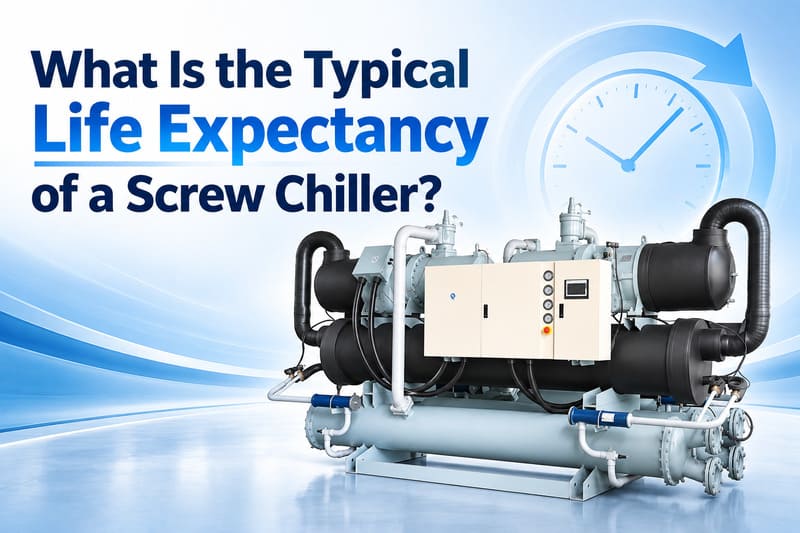
A screw chiller can serve reliably for many years, but buyers often ask for one fixed lifespan number and overlook the operating conditions that shape it. Continuous production, poor water quality, incorrect sizing, and weak maintenance can shorten equipment life. I evaluate useful life by workload, environment, configuration, and service planning rather than by calendar years alone.
A screw chiller does not have one guaranteed typical lifespan. Under suitable sizing, stable operating conditions, proper water treatment, correct installation, and preventive maintenance, an industrial screw chiller may provide long-term service, but the actual result must be verified for its load profile, annual running hours, ambient conditions, water quality, compressor operation, and maintenance program.
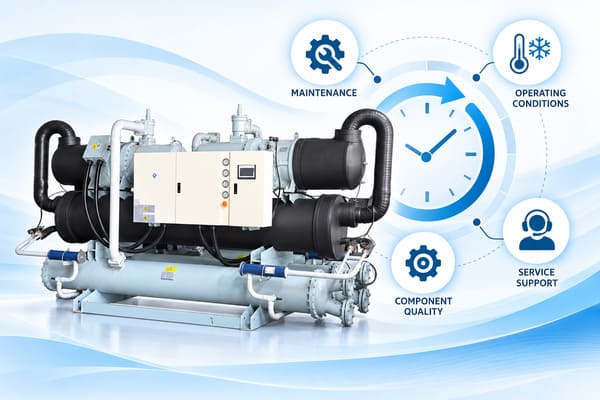
I have seen buyers compare quotations mainly by cooling capacity and purchase price. That approach can hide the real risks. The better question is not simply how long a chiller lasts, but how much useful, efficient, and dependable cooling it can deliver during its operating life.
What determines screw chiller life expectancy?
The life expectancy of a screw chiller depends mainly on how hard the equipment works and whether the system remains within its design conditions. A lightly loaded machine in a clean environment may experience very different wear from a heavily loaded unit operating continuously in a hot industrial plant.
Workload matters more than the calendar
I begin technical selection by reviewing the actual duty rather than accepting a nominal tonnage figure. Important factors include:
- Annual operating hours
- Continuous or intermittent production
- Average and peak cooling load
- Number of starts and stops
- Required chilled-water temperature
- Ambient temperature
- Condenser-water conditions
- Process fluid and fouling risk
A plant that operates 8,000 hours per year places a different demand on its chiller than a facility operating 2,000 hours. Frequent starts and stops can also increase mechanical and electrical stress1. A screw compressor is generally well suited to continuous industrial operation2, but it still needs stable oil management, correct suction and discharge conditions, and appropriate capacity control.
Oversizing creates another risk. A significantly oversized chiller may cycle frequently at low load, while an undersized unit may run continuously near its limit. Neither condition automatically causes immediate failure, but both can increase operating cost and shorten the useful service period.
Installation conditions affect durability
High ambient temperatures reduce condenser performance and raise condensing pressure3. Dust, corrosive gases, restricted airflow, and inadequate ventilation can create additional stress. In water-cooled systems, poor cooling-tower performance can produce similar problems.
During project discussions, I therefore ask for site information such as:
- Design summer ambient temperature
- Electrical supply and voltage stability
- Available equipment-room ventilation
- Water analysis and treatment method
- Required redundancy and backup capacity
- Access for inspection and component replacement
A supplier that cannot explain these assumptions may offer an attractive price but leave the buyer with an unsuitable machine.
How do water quality and maintenance affect screw chiller life?
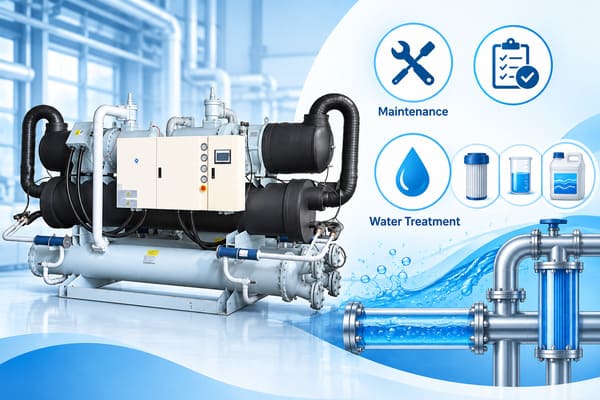
Water quality and maintenance can determine whether a screw chiller continues to exchange heat efficiently or gradually operates under damaging conditions. Scaling, corrosion, biological growth, blocked filters, refrigerant loss, and oil problems can all increase energy use and mechanical stress before a major failure becomes visible.
Water-side problems
In a water-cooled screw chiller, condenser and evaporator performance depends on clean heat-transfer surfaces. Hard-water scale acts as insulation. Corrosion can damage tubes, vessels, and connections. Suspended solids can restrict flow or damage pumps and control valves.
In an air-cooled system, water quality still matters when the chiller connects to a process loop, chilled-water circuit, or auxiliary heat exchanger. The correct treatment method depends on the material, fluid, temperature, and local water chemistry. I recommend that buyers request a documented water-quality plan instead of relying on a general statement such as “standard industrial water.”
A practical maintenance program
A preventive maintenance schedule should normally include:
- Checking operating pressures and temperatures
- Inspecting oil level, oil condition, and oil filters
- Cleaning condenser coils or monitoring condenser tubes
- Testing water flow and differential pressure
- Inspecting electrical terminals and control panels
- Checking refrigerant charge for signs of leakage
- Calibrating sensors and safety controls
- Reviewing alarms and operating trends
- Testing pumps, fans, valves, and expansion devices
The exact frequency requires professional confirmation. A dusty factory, corrosive chemical site, or high-temperature location may need more frequent inspection than a clean commercial environment.
I once reviewed an anonymized industrial application where the chiller itself was properly selected, but the cooling-tower water treatment was inconsistent. Heat-transfer performance declined, condensing pressure increased, and the operator initially blamed the compressor. The lesson was clear: equipment durability depends on the complete cooling system, not one component.
Do all screw chiller components have the same service life?
The complete screw chiller should be evaluated as a system, not as a single item with one uniform service life. Compressors, heat exchangers, controls, pumps, fans, valves, sensors, and electrical components experience different operating stresses and may require different repair or replacement decisions.
Major component considerations
| Component | Main durability factors | Buyer evaluation points |
|---|---|---|
| Screw compressor | Load profile, oil management, pressure ratio, starts | Service access, oil system, operating limits |
| Heat exchanger | Water quality, corrosion, fouling, flow | Materials, cleanability, water treatment |
| Electrical controls | Heat, dust, humidity, voltage quality | Panel protection, spare parts, documentation |
| Fans and pumps | Bearing wear, vibration, dirt, alignment | Motor quality, maintenance access |
| Sensors and valves | Calibration, fluid conditions, cycling | Availability and replacement procedure |
A compressor brand is important, but it does not determine the service life of the entire machine by itself. A reputable compressor can still operate poorly if the chiller has inadequate oil return, unstable water flow, incorrect refrigerant selection, or poor control logic. Conversely, a well-designed system using properly selected components can deliver dependable performance when the application is suitable.
Repair, refurbishment, or replacement?
A buyer should compare the cost and risk of each option when a major component requires attention:
- Repair: Appropriate when the core vessel, frame, controls, and compressor remain in good condition.
- Refurbishment: Useful when several aging components need coordinated replacement.
- Replacement: More practical when efficiency has declined, refrigerant regulations affect the design, or spare parts are difficult to obtain.
I advise EPC companies and end users to request a component availability statement before purchase. The statement should identify normal spare parts, recommended critical spares, service response, and the documentation supplied with the unit. Buyers should also verify any claimed certifications, test reports, and compliance documents directly against the project requirements.
How should buyers compare long-term screw chiller value?
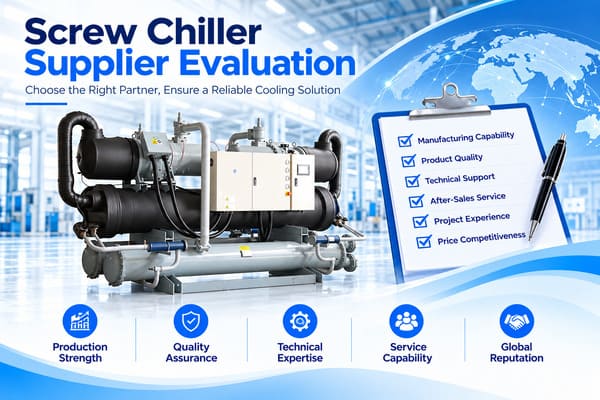
Buyers should compare a screw chiller through total cost of ownership rather than advertised lifespan or initial price alone. The evaluation should include energy consumption, maintenance, spare parts, downtime exposure, installation requirements, and the supplier’s technical support.
A useful procurement checklist
I suggest that buyers request the following information from each shortlisted supplier:
- Rated and actual cooling capacity at the project conditions
- Input power and expected part-load performance
- Refrigerant type and applicable compliance requirements
- Compressor, controller, pump, and electrical component brands
- Operating limits for ambient temperature and leaving-water temperature
- Water-quality and flow requirements
- Preventive maintenance recommendations
- Warranty scope and exclusions
- Spare-parts availability and service arrangements
- Factory testing and commissioning procedures
The warranty period should not be treated as proof of service life. A warranty defines certain contractual responsibilities for a limited period; it does not guarantee a universal operating lifespan.
Why low purchase price can create higher cost
A low-cost chiller may have acceptable performance, but I would examine what the quotation excludes. Missing flow switches, weak controls, limited documentation, unsuitable pumps, or unclear commissioning responsibilities can create later expenses. A higher initial investment may be justified when it improves energy efficiency, maintainability, redundancy, or process protection.
For example, a process plant may lose far more production value during one unplanned shutdown than the original price difference between two chiller offers. The buyer should therefore calculate downtime risk using the plant’s own production data rather than using a generic industry assumption.
A supplier such as IceStar Energy Technology can support this evaluation by matching air-cooled, water-cooled, low-temperature, variable-frequency, explosion-proof, or other configurations to the process. However, I still recommend qualified professional review of the final selection, especially for hazardous areas, unusual fluids, extreme ambient temperatures, and critical continuous production.
Frequently Asked Questions
Is a screw chiller suitable for continuous industrial operation?
A screw chiller is often suitable for continuous industrial cooling because its compressor design supports stable, long-duration operation4. The final suitability depends on correct capacity selection, control strategy, condenser conditions, water quality, redundancy, and maintenance access. I recommend application-specific engineering review before procurement.
Does a more expensive compressor guarantee longer chiller life?
No. Compressor quality matters, but the complete system also depends on heat exchangers, controls, oil management, water flow, electrical conditions, installation, and maintenance. Buyers should evaluate the whole configuration instead of assuming that one component brand guarantees the life of the finished chiller.
Can high ambient temperature shorten screw chiller life?
High ambient temperature can increase condensing pressure, reduce capacity, and raise power consumption. If the unit is not selected for the site’s actual summer conditions, repeated high-load operation may increase stress. Buyers should request performance data at the real design ambient temperature.
How can I reduce premature screw chiller failure?
I would begin with accurate load calculation and proper equipment sizing. I would then establish water treatment, maintain adequate airflow or cooling-tower performance, monitor operating trends, inspect electrical and refrigeration components, and keep critical spare parts available.
Conclusion
The typical life expectancy of a screw chiller cannot be reduced to one guaranteed number. Useful life depends on workload, annual hours, starts and stops, water quality, ambient conditions, installation, component selection, and preventive maintenance. I encourage buyers to compare energy use, serviceability, documentation, spare parts, and downtime risk alongside the purchase price. Contact IceStar Energy Technology with your process conditions and project requirements so our engineering team can help develop a properly matched industrial cooling solution.
"Improving the Reliability of a Domestic Refrigerator ...", https://docs.lib.purdue.edu/cgi/viewcontent.cgi?article=3515&context=icec. Research on compressor cycling describes repeated starts as a source of transient mechanical, thermal, and electrical loading that can affect component reliability under unfavorable operating conditions. Evidence role: mechanism; source type: research. Supports: The source should explain how repeated starting subjects compressor motors, bearings, lubrication systems, and electrical equipment to transient loads or thermal cycling.. Scope note: The magnitude of the effect depends on compressor design, controls, minimum run times, load profile, and operating environment. ↩
"Comparison of Part-Load Efficiency Characteristics of Screw ...", https://docs.lib.purdue.edu/cgi/viewcontent.cgi?article=2826&context=icec. A technical analysis of screw compressors identifies their applicability to continuous refrigeration service when lubrication, pressure conditions, capacity control, and operating limits remain within design specifications. Evidence role: general_support; source type: paper. Supports: The source should describe the suitability of screw compressors for sustained industrial refrigeration duty and the operating conditions required for reliable performance.. Scope note: This supports general compressor suitability, not the service life or reliability of every complete screw-chiller installation. ↩
"What Is the Refrigeration Cycle? A Guide for HVAC Students", https://northbridge.edu/en/publications/things-hvac-students-should-know-about-refrigeration-cycle/. Thermodynamic analyses of vapor-compression systems show that increased condenser-side temperature raises condensing temperature and pressure and can reduce available heat-rejection performance. Evidence role: mechanism; source type: paper. Supports: The source should explain how higher outdoor or entering-air temperature affects condenser heat rejection, condensing temperature, and compressor operating pressure.. Scope note: The effect varies with condenser design, airflow, fouling, refrigerant, and control strategy. ↩
"Chiller System - Engineering and Engineering Technology", https://www.uwosh.edu/engineeringtech/resources/teril/chiller/. Refrigeration engineering literature describes screw-compressor systems as applicable to continuous industrial cooling where capacity control, lubrication, heat rejection, and operating limits are properly designed and maintained. Evidence role: general_support; source type: paper. Supports: The source should describe screw-compressor characteristics relevant to continuous duty, such as capacity modulation, low-speed operation, lubrication, and industrial load profiles.. Scope note: This supports suitability in appropriate applications, not a guarantee of continuous operation or longer service life for every chiller. ↩