When I compare screw and scroll compressor chillers, I first look beyond the compressor label. Many buyers focus on efficiency or price, but the greater risk is selecting a unit with the wrong capacity or operating range. I have seen project proposals become difficult when equipment matched a catalog number but not the customer’s actual process conditions.
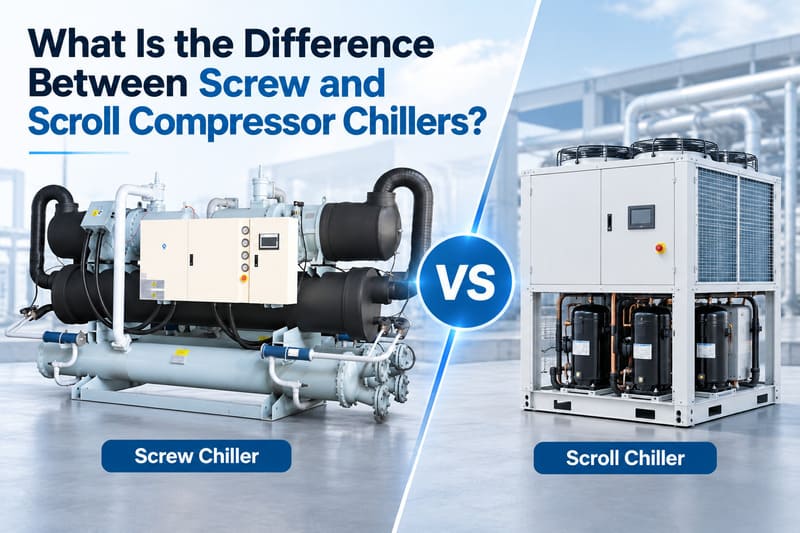
The main difference between screw and scroll compressor chillers is their compressor configuration, capacity structure, and operating suitability. Screw chillers commonly use one or more semi-hermetic screw compressors, while scroll chillers use multiple scroll compressors. Neither type is universally better. I recommend selecting between them according to total cooling demand, single-unit capacity, load profile, temperature requirements, energy data, and service conditions.
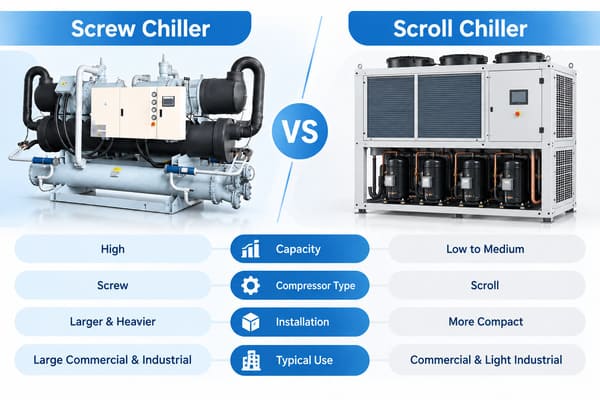
The most useful comparison begins with selection risk rather than a simple “screw versus scroll” contest. I normally review the process heat load, required leaving-water temperature, ambient conditions, redundancy expectations, available installation space, and supplier documentation before recommending a configuration.
How Do Screw and Scroll Compressor Chillers Differ?
A buyer can make an expensive mistake by treating compressor type as the complete specification. I have participated in industrial chiller selection for end users and EPC projects, and I have found that the same compressor technology can perform differently across models. The complete refrigeration circuit and control strategy matter.
Screw chillers use rotating twin-screw compression, while scroll chillers use orbiting scroll elements. Screw configurations often support larger individual capacities and broad industrial applications.1 Scroll configurations commonly use several smaller compressors for staged capacity control.2 However, the practical difference depends on the specific model, refrigerant, evaporating temperature, condenser condition, and control system.
Compressor Design and Capacity Structure
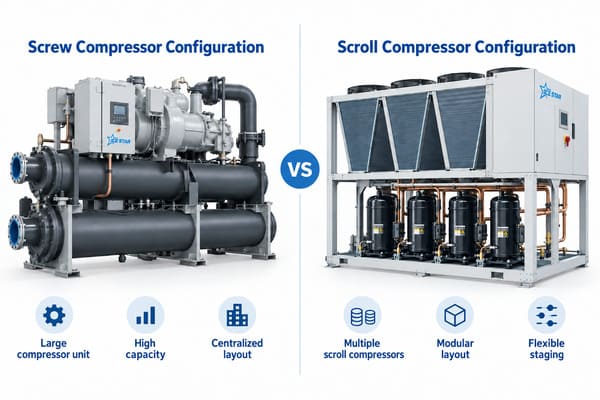
A screw compressor uses meshing rotors to compress refrigerant continuously. A scroll compressor uses two spiral elements, with one orbiting around the other. Both designs can provide reliable cooling when the manufacturer correctly matches the compressor, heat exchangers, expansion device, motor, and controls.
The configuration often creates a practical difference:
- Screw chillers may use one large compressor or two compressors.
- Scroll chillers usually use multiple smaller compressors in parallel.
- Multiple compressors can create capacity steps and provide partial redundancy.3
- A single larger compressor may simplify a high-capacity package but can create a larger capacity step if it is not equipped with suitable modulation.
I avoid describing one architecture as automatically more reliable. Reliability depends on compressor loading, oil management, refrigerant circuit design, component quality, maintenance, water treatment, and operating discipline.
What Should Buyers Compare?
| Evaluation factor | Screw chiller | Scroll chiller |
|---|---|---|
| Individual unit capacity | Often suitable for medium-to-high capacity packages, depending on model | Often suitable for small-to-medium packages, with exceptions |
| Capacity staging | May use slide valve, inverter control, or multiple compressors | Often stages multiple compressors or circuits |
| Part-load behavior | Depends strongly on compressor and control design | Depends on compressor staging and inverter options |
| Installation footprint | Can be compact for higher capacity, but varies | May require more components for equivalent output |
| Maintenance | Requires model-specific procedures, including oil and control checks | Requires circuit-by-circuit inspection and electrical checks |
| Best selection basis | Actual duty, modulation, and system configuration | Actual duty, staging, and single-unit requirement |
This table gives me a starting point, not a purchasing conclusion. I ask suppliers to provide performance data at the project’s actual chilled-water temperatures and design ambient. Nominal capacity at one standard condition cannot prove suitability for a chemical process, plastic molding line, food plant, or battery production facility.
Does Cooling Capacity Determine Whether I Should Choose Screw or Scroll?
Cooling capacity is one of the first filters in a chiller comparison, but total plant demand is not the only number I need. I also calculate the required capacity of each individual chiller, the load pattern, and the consequence of losing one unit. A technically sound compressor can still be the wrong choice if the unit is oversized or undersized.
Cooling capacity strongly influences the practical choice between screw and scroll compressor chillers. I generally consider scroll configurations when the required units are smaller or when staged modular capacity is useful. I consider screw configurations when each unit must deliver a larger capacity or operate under demanding industrial conditions. I still verify every recommendation using model-specific performance data and project conditions.
Start With the Heat-Load Calculation
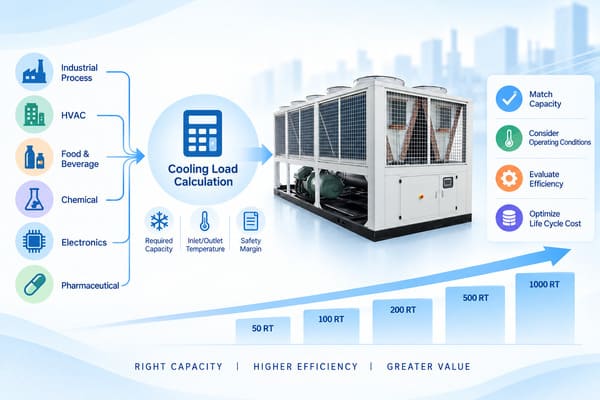
I first separate the cooling requirement into process loads and auxiliary loads. A production line may require cooling for molds, hydraulic oil, reactors, compressors, laser equipment, or temperature-controlled rooms. Each load may have a different supply temperature and operating schedule.
A useful preliminary calculation is:
[ Q = dot{m} times C_p times Delta T ]
Here, Q represents cooling capacity, ṁ represents water flow, Cp represents the specific heat of the fluid, and ΔT represents the temperature difference. This calculation is only a starting point. I also account for heat gains from pumps, piping, tanks, ambient conditions, and process changes.
Total Capacity Versus Single-Unit Capacity
Suppose a plant requires 1,000 kW of cooling. The procurement decision changes depending on the desired arrangement:
- One 1,000 kW chiller: The project may require a larger screw package or another suitable high-capacity design.
- Two 500 kW chillers: The project may compare two screw units, multiple scroll packages, or a combination.
- Four 250 kW chillers: Modular scroll equipment may become practical, but footprint, controls, and maintenance access require review.
I have worked on recommendations where the total load initially suggested a large chiller. After reviewing production schedules, we found that the customer needed flexible operation at 40–60% load for much of the year. The supplier then had to show how each proposed configuration performed at those conditions.
Avoiding Oversizing and Undersizing
Oversizing can cause short cycling, poor humidity control, unnecessary capital cost, and unstable leaving-water temperature. Undersizing can create continuous full-load operation, high process temperatures, and production interruptions.
I ask the buyer to verify:
- Design cooling load and safety margin
- Minimum and maximum process load
- Required leaving-water temperature
- Chilled-water flow and allowable pressure drop
- Design ambient temperature
- Altitude and electrical supply
- Future production expansion
- Required standby or N+1 capacity
The correct compressor type becomes clearer after these questions are answered.
Are Screw Chillers Always More Efficient Than Scroll Chillers?
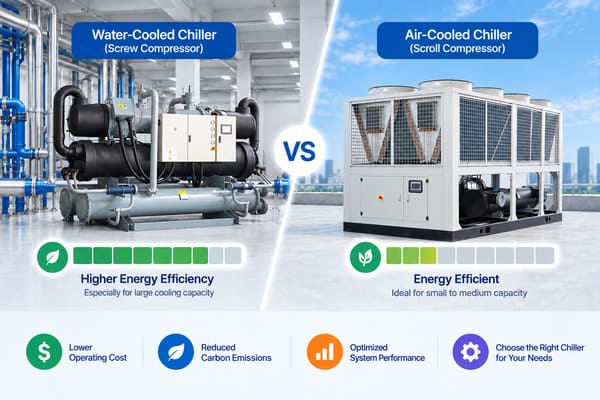
Efficiency is often the most attractive claim in a chiller proposal, but I do not accept broad statements such as “screw is always more efficient” or “scroll is always better at part load.” Efficiency depends on the compressor, refrigerant, heat exchangers, fan or pump power, controls, and operating point.
Neither screw nor scroll compressor chillers are always more energy-efficient. Buyers should compare certified or manufacturer-issued performance data at the actual cooling and ambient conditions. The most relevant metrics may include full-load power, integrated part-load value, coefficient of performance, seasonal efficiency, and total system power rather than compressor efficiency alone.
Compare the Complete Operating Profile
I request a performance table that includes several load points instead of one attractive nominal value. A useful schedule may include 25%, 50%, 75%, and 100% capacity, although the correct points depend on the application.
| Data point | Why I review it |
|---|---|
| Cooling capacity | Confirms that the equipment meets process demand |
| Input power | Supports operating-cost comparison |
| COP or EER | Shows efficiency under a defined condition |
| Part-load performance | Indicates behavior during normal production |
| Leaving-water temperature | Confirms process compatibility |
| Condensing temperature | Reflects ambient and heat-rejection conditions |
| Flow rate and pressure drop | Helps size pumps and piping |
A scroll chiller with several compressors may stage capacity effectively at moderate loads. A screw chiller with slide-valve or variable-frequency control may also perform well, depending on its design. I need model data before making that judgment.
Operating Conditions Change the Result
High ambient temperature can reduce capacity and increase power consumption.4 Low leaving-water temperatures can also change compressor operating conditions and may require special selection. Fouled condensers, poor cooling-tower performance, dirty filters, inadequate water flow, and incorrect control settings can reduce real-world efficiency for either technology.
For this reason, I recommend evaluating:
- Air-cooled or water-cooled condenser design
- Actual summer ambient or cooling-water temperature
- Process supply and return temperatures
- Refrigerant and compressor operating envelope
- Fan and pump energy
- Control sequence during low load
- Maintenance requirements and expected service intervals
I also compare lifecycle cost rather than purchase price alone. A lower initial quotation may not remain economical if the unit has limited part-load data, weak technical support, or unsuitable components. IceStar, for example, can configure equipment with recognized components such as Hanbell, Bitzer, Siemens, Schneider, Emerson, or Carel, but I still advise buyers to verify the exact component list and performance documents for the proposed model.
How Should I Evaluate a Supplier’s Screw or Scroll Chiller Proposal?
A supplier proposal can look complete while leaving important selection risks unanswered. I have learned to treat a quotation as a technical document, not only a commercial offer. The proposal should explain what the equipment can do at the customer’s actual conditions and what assumptions the supplier used.
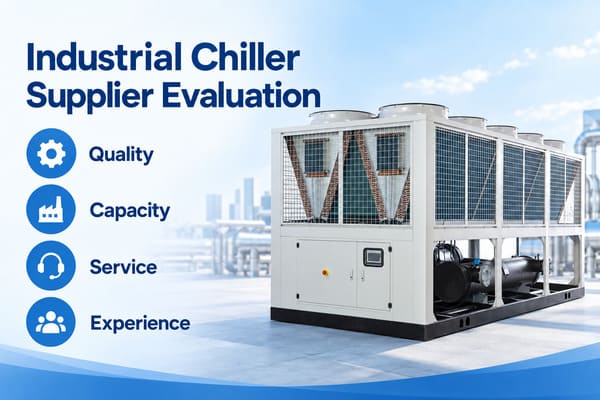
I evaluate a screw or scroll chiller proposal by checking the duty conditions, capacity tolerance, performance data, component list, controls, certifications, delivery scope, warranty, and service plan. I also ask the supplier to identify exclusions and confirm whether the proposed unit can operate continuously within the required temperature and ambient range.
Questions I Put Into the Technical Clarification
I normally send a structured clarification list to each shortlisted supplier:
- What is the cooling capacity at the stated entering and leaving fluid temperatures?
- What is the capacity at the project’s maximum ambient condition?
- What is the input power at full load and part load?
- What is the minimum stable operating capacity?
- How does the system respond to rapid process-load changes?
- What happens if one compressor or refrigeration circuit stops?
- Which components are standard, and which are optional?
- What alarms, remote monitoring functions, and communication protocols are included?
- What spare parts and maintenance procedures are recommended?
- Which certificates and test records will the supplier provide?
These questions help me distinguish a real engineering proposal from a generic product sheet.
Verify Certifications and Service Capability
Certifications should be treated as documents for buyer verification. I ask for certificates that apply to the exact model, configuration, market, and electrical design. I also check whether the supplier can provide wiring diagrams, pressure-test records, factory test reports, operation manuals, and commissioning support.
Service capability matters especially for continuous production. I review:
- Remote technical response time
- Availability of replacement compressors and controls
- Local distributor or service-partner coverage
- Commissioning responsibilities
- Training for operators
- Warranty conditions
- Recommended preventive maintenance
IceStar serves industrial end users, EPC companies, integrators, distributors, and OEM partners with customized industrial cooling solutions. From my project experience, that flexibility can help when customers need special voltage, high-ambient operation, low-temperature chilled water, explosion-protected design, or integrated pumps and tanks. I would still ask a qualified engineer to confirm application suitability before purchase.
Frequently Asked Questions
Is a screw chiller better than a scroll chiller?
Not automatically. I select between them according to capacity, operating range, load profile, control requirements, installation conditions, and lifecycle cost. The supplier should provide model-specific data at the project’s actual temperatures and ambient conditions.
Are scroll chillers only suitable for small applications?
Scroll chillers are often used in smaller or modular systems, but I do not use that as an absolute rule. Multiple scroll compressors can create a larger package. The buyer should compare the required capacity of each unit, not only the total plant load.
Do screw chillers always consume less electricity?
No. Efficiency depends on the complete chiller and its operating point. I compare full-load and part-load power, condenser or cooling-tower requirements, pump and fan energy, and actual annual operating conditions.
Which chiller is easier to maintain?
Neither compressor type is universally easier to maintain. Screw systems may require specific oil and compressor service procedures, while scroll systems may involve several refrigeration circuits. I evaluate local service support, spare parts, documentation, and technician capability.
Conclusion
The difference between screw and scroll compressor chillers is important, but compressor type should not control the decision by itself. I first confirm the heat load, single-unit capacity, process temperatures, ambient conditions, load profile, redundancy plan, and supplier performance data. I then compare energy use, controls, maintenance, documentation, and lifecycle support. For a project-specific recommendation, contact IceStar Energy Technology with your operating conditions and required cooling capacity so our engineering team can prepare a qualified proposal for review.
"Magnetic-Bearing Chiller Compressors - Department of Energy", https://www.energy.gov/cmei/femp/magnetic-bearing-chiller-compressors. Technical literature characterizes screw-compressor chillers as common in medium- and large-capacity refrigeration and industrial cooling applications, providing contextual support for the stated capacity tendency. Evidence role: general_support; source type: research. Supports: The source should document typical applications and capacity ranges for screw-compressor chillers relative to smaller packaged chiller technologies.. Scope note: Capacity ranges overlap across technologies and vary by refrigerant, configuration, and manufacturer, so the source cannot support an absolute rule. ↩
"Comparative Studies of Scroll and Rotary Compressors for US ...", https://docs.lib.purdue.edu/icec/2664/. A refrigeration study describes modular scroll-chiller arrangements in which multiple compressors or circuits are cycled to match load, supporting the mechanism of staged capacity control. Evidence role: mechanism; source type: paper. Supports: The source should explain how multiple scroll compressors or refrigeration circuits are sequenced to provide discrete capacity steps and part-load operation.. Scope note: The evidence applies to the studied or described configurations and does not establish that every scroll chiller uses multiple compressors. ↩
"A Chiller Control Algorithm for Multiple Variable - Purdue e-Pubs", https://docs.lib.purdue.edu/cgi/viewcontent.cgi?article=3339&context=icec. Research on multi-compressor refrigeration systems indicates that independent compressor staging provides discrete capacity control and may allow continued operation at reduced capacity after a single compressor outage. Evidence role: mechanism; source type: research. Supports: The source should show that independent compressors can be staged for capacity control and that remaining circuits may continue operating after a single-compressor fault.. Scope note: Partial redundancy is conditional on circuit design, isolation, controls, and the fault location; it is not equivalent to full standby capacity. ↩
"Energy simulation of sustainable air-cooled chiller system ...", https://www.caee.utexas.edu/prof/Novoselac/classes/CE397b/Handouts/Energy%20simulation%20of%20sustainable%20air-cooled%20chiller%20system%20for%20commercial%20buildings%20under%20climate%20change.pdf. Studies of vapor-compression chillers report that elevated condensing or ambient temperature increases compressor pressure lift and typically lowers capacity while raising power consumption. Evidence role: mechanism; source type: paper. Supports: The source should document the relationship between increased condensing temperature, compressor lift, cooling capacity, and power demand.. Scope note: The size of the effect depends on condenser type, airflow or water temperature, refrigerant, controls, and the operating envelope. ↩