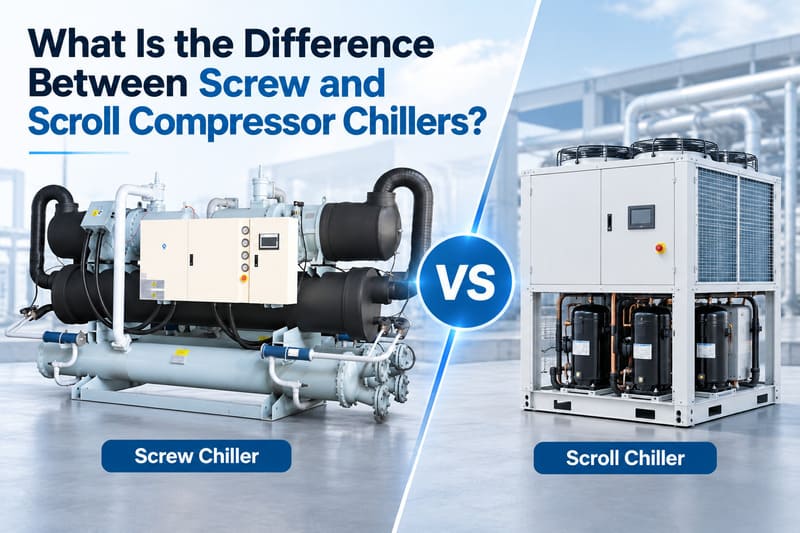
A centrifugal chiller and screw chiller can both support demanding industrial cooling, but they do not suit the same operating pattern. I have seen buyers focus on capacity or purchase price, then overlook load variation, maintenance access, and downtime exposure. That mistake can increase lifecycle cost. I recommend comparing the technologies against the actual cooling task before requesting quotations.
The main difference between a centrifugal chiller and screw chiller is their operating behavior, not only their compressor design. Centrifugal chillers can suit large, relatively stable cooling loads, while screw chillers often provide flexible performance for variable industrial demand. The correct choice depends on load profile, leaving-water temperature, operating hours, part-load efficiency, maintenance resources, system design, and the financial effect of production downtime.
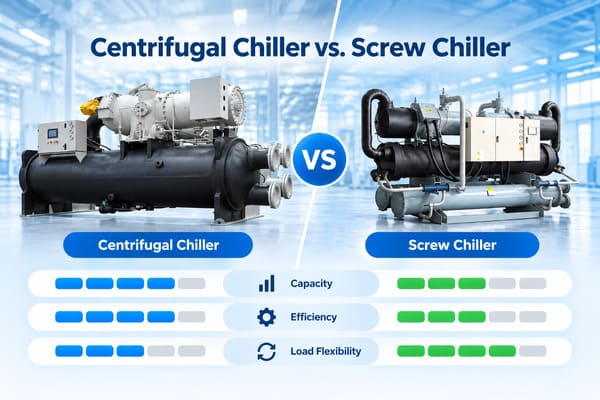
I use this comparison as a project-selection exercise rather than a simple technology ranking. In the following sections, I will explain how I assess capacity, efficiency, lifecycle cost, service requirements, and supplier capability before recommending either a centrifugal or screw configuration.
How Do a Centrifugal Chiller and Screw Chiller Differ in Industrial Operation?
Many buyers need reliable process cooling but receive quotations based mainly on nominal refrigeration capacity. I have found that this approach hides important differences in turndown, control response, and operating conditions. The first step is to understand how each chiller behaves across the complete production load.
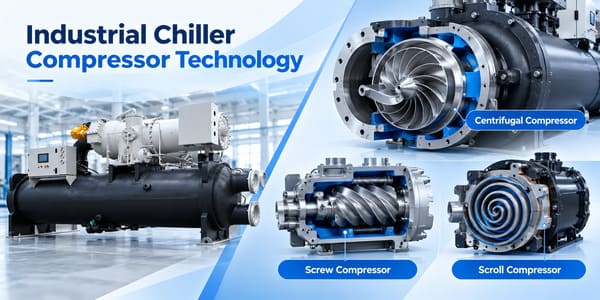
A centrifugal chiller uses high-speed impellers to transfer energy to the refrigerant, while a screw chiller uses rotating twin-screw rotors to compress refrigerant.1 In practice, I compare the technologies through the following factors:
- Required cooling capacity and redundancy
- Minimum and typical operating load
- Leaving-water temperature
- Cooling-water or ambient conditions
- Daily and seasonal load variation
- Process continuity and allowable downtime
- Available maintenance skills and spare parts
What does the compressor difference mean?
A centrifugal compressor is generally associated with larger chilled-water systems and stable operating conditions. Its performance depends strongly on flow, pressure ratio, inlet conditions, and control strategy. Surge protection and proper system control matter because operation outside the suitable range can affect stability.
A screw compressor uses positive displacement.2 This characteristic can make it practical for industrial processes with changing loads, higher condensing temperatures, or more varied operating conditions. However, I do not treat that statement as a universal reliability advantage. The complete package still depends on compressor quality, oil management, controls, heat exchangers, installation, and service.
| Evaluation point | Centrifugal chiller | Screw chiller |
|---|---|---|
| Typical project fit | Large central cooling systems | Industrial and process applications |
| Load behavior | Often strongest with stable, substantial loads | Often flexible across changing loads |
| Control concern | Surge control and operating envelope | Capacity modulation and oil management |
| Installation scale | Commonly larger systems | Available across a broad range |
| Selection priority | System efficiency and stable operation | Flexibility, serviceability, and process fit |
I have participated in selections where a centrifugal unit looked attractive because the design capacity was high. After reviewing the actual production schedule, the plant spent much of its time at partial load. In another case, a screw configuration offered a more practical match because the process load changed frequently. These examples do not prove that one technology is better. They show why the operating task should lead the decision.
Which Chiller Is More Efficient at Full Load and Part Load?
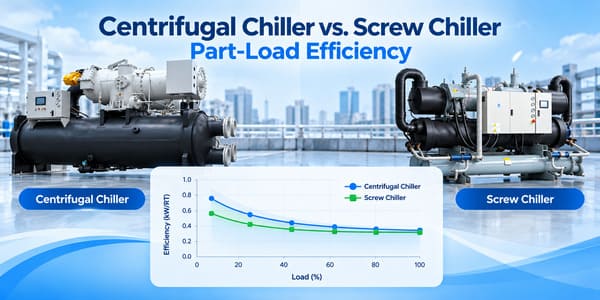
Energy efficiency is often the strongest reason for considering a centrifugal chiller, but buyers should avoid universal claims. I evaluate full-load efficiency and part-load efficiency separately because factories rarely operate at one fixed design condition throughout the year.
Neither a centrifugal chiller nor a screw chiller is always more efficient.3 A centrifugal solution may perform very well in a large, stable system near its design conditions. A screw solution may provide better practical results where the load changes often or where operating conditions move outside the ideal design point. Controls, condenser design, water temperatures, and maintenance also influence the result.
What data should I request?
I ask suppliers to provide performance data at several operating points rather than one rated condition:
- 100% load, using the specified entering and leaving temperatures.
- 75%, 50%, and 25% load, where the project can operate at those conditions.
- Cooling-tower or ambient assumptions.
- Electrical input, refrigerant conditions, and control method.
- Minimum stable capacity and unloading behavior.
- Pump, fan, and auxiliary energy where relevant.
A catalogue efficiency value can mislead if the tested conditions do not match the factory. For example, a process may require low leaving-water temperature, high ambient operation, or continuous summer production. Those conditions can change compressor lift and total power consumption.
I also review the system rather than the compressor alone. A chiller with an efficient compressor can lose its advantage if the condenser is undersized, chilled-water flow is poorly controlled, or pumps operate unnecessarily at full speed. Variable-frequency drives, properly selected heat exchangers, condenser-water reset, and sequencing between multiple units can affect annual energy use.
Why does the load curve matter?
I prepare a simple load-duration profile when project data is available. The profile identifies how many hours the plant operates near full load and how many hours it operates at reduced demand. I then compare expected annual energy use using verified supplier data. I do not promise savings or payback without measured conditions and a transparent calculation.
For industrial buyers, the most useful quotation includes:
- Guaranteed capacity at specified temperatures
- Full-load and part-load power
- Sound and vibration information
- Minimum and maximum operating limits
- Control sequence and staging logic
- Assumptions behind all performance figures
How Should I Compare Lifecycle Cost, Maintenance, and Downtime Risk?
A low purchase price can become expensive when service access is poor or an unplanned shutdown interrupts production. I compare initial investment with energy, maintenance, spare parts, engineering support, and downtime exposure. I also consider whether the owner has qualified technicians and suitable local service coverage.
Lifecycle cost includes more than the chiller invoice.4 I normally review the following cost groups:
- Equipment, controls, pumps, tanks, and installation
- Electricity under the real load profile
- Routine inspection and consumables
- Compressor, motor, oil, and refrigerant service
- Spare-parts availability
- Emergency response and production interruption
- Expected replacement or refurbishment requirements

Which maintenance issues should buyers examine?
A centrifugal package requires careful attention to operating envelope, surge protection, high-speed rotating components, controls, and system cleanliness. A screw package requires attention to oil separation, oil charge, rotor condition, capacity control, motor performance, and refrigerant circuit integrity. Both technologies require correct commissioning and planned maintenance.
I ask suppliers for a maintenance matrix that identifies:
| Item | Buyer should verify |
|---|---|
| Service interval | Recommended inspection and replacement timing |
| Critical spares | Availability, lead time, and local stock |
| Specialist tools | Required equipment and technician training |
| Alarm history | Data logging and remote diagnostic capability |
| Warranty | Scope, exclusions, and response process |
| Documentation | Manuals, wiring diagrams, and commissioning records |
I do not describe screw chillers as automatically easier to maintain, or centrifugal chillers as automatically more difficult. Serviceability depends on package layout, component selection, documentation, access space, and the supplier’s technical support. A well-designed industrial chiller can reduce maintenance exposure regardless of compressor type.
How should I evaluate downtime risk?
I first ask how much a cooling interruption costs the factory. A short temperature excursion may damage product, interrupt a continuous process, or create a lengthy restart procedure. The answer affects redundancy more than compressor preference.
A plant may reduce risk through:
- Two or more chillers instead of one large unit
- Standby pumps and critical controls
- Isolation valves for service
- Remote alarms and trend monitoring
- Emergency operating procedures
- Local spare-parts and service arrangements
In my supplier evaluations, I also check manufacturing quality, pressure testing, electrical inspection, factory testing, and documented commissioning procedures. Buyers should verify any stated certifications, test reports, and compliance documents directly. Qualified professionals should confirm whether the selected design meets local codes and application requirements.
How Can I Choose Between a Centrifugal Chiller and Screw Chiller?
The best selection process begins with project data, not a preferred brand or compressor category. I usually recommend a centrifugal solution for a large, steady central load when the design conditions and control strategy support it. I consider a screw solution when the process has variable demand, demanding ambient conditions, or a stronger need for flexible capacity control.
I use this practical framework:
- Define actual and peak cooling load.
- Record operating hours and seasonal conditions.
- Map the percentage of time at 25%, 50%, 75%, and 100% load.
- Confirm entering and leaving fluid temperatures.
- Identify process continuity and redundancy requirements.
- Compare verified performance data.
- Review maintenance capability and supplier response.
- Calculate lifecycle cost using project-specific assumptions.
When may a centrifugal solution deserve consideration?
A centrifugal chiller may deserve consideration when the site has a substantial chilled-water demand, long operating hours, relatively stable load, suitable water-side conditions, and qualified technical support. I also examine whether multiple units can stage efficiently as demand changes.
When may a screw solution be more practical?
A screw chiller may be more practical for process cooling with fluctuating demand, higher ambient conditions, lower or variable capacity requirements, or a need for modular redundancy. The final decision still depends on the selected refrigerant, compressor, heat exchangers, controls, and factory configuration.
Before requesting offers, I ask buyers to prepare:
- Cooling load calculations and process descriptions
- Fluid type, flow, and temperature range
- Ambient or condenser-water design conditions
- Voltage, frequency, and installation location
- Noise, vibration, and hazardous-area requirements
- Required certifications and local regulations
- Preferred core components and service expectations
- Delivery, commissioning, and training requirements
I have seen technically strong suppliers produce different recommendations from the same basic capacity because they interpreted load variation and site conditions differently. That is why I compare complete technical schedules, not only headline capacity and price. IceStar Energy Technology can support this process with customized industrial chiller configurations, including air-cooled, water-cooled, low-temperature, explosion-proof, variable-frequency, and integrated pump or control solutions.
Frequently Asked Questions
Is a centrifugal chiller always more efficient than a screw chiller?
No. A centrifugal chiller may be highly efficient under suitable large-load conditions, but actual annual efficiency depends on load profile, temperatures, controls, auxiliaries, and maintenance. I recommend comparing tested or guaranteed performance at several operating points.
Is a screw chiller more reliable for industrial production?
Not automatically. Reliability depends on design quality, component selection, commissioning, operating conditions, maintenance, and service support. I evaluate redundancy, alarm functions, spare parts, and supplier response instead of assuming reliability from compressor type alone.
Which chiller is better for variable industrial loads?
A screw chiller often deserves consideration when the load changes frequently because its capacity-control arrangement may suit that operating pattern. However, I still require part-load data and a review of the complete system before making a recommendation.
What information should I send to a chiller supplier?
I recommend sending the required cooling capacity, fluid and temperatures, flow rate, ambient conditions, operating schedule, electrical supply, installation constraints, redundancy expectations, certifications, and process continuity requirements.
Conclusion
The difference between a centrifugal chiller and screw chiller becomes meaningful only when I connect technology with the factory’s real operating task. I compare load variation, part-load performance, temperatures, lifecycle cost, maintenance access, redundancy, and downtime risk before selecting a configuration. Buyers should request transparent performance data and verify certifications, test documents, and service commitments. For a project-specific recommendation, contact IceStar Energy Technology with your process conditions and load profile so our engineering team can develop a suitable industrial cooling solution.
"Improving Compressed Air System Performance", https://www.eere.energy.gov/manufacturing/tech_assistance/pdfs/compressed_air_sourcebook.pdf. An engineering reference defines centrifugal compressors as dynamic machines that impart velocity through an impeller and screw compressors as positive-displacement machines using intermeshing helical rotors. Evidence role: definition; source type: education. Supports: An engineering reference defining centrifugal and twin-screw refrigeration compressor operating principles.. ↩
"Optimization Of Screw Compressor Design - Purdue e-Pubs", https://docs.lib.purdue.edu/cgi/viewcontent.cgi?article=2591&context=icec. An engineering reference classifies screw compressors as positive-displacement compressors that trap and progressively compress gas between rotating helical rotors. Evidence role: definition; source type: encyclopedia. Supports: A standard engineering definition classifying twin-screw compressors as positive-displacement machines.. ↩
"Comparison of Part-Load Efficiency Characteristics of Screw ...", https://docs.lib.purdue.edu/cgi/viewcontent.cgi?article=2826&context=icec. Public-sector efficiency guidance treats chiller performance as dependent on operating conditions and system configuration, rather than identifying one compressor type as universally most efficient. Evidence role: expert_consensus; source type: government. Supports: Government or public-sector guidance explaining that chiller efficiency varies with load, temperatures, controls, and equipment configuration rather than compressor category alone.. Scope note: General guidance does not replace project-specific certified performance data at the required operating points. ↩
"Purchasing Energy-Efficient Residential Central Air ...", https://www.energy.gov/cmei/femp/purchasing-energy-efficient-residential-central-air-conditioners. Lifecycle-cost guidance defines total ownership cost as extending beyond acquisition to include operation, maintenance, repair, replacement, and other costs incurred over the analysis period. Evidence role: definition; source type: government. Supports: A recognized lifecycle-cost framework covering acquisition, operation, maintenance, replacement, and related ownership costs.. Scope note: Whether production interruption is included, and how it is valued, depends on the selected accounting boundary and project methodology. ↩