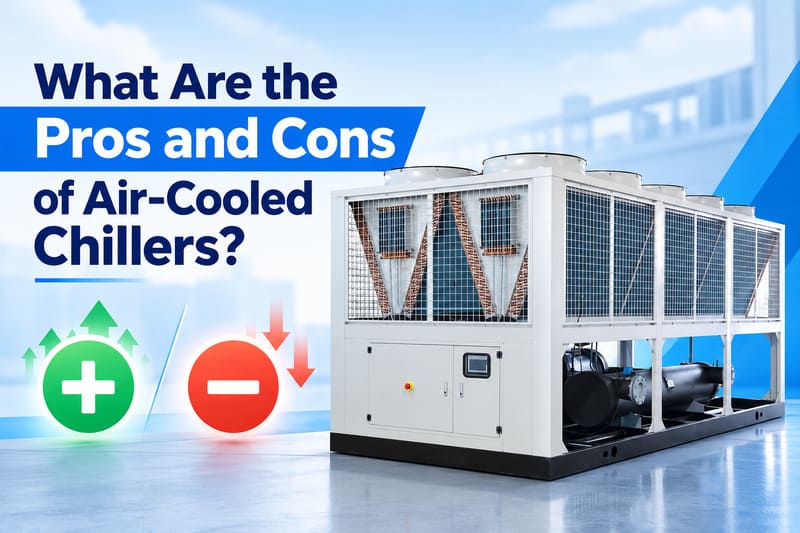
An air-cooled chiller can be difficult to size when a project begins with incomplete data, an assumed tonnage, or a machine nameplate. I often see buyers focus on motor power or room area, even though those figures do not define the actual cooling demand. A better approach starts with the process heat load and verifies the result against real operating conditions.
To size an air-cooled chiller, first determine the process heat load from the circulating-fluid flow rate, specific heat, and supply-and-return temperature difference. Then confirm the required capacity at the actual leaving-water temperature, entering-water temperature, design ambient temperature, fluid type, flow rate, and operating schedule. The final selection should match manufacturer performance data and receive qualified engineering review.
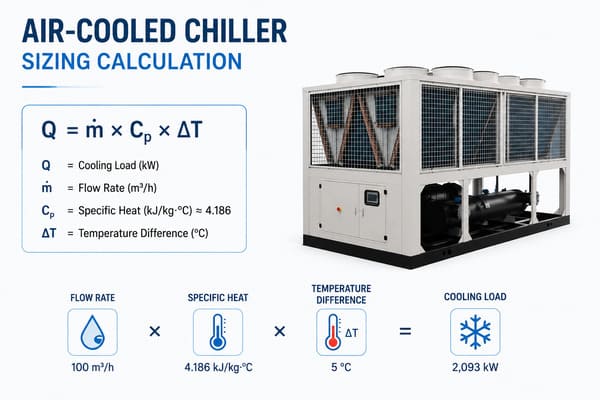
The preliminary calculation gives me a useful starting point, but it does not provide the complete selection. The chiller’s capacity can change substantially when the ambient temperature, water temperature, glycol concentration, or operating pattern changes. In the following sections, I will explain how I organize the data, check the calculation, and compare supplier quotations more accurately.
What information do I need to size an air-cooled chiller?
Many chiller inquiries fail because they provide only a requested capacity, such as “100 tons,” without explaining how that number was established. I usually ask several follow-up questions before recommending a model. Without those answers, a quotation may look precise while actually relying on unknown assumptions.
The essential information includes the process heat load, fluid flow rate, entering and leaving fluid temperatures, design ambient temperature, fluid properties, electrical standard, operating schedule, and future expansion plans. I also need to know whether the chiller serves one process, several machines, or a buffer tank.
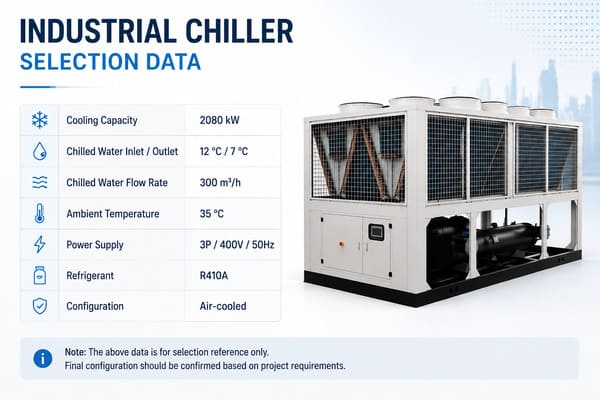
When I review a new project, I separate the information into four groups:
- Thermal requirements
- Hydraulic requirements
- Site and electrical conditions
- Commercial and operating expectations
Thermal requirements
The thermal information should identify what the chiller must remove and under which conditions. I normally request:
- Required cooling capacity or estimated process heat load
- Fluid entering temperature
- Fluid leaving temperature
- Required temperature stability
- Minimum and maximum process load
- Continuous or intermittent operation
- Heat generated by pumps, motors, heaters, and production equipment
- Expected future production expansion
A customer may write, “We need chilled water at 7°C for a plastic production line.” That statement identifies a target supply temperature, but it does not tell me the return temperature, flow rate, operating hours, or actual process heat release.
Hydraulic and fluid requirements
The circulating medium affects both capacity and flow. Water and water-glycol mixtures do not have identical specific heat values.1 Glycol also increases viscosity, which can affect pressure drop and pump selection.2
I ask for:
- Fluid type
- Glycol concentration, if applicable
- Required flow rate
- Available system pressure
- Pipe size and connection requirements
- Open or closed circulation system
- Whether a process pump and tank are included
Site and electrical conditions
An air-cooled chiller rejects heat directly to outdoor air. Therefore, the design ambient temperature is especially important. A unit selected at 35°C ambient may not deliver the same capacity at 45°C.
I also confirm:
- Maximum and minimum outdoor temperature
- Installation altitude
- Indoor or outdoor installation
- Ventilation clearance
- Voltage and frequency
- Phase configuration
- Local electrical and safety requirements
- Noise restrictions
- Access for maintenance and replacement
What happens when information is missing?
I have received inquiries that included only a photograph of an old chiller and a request for “the same capacity.” In that situation, I cannot safely assume that the old unit’s nominal rating matches the current process. I need to check its actual leaving-water temperature, ambient rating, refrigerant circuit, operating history, and process changes.
A technically complete inquiry saves time for both the buyer and supplier. It also makes quotations easier to compare because every supplier receives the same operating conditions.
How do I calculate the preliminary air-cooled chiller load?
A preliminary air-cooled chiller calculation usually starts with the heat removed from the circulating fluid. I use the relationship between mass flow, specific heat, and temperature difference as an initial estimate. However, I treat this result as a planning value rather than a final equipment rating.
The basic relationship is:
[ Q = dot{m} times C_p times Delta T ]
Where:
- (Q) is the heat load
- (dot{m}) is the mass flow rate
- (C_p) is the specific heat of the fluid
- (Delta T) is the difference between entering and leaving fluid temperature
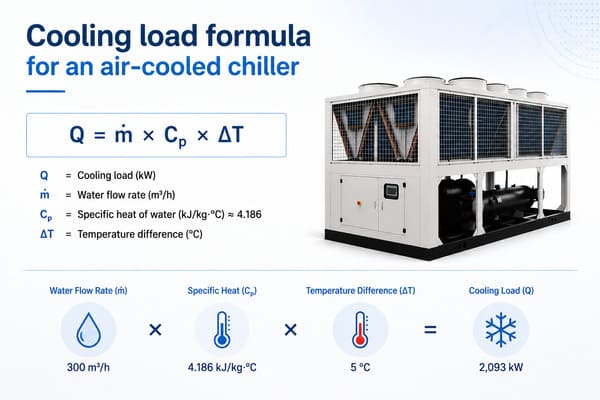
For water-based systems, I can also use a practical form based on the selected engineering units. For example, when flow is expressed in m³/h and the temperature difference is expressed in °C, the estimated heat load in kW is approximately:
[ Q approx 1.163 times text{flow} times Delta T ]
This approximation assumes water with a specific heat close to 4.18 kJ/kg·K and a density near 1,000 kg/m³.
Example preliminary calculation
Suppose I have the following process data:
| Parameter | Value |
|---|---|
| Fluid | Water |
| Flow rate | 20 m³/h |
| Entering-water temperature | 12°C |
| Leaving-water temperature | 7°C |
| Temperature difference | 5°C |
The preliminary load is:
[ Q approx 1.163 times 20 times 5 = 116.3text{ kW} ]
That result represents approximately 116 kW of heat removal under the stated fluid conditions. It does not automatically mean that I should select a chiller marketed as exactly 116 kW.
The final selection must consider whether the 20 m³/h flow is measured or estimated, whether the temperatures remain stable, and whether the process adds heat from pumps, tanks, motors, or exposed piping.
Why the formula is not a complete design method
The flow-temperature calculation can be misleading when the operating data is inaccurate. For example:
- A flow meter may show the pump’s rated flow rather than the actual process flow.
- The return temperature may vary widely during production.
- The fluid may contain glycol.
- The process may operate in batches rather than continuously.
- Heat may enter through an uninsulated tank or pipe.
- The customer may quote the pump motor power instead of the absorbed process heat.
I have seen a customer provide a 75 kW pump motor rating and request a 75 kW chiller. That approach is not valid by itself. The motor’s electrical input is not equal to the heat that the process requires the chiller to remove. Some energy becomes mechanical work, some heat enters the fluid, and some heat leaves through the equipment structure.
How should I treat uncertain data?
I identify which values are measured, which values come from process calculations, and which values are assumptions. I then ask the buyer to confirm the most important uncertainties before final selection.
A useful preliminary load worksheet should include:
- Measured flow rate
- Measured entering temperature
- Required leaving temperature
- Fluid composition
- Minimum, normal, and maximum production load
- Heat from connected equipment
- Operating hours per day
- Expected future load
If the project has substantial variation, I may evaluate several operating points instead of using one average number. This approach helps the buyer understand both peak capacity and low-load behavior.
Which operating conditions affect air-cooled chiller capacity?
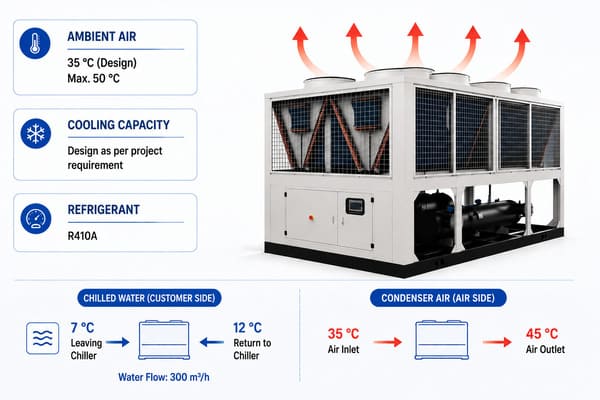
The quoted capacity of an air-cooled chiller has meaning only when its rating conditions are clear. I never compare two capacity numbers without checking the ambient temperature, leaving-water temperature, entering-water temperature, flow rate, and fluid type behind each quotation.
A higher ambient temperature generally makes heat rejection more difficult for an air-cooled unit.3 A lower leaving-water temperature can also reduce available capacity and increase compressor work.4 These factors can change the selected model even when the preliminary process load remains the same.
Ambient temperature
An air-cooled chiller uses outdoor air to remove condenser heat. When outdoor air becomes hotter, the condenser must operate against a higher condensing temperature. The compressor may require more power, and the available cooling capacity may decrease.
For projects in the Middle East, Africa, or other hot regions, I pay close attention to the design ambient temperature. A quotation based on 35°C ambient should not be treated as equivalent to a quotation based on 45°C ambient.
The buyer should ask the supplier to state:
- Standard ambient rating
- Maximum design ambient
- Capacity at the project design ambient
- Compressor operating limits
- Any high-ambient controls or component modifications
Leaving-water temperature
The requested leaving-water temperature directly affects the refrigeration cycle. A chiller producing 7°C water operates under different conditions from a unit producing -5°C glycol solution.
I also check whether the temperature is:
- A normal operating target
- A minimum required temperature
- A short-term process condition
- A temperature measured at the chiller outlet or at the production machine
Small temperature differences can matter when the process has tight control requirements. The supplier should state the temperature conditions used for the quoted capacity.
Entering-water temperature and temperature difference
The entering-water temperature indicates how much heat the fluid carries back to the chiller. The difference between entering and leaving temperature helps determine the required flow for a given load.
If a buyer requests 7°C leaving water but does not provide the return temperature, I cannot verify the expected heat transfer. A system returning at 12°C has a different operating condition from a system returning at 18°C, even if both systems use 7°C supply water.
Fluid properties and flow
Water-glycol mixtures usually have lower specific heat and higher viscosity than plain water. Therefore, the same volumetric flow may provide less heat removal, while the pump may need to overcome greater resistance.
I check whether the chiller supplier has included:
- Glycol concentration
- Design fluid temperature
- Correct specific heat
- Correct density
- Pressure drop
- Pump head
- Minimum flow protection
Operating schedule
A process that operates continuously at peak load has different selection requirements from a batch process that reaches peak load for only a few minutes. A buffer tank may help manage short-term fluctuations, but the tank volume and control strategy must be evaluated.5
I ask whether the plant requires:
- 24-hour continuous operation
- Multiple shifts
- Seasonal operation
- Standby capacity
- Duty and assist sequencing
- Rapid pull-down after startup
The manufacturer’s performance data should match the real project conditions. If it does not, the buyer should request a revised selection rather than comparing nominal capacity alone.
How much safety margin should an air-cooled chiller have?
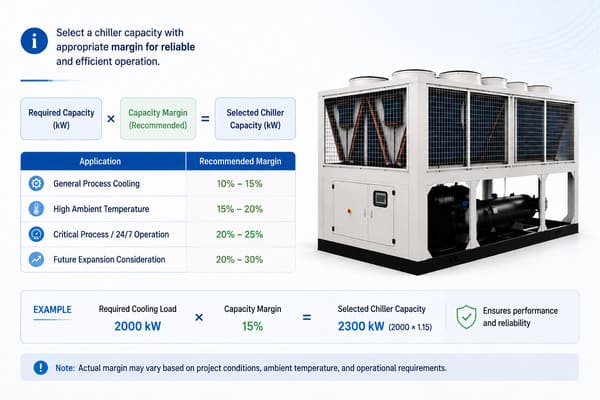
I do not apply one universal safety factor to every air-cooled chiller project. A margin can be useful, but it should reflect confirmed uncertainty, load fluctuation, fouling, future expansion, or unusual site conditions. An unexplained percentage can create unnecessary cost and operating problems.
A chiller that is too small may fail to reach the required process temperature during peak demand.6 A chiller that is too large may cost more, cycle frequently, operate inefficiently at low load, and create control difficulties. The right margin depends on the quality of the load data and the project’s operating profile.
Risks of undersizing
Undersizing can create immediate production problems. I have seen inquiries where the existing chiller could maintain the target temperature during mild weather but lost performance during the hottest part of the year. The original selection had not considered the site’s actual summer ambient condition.
Typical consequences include:
- Process temperature rising above the permitted limit
- Longer compressor operation
- Reduced production speed
- Product quality variation
- High-pressure alarms
- Emergency rental or replacement costs
- Greater risk of production downtime
Undersizing becomes especially serious in processes such as plastics, chemicals, pharmaceuticals, food production, and battery manufacturing, where temperature stability can affect product quality and safety.
Risks of oversizing
Oversizing is not automatically a reliability strategy. A substantially oversized unit may satisfy the peak capacity number, but it can perform poorly when the normal load is much lower.7
Potential consequences include:
- Higher initial purchase cost
- Larger installation footprint
- Greater electrical infrastructure requirements
- Poor compressor cycling behavior
- Reduced part-load efficiency
- Unstable leaving-water temperature
- More frequent starts and stops
- Increased maintenance exposure
Modern systems may use capacity control, inverter compressors, multiple refrigeration circuits, or staged compressors to handle variable load. However, those features should be selected according to the load profile rather than used to justify an arbitrary oversized unit.
How should I establish a reasonable margin?
I start by classifying the load data:
| Data quality | Typical selection approach |
|---|---|
| Measured flow and temperatures with stable production data | Use the verified peak load and check manufacturer performance |
| Calculated load with moderate uncertainty | Investigate the uncertainty and apply a documented project allowance |
| Major future expansion already approved | Include the confirmed future load or plan modular capacity |
| Highly variable batch process | Analyze peak duration, buffer volume, and control strategy |
| Very limited information | Complete the technical survey before final selection |
I also distinguish between design margin and future capacity. A small allowance for measurement uncertainty is not the same as adding capacity for a production line planned several years later.
If future expansion is realistic, I may recommend multiple smaller modules, a larger frame with capacity control, or provisions for a second chiller. The best option depends on redundancy, site space, maintenance requirements, and total cost of ownership.
Why I prefer documented reasoning
When I issue a technical recommendation, I want the buyer to understand why the selected capacity differs from the preliminary calculated load. The explanation may involve high ambient temperature, glycol concentration, pump heat, future production, or a required standby philosophy.
This documentation helps procurement teams compare suppliers fairly. It also gives the engineering team a clear record for future troubleshooting.
How should I compare air-cooled chiller quotations?
A supplier quotation can be technically complete only when it states the conditions behind the capacity. I recommend that buyers use the same data sheet for every bidder and require each supplier to identify the performance basis.
The buyer should compare delivered capacity, operating efficiency, controls, component quality, service support, and total cost of ownership instead of comparing nominal tons alone.
What should I include in the inquiry?
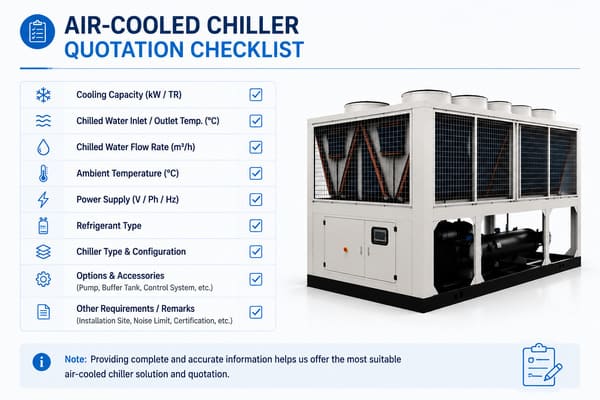
I recommend including the following information:
- Required cooling capacity or preliminary heat load
- Entering-water temperature
- Leaving-water temperature
- Required water or fluid flow rate
- Fluid type and glycol concentration
- Design ambient temperature
- Minimum and maximum ambient temperature
- Voltage, frequency, and phase
- Operating hours and production pattern
- Indoor or outdoor installation
- Required noise level
- Required control interface
- Local standards and documentation
- Future load expectations
- Preferred delivery date
- Installation and commissioning scope
I also ask suppliers to state whether the quoted capacity includes the process pump, tank, filters, controls, and other accessories. Two suppliers may quote the same chiller capacity while including different system boundaries.
Which performance data should suppliers provide?
A useful quotation should identify:
| Evaluation item | Buyer’s question |
|---|---|
| Cooling capacity | At which ambient and water temperatures? |
| Power input | At full load, part load, or both? |
| COP or efficiency | Which test or rating conditions apply? |
| Flow rate | What is the design and minimum flow? |
| Pressure drop | Does the value include the evaporator and accessories? |
| Refrigerant | Which refrigerant and safety classification apply? |
| Compressor | What brand, model, and control method are used? |
| Condenser | What material, fan type, and protection are included? |
| Controls | What alarms, protections, and communication protocols are available? |
| Service | What commissioning, spare parts, and response support are included? |
I treat certification documents as important procurement records, but I also recommend that buyers verify their scope, validity, issuing organization, and applicability to the delivered model. A general company certificate may not prove that every configuration meets a particular project requirement.
How do I evaluate the manufacturer?
The equipment itself is only part of the purchase decision. I also review whether the manufacturer can support engineering clarification, production quality, testing, commissioning, and after-sales troubleshooting.
At IceStar, I describe our experience in relation to the project scope rather than presenting it as a guarantee for every application. Our business has more than 20 years of industrial chiller manufacturing experience, production bases in Shanghai and Nantong, and an engineering team of more than 200 people. Our reported annual capacity exceeds 6,000 units.
For a buyer, these facts are useful only when they connect to practical project requirements. I suggest asking for:
- Factory and production information
- Quality inspection records
- Factory acceptance testing procedures
- Reference projects with similar conditions
- Spare-parts availability
- Remote diagnostic capability
- Commissioning responsibilities
- Warranty terms
- Local service arrangements
- Lead time for customized equipment
I also ask how the supplier handles high-ambient applications, low-temperature requirements, special voltage standards, explosion-protection needs, and integration with existing plant controls.
Why does total cost of ownership matter?
The lowest purchase price may not produce the lowest project cost. I compare:
- Initial equipment price
- Installation and electrical infrastructure
- Expected energy consumption
- Maintenance requirements
- Replacement parts
- Downtime exposure
- Refrigerant and regulatory considerations
- Service response
- Equipment life expectancy
A supplier using recognized core components from brands such as Hanbell, Bitzer, Danfoss, Siemens, Schneider, or Emerson may offer a configuration that supports serviceability and reliability. However, I still recommend that buyers verify the exact component list, model, availability, and suitability for the intended application.
Frequently Asked Questions
Can I size an air-cooled chiller from motor power?
No. Motor power does not directly equal process cooling load. Some motor energy becomes mechanical work, while some heat enters the fluid or surrounding equipment. I use motor power only as one supporting data point and calculate the process load from measured heat transfer and operating conditions.
Can I use room area to select an air-cooled chiller?
Room area is not a reliable basis for industrial process cooling. Room-area methods may be relevant to certain building comfort-cooling estimates, but industrial equipment heat load depends on production machinery, fluid flow, temperature difference, process cycles, and site conditions.
Is a larger air-cooled chiller always safer?
No. A larger unit may prevent capacity shortage, but excessive oversizing can increase cost, cycling, energy use, and control problems. I select the capacity from verified peak load, operating conditions, confirmed future demand, and the manufacturer’s performance data.
What ambient temperature should I use for selection?
I use the project’s design ambient temperature, normally based on site climate data, owner requirements, or engineering specifications. A supplier should state the ambient condition behind its quoted capacity. Buyers in hot regions should not compare a 35°C rating with a 45°C project requirement.
Should I choose water or glycol for the system?
The choice depends on freeze protection, process temperature, materials, and operating conditions. Glycol changes specific heat, density, viscosity, and pressure drop. I require the supplier to calculate capacity and hydraulic performance using the actual glycol concentration rather than assuming plain water.
Conclusion
Sizing an air-cooled chiller starts with the real process heat load, not motor power, floor area, or a standard tonnage rule. I use flow rate, fluid properties, and supply-return temperature difference for a preliminary estimate, then verify capacity at the required water temperatures, flow, ambient condition, and operating schedule. I also compare supplier documentation, manufacturing capability, testing, service, and total cost of ownership. For a project-specific selection, send IceStar your process data and operating conditions so our engineering team can prepare a technically supported recommendation.
"1,2-Ethanediol - the NIST WebBook", https://webbook.nist.gov/cgi/cbook.cgi?ID=C107211&Units=SI&Mask=FFF. Thermophysical-property measurements and reference correlations show that the specific heat of aqueous glycol solutions varies with glycol concentration and temperature, so water-only heat-load calculations are not generally transferable to glycol systems. Evidence role: mechanism; source type: research. Supports: Published thermophysical-property data showing that glycol concentration changes the specific heat of water-glycol solutions.. Scope note: The exact value depends on glycol type, concentration, and temperature; a general property source does not replace project-specific fluid data. ↩
"Rheological and Thermal Conductivity Study of Two-Dimensional ... - PMC", https://pmc.ncbi.nlm.nih.gov/articles/PMC8954611/. Hydronic-system analyses establish that glycol solutions are more viscous than water under comparable conditions, which can increase frictional pressure losses and alter pump selection and operating power. Evidence role: mechanism; source type: paper. Supports: Fluid-property and hydronic-system analyses linking glycol concentration to viscosity, pressure loss, and pump requirements.. Scope note: The magnitude of the effect depends on glycol formulation, concentration, temperature, pipe geometry, and flow regime. ↩
"[PDF] Refrigerant Charge and Ambient Temperature Effects on the ...", https://docs.lib.purdue.edu/cgi/viewcontent.cgi?article=1696&context=iracc. Refrigeration-cycle analyses show that higher condenser entering-air temperature tends to raise condensing pressure and compressor work, commonly reducing the available cooling capacity or efficiency of air-cooled equipment. Evidence role: mechanism; source type: paper. Supports: Refrigeration studies showing that increased condenser entering-air temperature raises condensing conditions and affects compressor power and cooling capacity.. Scope note: The direction and magnitude of the capacity change depend on compressor type, controls, refrigerant, condenser design, and operating limits. ↩
"(PDF) An experimental study of the effect of evaporator temperature on ...", https://www.academia.edu/7263073/An_experimental_study_of_the_effect_of_evaporator_temperature_on_the_compressor_work_of_a_simple_vapour_compression_refrigeration_system. Refrigeration-cycle research indicates that lowering the chilled-fluid temperature generally increases the temperature lift required of the compressor and can increase compressor work while changing the available capacity. Evidence role: mechanism; source type: research. Supports: Refrigeration-cycle and chiller-performance research relating lower evaporating or leaving-water temperatures to compressor lift, power demand, and capacity.. Scope note: Actual performance is model-specific and may be modified by compressor staging, expansion-valve control, refrigerant selection, and rating constraints. ↩
"Chilled-Water Buffer Tanks for Data Centers", https://www.smithindustriestx.com/post/chilled-water-buffer-tanks-for-data-centers. Chilled-water storage and buffer-tank analyses show that added fluid volume can increase thermal inertia and reduce the effect of short-duration load changes, subject to appropriate sizing and control configuration. Evidence role: mechanism; source type: research. Supports: Studies or engineering guidance explaining how chilled-water volume provides thermal inertia and affects chiller cycling and control response.. Scope note: A buffer tank does not remove sustained heat load and may be ineffective or counterproductive if its volume, placement, or control sequence is unsuitable. ↩
"Chilled Water Plant Design Guide energydesignresources", https://datacenters.lbl.gov/sites/default/files/EDR_DesignGuidelines_CoolToolsChilledWater.pdf. Chiller performance studies support the operational principle that, when peak process heat input exceeds available cooling capacity under the prevailing conditions, the system cannot maintain its specified fluid temperature. Evidence role: general_support; source type: research. Supports: Chiller-load and control studies showing that available capacity below the required peak load leads to rising leaving-fluid temperature or unmet cooling demand.. Scope note: The severity and duration of the temperature deviation depend on controls, thermal mass, load duration, and allowable process limits. ↩
"Purchasing Energy-Efficient Electric Chillers", https://www.energy.gov/cmei/femp/purchasing-energy-efficient-electric-chillers. Chiller part-load studies indicate that equipment selected substantially above the normal load may experience less favorable cycling or control behavior and may not achieve its best seasonal efficiency at low load. Evidence role: mechanism; source type: paper. Supports: Research on chiller part-load performance, cycling, and efficiency under loads substantially below design capacity.. Scope note: Variable-speed drives, multiple circuits, staged compressors, and minimum-capacity controls can mitigate these effects, so oversizing consequences are not uniform. ↩