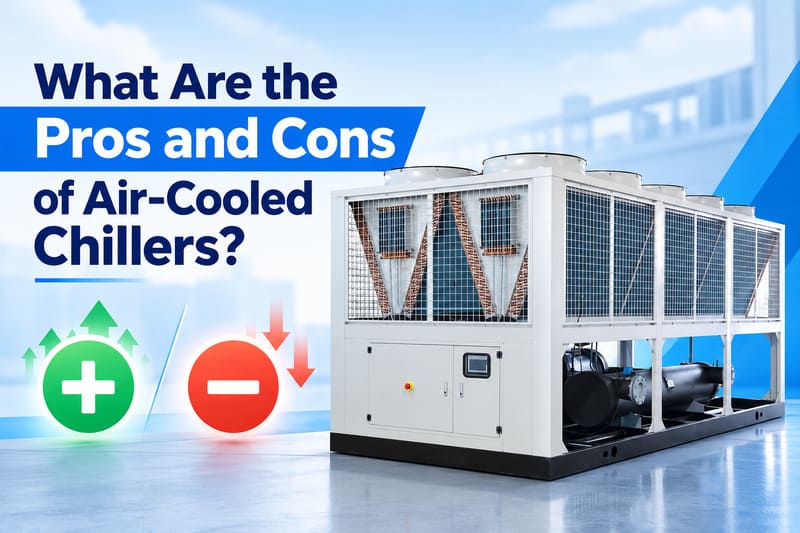
The disadvantages of air-cooled chillers usually appear when a project faces high ambient temperatures, dirty air, long operating hours, or strict energy targets. I often see buyers compare catalog prices first, then discover that site conditions, maintenance access, and downtime risks have a greater effect on long-term value. Careful evaluation reduces that risk.
The disadvantages of air-cooled chillers include sensitivity to high ambient temperatures, potentially higher energy consumption, outdoor noise, larger installation space, and condenser coil maintenance. However, these trade-offs do not make air-cooled technology unsuitable for every project. Buyers should compare actual site conditions, annual operating hours, water availability, maintenance requirements, and total lifecycle cost before choosing between air-cooled and water-cooled systems.
I do not treat air-cooled chillers as universally inferior equipment. I treat them as one system option with a specific operating profile. In customer selection discussions, I normally begin with ambient temperature, load behavior, air quality, installation conditions, and the cost of downtime. Those factors reveal when the disadvantages matter and when air cooling remains the more practical choice.
Do high ambient temperatures increase the disadvantages of air-cooled chillers?
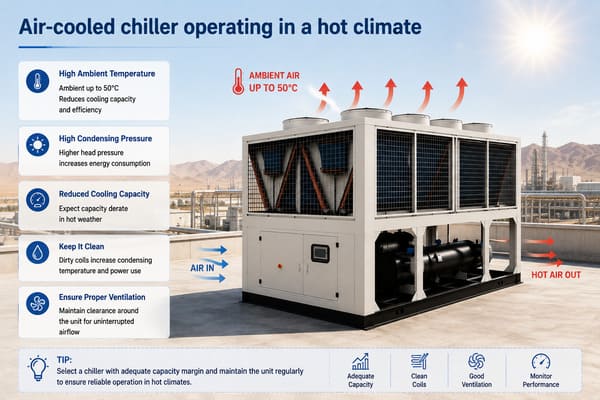
High ambient temperature is one of the most important limitations of air-cooled equipment. When outdoor air becomes hotter, the condenser must reject heat against a smaller temperature difference.1 I therefore ask buyers to evaluate performance at the actual peak site temperature, rather than relying only on a standard catalog rating.
High ambient temperatures can reduce the available cooling capacity, increase compressor workload, raise condensing pressure, and affect operating stability.2 Buyers should request performance data at the project’s maximum ambient temperature and design conditions. A unit designed for ordinary weather may require special engineering for hot regions such as the Middle East, Africa, or tropical industrial zones.
Why ambient temperature changes chiller performance
An air-cooled chiller uses outdoor air to remove heat from the refrigerant through condenser coils. The refrigeration cycle must reject both the heat absorbed from the process and the heat generated by compressor operation. As outdoor air becomes hotter, the system usually needs a higher condensing temperature to transfer that heat.
This condition can create several effects:
- Lower cooling capacity: The refrigeration circuit may produce less useful cooling at the same operating conditions.
- Higher power demand: Compressors and condenser fans may work harder.
- Higher condensing pressure: The control system may approach its operating limits during peak weather.
- More frequent protective control: The chiller may unload, cycle, or stop if safety limits are reached.
- Greater component stress: Extended operation under high pressure can increase the importance of correct component selection and maintenance.
I often see buyers ask whether a chiller rated at 35°C can operate in a location where summer temperatures reach 45°C or more. The answer cannot come from the nameplate alone. The buyer needs a performance selection based on the actual ambient temperature, leaving-water temperature, entering-water temperature, altitude, and load profile.
What should buyers verify for hot-climate projects?
I recommend asking the supplier for a written selection sheet that includes:
| Evaluation item | Why it matters |
|---|---|
| Maximum design ambient temperature | It determines whether the condenser and compressor are suitably selected |
| Required chilled-water temperature | Lower leaving-water temperatures can increase refrigeration duty |
| Full-load and part-load performance | The plant may operate more often at partial load than at full load |
| Refrigerant and compressor type | Different configurations respond differently to high condensing pressure |
| Fan and condenser design | Coil size, airflow, and fan control affect heat rejection |
| High-pressure protection settings | The system needs safe control during peak conditions |
| Altitude | Reduced air density can influence fan and heat-transfer performance |
| Dust and sand exposure | Fouling can gradually reduce airflow through the condenser |
In hot and dusty regions, I also consider whether the unit needs a larger condenser, enhanced fan motors, special controls, or a different operating envelope. These features may increase the initial price, but they can reduce the risk of unstable operation.
Air-cooled chiller selection for hot regions
I have seen repeated customer questions about whether an air-cooled chiller is appropriate for high-temperature factories. I explain that the answer depends on the required process temperature and the plant’s consequences of failure. A chiller serving a noncritical comfort-cooling load may have a different risk profile from a unit cooling pharmaceutical production, plastic molding, or battery manufacturing equipment.
The buyer should also consider the seasonal load. A unit may operate under moderate conditions for much of the year and face extreme conditions only during a few weeks. That does not make peak design conditions irrelevant. If production continues during the hottest period, the chiller must maintain acceptable performance when the plant needs it most.
I recommend that qualified engineers review:
- The actual historical and projected peak ambient temperature.
- The required supply and return water temperatures.
- The process heat load and expected load variation.
- The redundancy requirement for critical production.
- The available electrical capacity during peak operation.
- The supplier’s high-ambient design documentation.
High ambient temperature is not an automatic reason to reject air cooling. It is a reason to demand more precise engineering data.
Are air-cooled chillers less efficient than water-cooled chillers?
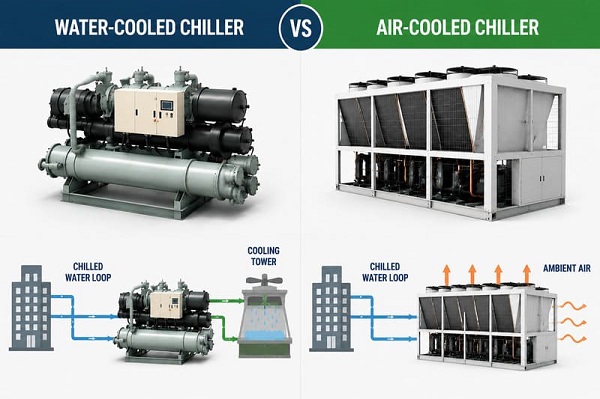
Air-cooled chillers can have lower efficiency than comparable water-cooled systems under suitable test conditions, but the comparison is incomplete without considering the entire cooling system. I compare compressor energy, fan energy, pumps, cooling towers, water treatment, water consumption, maintenance, and local utility costs before reaching a conclusion.
Water-cooled chillers may achieve better efficiency in suitable conditions because water can reject heat more effectively than outdoor air.3 Air-cooled systems, however, avoid cooling towers, condenser-water pumps, water treatment, and much of the associated water infrastructure. The more efficient choice depends on climate, operating hours, water availability, maintenance capability, and the complete system design.4
Why the efficiency comparison needs a system boundary
A common procurement mistake involves comparing only the chiller compressor’s rated efficiency. That approach may favor water-cooled equipment, but it can ignore the energy and operating requirements of the cooling tower and condenser-water system.
A more useful comparison includes:
- Chiller compressor power
- Evaporator-side chilled-water pump power
- Condenser-water pump power
- Cooling-tower fan power
- Cooling-tower makeup water
- Water treatment equipment
- Blowdown and wastewater management
- Cleaning and inspection requirements
- Freeze protection where applicable
- Auxiliary control and ventilation loads
A water-cooled system can offer strong efficiency in a suitable climate, especially when the plant operates many hours each year. However, the system also needs a reliable water source, proper tower placement, water treatment, pump maintenance, and trained operating staff.
An air-cooled system usually has a simpler arrangement. I can often place the chiller outdoors without installing a cooling tower or condenser-water loop. That simplicity can reduce installation coordination and make the system attractive to factories with limited water access.
When can air cooling remain a practical choice?
I generally consider air-cooled chillers practical when the project has one or more of the following conditions:
- The site has limited water availability.
- The customer wants to avoid cooling-tower maintenance.
- The project requires a relatively simple installation.
- The plant has moderate annual operating hours.
- The system serves distributed loads or separate production areas.
- The site cannot easily manage water treatment and blowdown.
- The customer values quicker installation and lower infrastructure complexity.
- The outdoor environment supports acceptable heat rejection.
The buyer should not interpret “lower efficiency” as “wrong technology.” A system with a slightly higher chiller energy requirement may still provide a lower overall project burden if it avoids water infrastructure and reduces maintenance complexity.
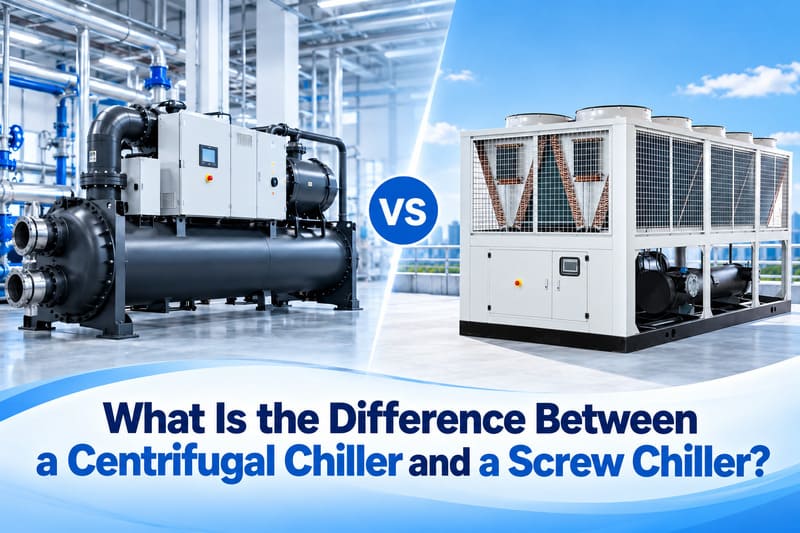
Comparing air-cooled and water-cooled systems
| Factor | Air-cooled chiller | Water-cooled chiller |
|---|---|---|
| Heat rejection medium | Outdoor air | Condenser water and cooling tower |
| Cooling tower required | No | Usually yes |
| Water consumption | Very low for heat rejection | Requires makeup water and blowdown |
| Condenser-water pumps | Not required | Required |
| High ambient sensitivity | Often more significant | The tower approach can provide favorable heat rejection, depending on wet-bulb conditions |
| Installation complexity | Generally simpler | More components and piping |
| Maintenance focus | Condenser coils, fans, refrigerant circuit | Tower, pumps, water treatment, condenser, and refrigerant circuit |
| Space requirement | Outdoor footprint and airflow clearance | Chiller room or plant area plus tower space |
| Noise considerations | Outdoor fan and compressor noise | Tower and pump noise, with chiller placement considerations |
| Water quality risk | Limited | Scale, corrosion, biological growth, and fouling require control |
I also ask whether the project has a suitable cooling-tower environment. A tower may not be ideal near sensitive production areas, residential zones, food facilities, or locations with strict water regulations. The correct solution depends on the plant, not on a single efficiency number.
How I evaluate energy priorities
When customers focus on energy, I ask for the operating schedule rather than assuming full-load operation. Many industrial chillers operate at varying loads. Part-load control, compressor staging, fan control, chilled-water reset, and process scheduling can influence annual consumption.
I recommend that buyers request:
- Full-load power at actual design temperatures
- Part-load performance where available
- Expected annual operating hours
- Seasonal operating conditions
- Control strategy and turndown range
- Estimated auxiliary energy
- Assumptions used in the supplier’s calculation
I also recommend that a qualified professional verify the comparison for the specific project. A water-cooled design may be more efficient in one factory, while an air-cooled design may deliver better practical value in another.
Do air-cooled chillers have higher lifecycle costs?
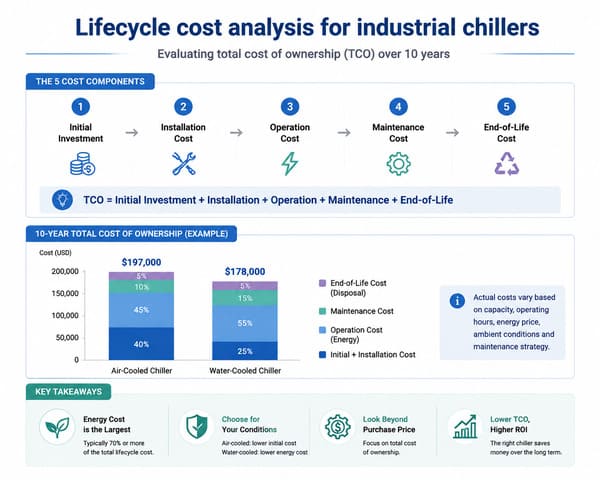
The lifecycle cost of an air-cooled chiller can become higher when the unit operates continuously in a hot, dusty environment or when energy prices are high.5 I do not judge cost from purchase price alone. I include electricity, service access, cleaning, replacement parts, downtime exposure, installation, water infrastructure, and expected operating life.
Air-cooled chillers may have higher lifecycle costs because they can consume more electricity under demanding conditions and may require regular condenser-coil cleaning. However, water-cooled systems also create costs through cooling towers, water treatment, pumps, water consumption, and specialized maintenance. Buyers should compare total cost of ownership using project-specific operating assumptions.
What creates lifecycle cost in an industrial chiller?
I divide lifecycle cost into several categories:
-
Initial acquisition
- Chiller price
- Transportation and insurance
- Controls and accessories
- Commissioning and installation
-
Site infrastructure
- Electrical distribution
- Piping and pumps
- Cooling tower or condenser system
- Foundations and access platforms
- Ventilation and noise controls
-
Operating energy
- Compressor power
- Fan power
- Pump power
- Auxiliary equipment
-
Routine maintenance
- Coil cleaning
- Filter and control inspection
- Refrigerant checks
- Water treatment
- Tower cleaning
- Oil and component service
-
Business risk
- Production interruption
- Product quality loss
- Emergency service
- Spare parts availability
- Delayed project delivery
This framework helps me explain why a lower purchase price does not always produce a lower total cost. It also prevents buyers from assuming that water-cooled equipment automatically offers better value.
How air quality affects maintenance cost
Air-cooled chillers depend on airflow across the condenser coil. Dust, sand, oil mist, fibers, and other airborne contaminants can accumulate on the coil surface. Fouling reduces heat transfer and airflow. The system may then operate at higher condensing pressure and consume more energy.
The effect depends on the site. A clean electronics facility and a cement or metal-processing plant may have completely different maintenance needs. I ask buyers to assess:
- Dust concentration and particle type
- Nearby exhaust systems
- Outdoor placement
- Prevailing wind direction
- Cleaning water availability
- Access for pressure washing or coil-cleaning equipment
- Local maintenance labor capability
A maintenance plan should state how often technicians inspect and clean the coil. The correct frequency depends on actual site conditions, so I avoid presenting one universal interval.
How water-cooled systems create different costs
Water-cooled chillers may reduce some energy costs, but they require more equipment and operational control. Cooling towers can develop scale, corrosion, and biological contamination if the water treatment program is poorly managed. Operators must also manage water quality, chemical dosing, blowdown, drift, and seasonal conditions.
I use the following comparison during early procurement discussions:
| Cost category | Air-cooled consideration | Water-cooled consideration |
|---|---|---|
| Electricity | Compressor and condenser fans may draw more power in hot conditions | Chiller may perform efficiently, but tower and pumps consume energy |
| Water | Minimal heat-rejection water use | Makeup water, blowdown, and treatment are required |
| Cleaning | Condenser coils need inspection and cleaning | Tower fill, basin, condenser tubes, and water circuit need service |
| Installation | Simpler heat-rejection arrangement | More piping, pumps, tower, valves, and controls |
| Service skills | Refrigeration and electrical skills | Refrigeration, mechanical, water-treatment, and tower skills |
| Downtime risk | Coil fouling or high ambient conditions can affect operation | Poor water quality or tower failure can affect operation |
| Space | Requires outdoor airflow and service clearance | Requires chiller, tower, piping, and maintenance access |
How downtime changes the decision
For many industrial users, downtime costs more than energy. A plant that loses batches, molded parts, pharmaceutical production, or battery process stability may prioritize redundancy and service response over a small efficiency difference.
I recommend that buyers define the cost of failure before selecting equipment. They should ask:
- How quickly must the plant recover from a chiller fault?
- Does the process require continuous cooling?
- Can the plant operate temporarily at reduced load?
- Is a standby chiller necessary?
- Are critical components locally available?
- Can the supplier provide remote diagnosis and commissioning support?
- Does the service team understand the application?
I have found that customers make stronger decisions when they compare the full risk profile. A well-designed air-cooled system with suitable redundancy and maintenance access may be safer for one factory than a more efficient water-cooled system that lacks water-treatment support.
How should buyers evaluate the disadvantages of air-cooled chillers?
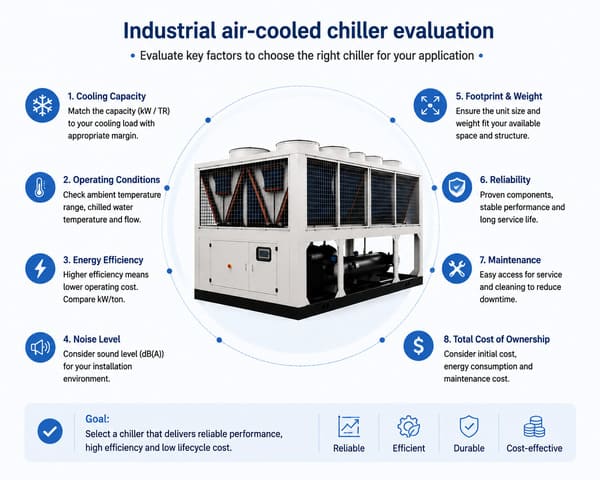
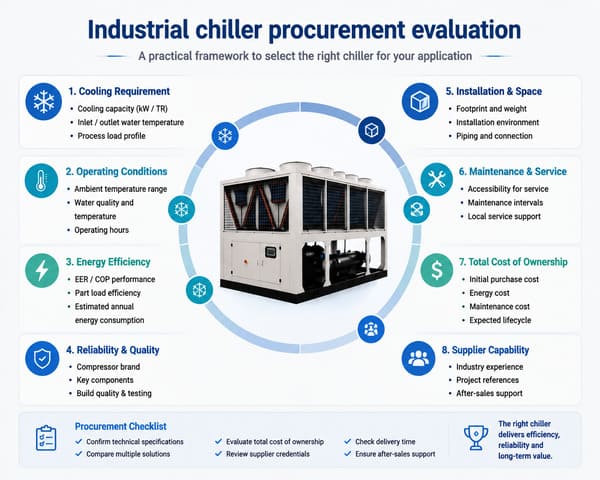
Buyers should evaluate the disadvantages of air-cooled chillers against actual operating conditions instead of using a generic pros-and-cons list. I start with the site’s peak ambient temperature, air quality, load profile, annual operating hours, installation space, energy priorities, maintenance resources, and the consequences of equipment downtime.
Buyers can evaluate air-cooled chiller suitability by reviewing seven factors: maximum ambient temperature, required cooling capacity, annual operating hours, air quality, installation space, maintenance capability, and downtime consequences. A supplier should provide project-specific performance data, technical documentation, service plans, and clearly stated design assumptions for professional review.
Step 1: Confirm the real design conditions
I first collect the operating information that determines the refrigeration load. The data should include:
- Required cooling capacity
- Chilled-water supply and return temperature
- Process flow rate
- Minimum and maximum load
- Maximum outdoor ambient temperature
- Site altitude
- Voltage and frequency
- Expected operating hours
- Required redundancy
- Installation location
I avoid accepting a selection based only on nominal tonnage. The same nominal capacity can produce different results under different ambient and water-temperature conditions.
Step 2: Study the load profile
Industrial loads often change during shifts, product changes, batch cycles, and seasonal production. A chiller that performs well at full load may not be the best choice if the plant spends most of its time at low or variable load.
I ask engineers to identify:
- Base load
- Peak load
- Start-up load
- Minimum stable load
- Daily operating pattern
- Seasonal variation
- Planned future expansion
This information helps the supplier select compressor staging, variable-speed control, buffer capacity, and system redundancy. It also supports a more realistic energy estimate.
Step 3: Examine the installation environment
Air-cooled chillers need sufficient airflow around the condenser. Walls, roofs, screens, adjacent equipment, and hot exhaust air can reduce heat-rejection performance. Recirculated air can make the chiller experience a higher effective ambient temperature than the local weather report suggests.
I recommend checking:
- Clearance around condenser coils
- Air discharge direction
- Risk of hot-air recirculation
- Crane and service access
- Structural loading
- Noise-sensitive areas
- Exposure to dust, salt, oil, or chemicals
- Drainage and weather protection
A qualified mechanical engineer should review the installation arrangement, especially for high-capacity systems or restricted rooftops.
Step 4: Compare suppliers, not just machines
The supplier’s engineering and service capability can influence long-term performance. During procurement, I recommend requesting the following documents:
| Supplier information | Procurement purpose |
|---|---|
| Technical data sheet | Confirms basic capacity, temperatures, power, and dimensions |
| Selection report | Shows performance at the project’s actual conditions |
| Electrical schematic | Supports integration and site planning |
| Control description | Explains sequencing, alarms, and communication options |
| Quality inspection plan | Defines factory checks and acceptance procedures |
| Warranty terms | Clarifies coverage, exclusions, and response obligations |
| Spare-parts list | Supports maintenance planning |
| Commissioning procedure | Reduces installation and start-up uncertainty |
| Reference information | Helps evaluate relevant industry experience |
| Certification documents | Allows the buyer to verify applicable compliance claims |
I treat certificates as documents that buyers should verify for the exact model, market, and scope. A certificate associated with one product family does not automatically prove compliance for every configuration.
Step 5: Consider design features for demanding sites
An air-cooled chiller can be adapted for challenging conditions, but the buyer should identify the need early. Possible design considerations include:
- Oversized condenser coils
- High-ambient compressor selection
- Variable-speed condenser fans
- Enhanced control logic
- Corrosion-resistant coil treatment
- Dust-resistant installation planning
- Low-temperature operation
- Special voltage and frequency
- Remote monitoring
- Redundant refrigeration circuits
- Heat recovery or heat-pump functions
- Explosion-protection requirements where applicable
These options should be evaluated against the application and verified by qualified professionals. I do not recommend adding features simply because they appear on a standard options list.
Step 6: Build a lifecycle decision matrix
I often use a weighted matrix to make the decision more transparent. The project team can assign scores based on its priorities.
| Decision factor | Suggested question |
|---|---|
| Ambient performance | Can the unit meet capacity at the real peak temperature? |
| Energy | What is the expected annual consumption under the actual load profile? |
| Water availability | Does the site have reliable water and treatment capability? |
| Maintenance | Can local staff clean, inspect, and service the equipment? |
| Space | Can the site provide airflow and service clearance? |
| Noise | Can the selected location meet project requirements? |
| Reliability | What happens if the unit trips during production? |
| Service | Can the supplier support commissioning and future repairs? |
| Delivery | Can the supplier meet the project schedule? |
| TCO | What are the expected costs over the planned service life? |
I have found that this method reduces arguments based only on price or brand familiarity. It also gives procurement, engineering, and management a common basis for discussion.
Frequently Asked Questions
Are air-cooled chillers unsuitable for hot climates?
No. Air-cooled chillers can serve hot-climate projects when the equipment is selected for the actual maximum ambient temperature and installed with proper airflow clearance. Buyers should request high-ambient performance data and consider condenser design, compressor selection, controls, redundancy, and maintenance conditions.
Why do air-cooled chillers use more energy in high temperatures?
Hot outdoor air makes it more difficult for the condenser to reject heat. The refrigeration system may need higher condensing pressure, which can increase compressor and fan power. The exact effect depends on the model, chilled-water conditions, load, airflow, and control strategy.
Are water-cooled chillers always more efficient?
No. Water-cooled chillers can provide strong efficiency, but buyers must include cooling-tower fans, condenser-water pumps, water treatment, makeup water, blowdown, maintenance, and infrastructure in the comparison. The best option depends on climate, water availability, operating hours, and site capabilities.
How often should an air-cooled chiller condenser coil be cleaned?
The required cleaning frequency depends on air quality, dust levels, nearby industrial emissions, and operating conditions. A clean site may require less frequent service than a dusty or oily plant. I recommend using a site-specific maintenance plan based on regular inspection and measured fouling.
What information should I request from an air-cooled chiller supplier?
I recommend requesting a project-specific selection sheet, performance data at peak ambient conditions, power information, dimensions, electrical requirements, control details, maintenance recommendations, warranty terms, spare-parts information, commissioning procedures, and verifiable certification documents.
Conclusion
The disadvantages of air-cooled chillers are mainly project-dependent trade-offs. High ambient temperatures, condenser fouling, outdoor noise, space requirements, and potentially higher energy use deserve careful attention. However, air-cooled systems can avoid cooling towers, water treatment, condenser-water pumps, and significant water consumption. I recommend comparing both technologies using actual site conditions, load profiles, annual operating hours, maintenance resources, downtime risks, and total cost of ownership. Contact IceStar for application-focused chiller selection, system design support, and qualified technical guidance for your industrial cooling project.
"[PDF] Effect of Ambient Design Temperature on Air- Cooled Binary Plant Output", https://inldigitallibrary.inl.gov/sites/sti/sti/5411168.pdf. Refrigeration engineering analyses describe the dependence of air-cooled condenser heat rejection on outdoor-air temperature and the resulting increase in condensing temperature under hotter conditions. Evidence role: mechanism; source type: paper. Supports: The source should explain how rising outdoor-air temperature affects condenser heat rejection and condensing temperature in vapor-compression systems.. Scope note: The magnitude of the effect depends on condenser design, refrigerant, airflow, fouling, and operating temperatures, so the mechanism does not establish a universal performance loss. ↩
"Vapor-compression refrigeration", https://en.wikipedia.org/wiki/Vapor-compression_refrigeration. Performance studies of vapor-compression refrigeration systems report that higher condensing temperatures generally increase compressor power requirements and can reduce cooling capacity while bringing operation closer to protective limits. Evidence role: mechanism; source type: research. Supports: The source should document the relationship between elevated condensing temperature or pressure and compressor power, cooling capacity, and operating limits.. Scope note: The direction and size of the changes are general engineering tendencies, not a quantified prediction for every air-cooled chiller. ↩
"Purchasing Energy-Efficient Electric Chillers", https://www.energy.gov/cmei/femp/purchasing-energy-efficient-electric-chillers. Comparative HVAC analyses commonly find that water-cooled chillers can attain lower rated or operating energy use than air-cooled chillers when cooling-tower conditions are favorable. Evidence role: general_support; source type: research. Supports: The source should compare air-cooled and water-cooled chiller efficiency under stated ambient or entering-condenser conditions.. Scope note: A chiller-only comparison may not represent whole-system energy use because cooling-tower fans, condenser-water pumps, water treatment, and auxiliary loads must also be included. ↩
"Campus Chilled Water System (CCWS) - Facilities & Services", https://fs.illinois.edu/campus-chilled-water-system-ccws/. Building-services guidance treats air-cooled and water-cooled chiller selection as a system-level decision involving climate, load profile, auxiliary energy, water requirements, maintenance, and lifecycle cost. Evidence role: general_support; source type: institution. Supports: The source should support evaluating chiller technologies using site climate, operating profile, auxiliary equipment, water use, and maintenance requirements.. Scope note: Such guidance establishes an evaluation method rather than proving that one technology is preferable for a particular project. ↩
"Climate-Specific Life-Cycle Cost Analysis of Different HVAC Systems", https://digital.lib.washington.edu/researchworks/items/43010163-b81d-4e48-9daf-e7aaba2b5131. Lifecycle-cost studies of commercial and industrial cooling systems identify electricity use, maintenance, environmental conditions, and service life as potentially material components of total ownership cost. Evidence role: general_support; source type: paper. Supports: The source should model how electricity consumption, maintenance, fouling, and operating conditions affect chiller lifecycle cost.. Scope note: The result is highly project-specific and cannot demonstrate that air-cooled equipment has higher lifecycle cost without comparable local assumptions. ↩