Air-cooled chillers and water-cooled chillers can deliver similar cooling functions, but they create very different demands at the site. I often see buyers compare only capacity and purchase price, then discover problems with heat rejection, water treatment, energy use, or maintenance. A better approach compares the complete cooling system with the plant’s climate, load, space, and operating risks.
The main difference is how each chiller rejects heat. Air-cooled chillers use fans and ambient air, while water-cooled chillers transfer heat to condenser water connected to a cooling tower, pump, and water-treatment system. Neither option is universally better. I recommend evaluating climate, cooling-water infrastructure, operating hours, maintenance capability, installation space, noise, and the cost of production downtime before selecting a configuration.
The choice affects more than the chiller itself. It also affects auxiliary equipment, utility consumption, service procedures, and long-term reliability. In the following sections, I will explain the technical differences and the procurement questions I use when helping industrial customers narrow their options.
How Do Air-Cooled Chillers and Water-Cooled Chillers Reject Heat?
Many buyers face a simple-looking decision: install a self-contained air-cooled package or build a water-cooled system around a cooling tower. The wrong choice can create avoidable installation work or unstable operation. I begin by reviewing the entire heat-rejection path, not just the compressor and evaporator.
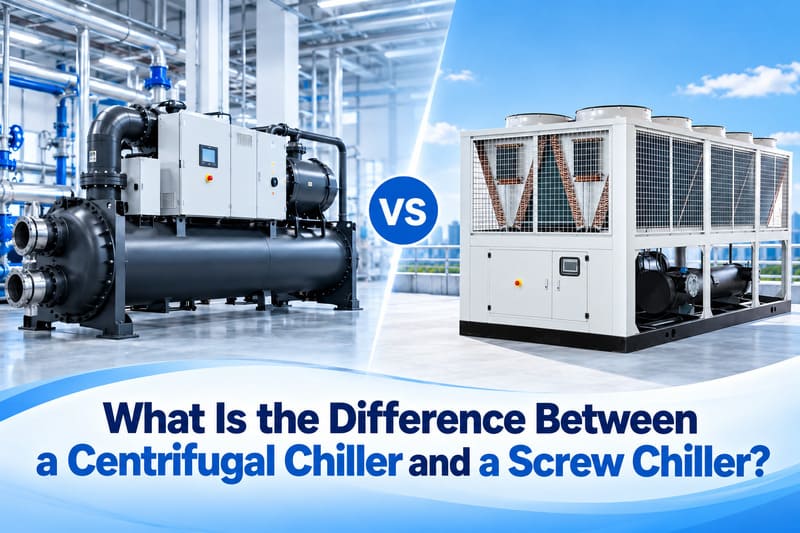
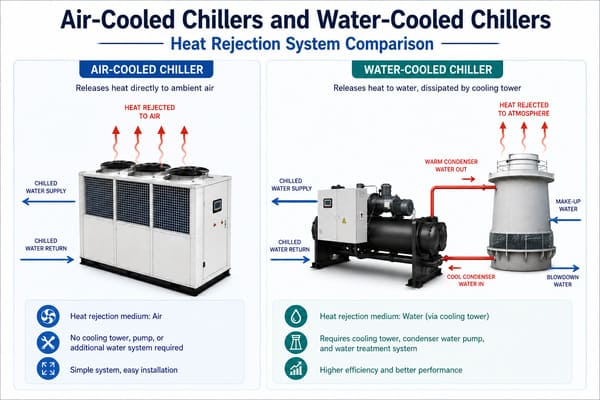
Air-cooled chillers reject condenser heat directly to outdoor air through condenser coils and fans. Water-cooled chillers reject heat through condenser water, which normally flows between the chiller and a cooling tower. The water-cooled arrangement usually includes pumps, piping, filtration, chemical treatment, and controls.
Air-cooled chiller operation
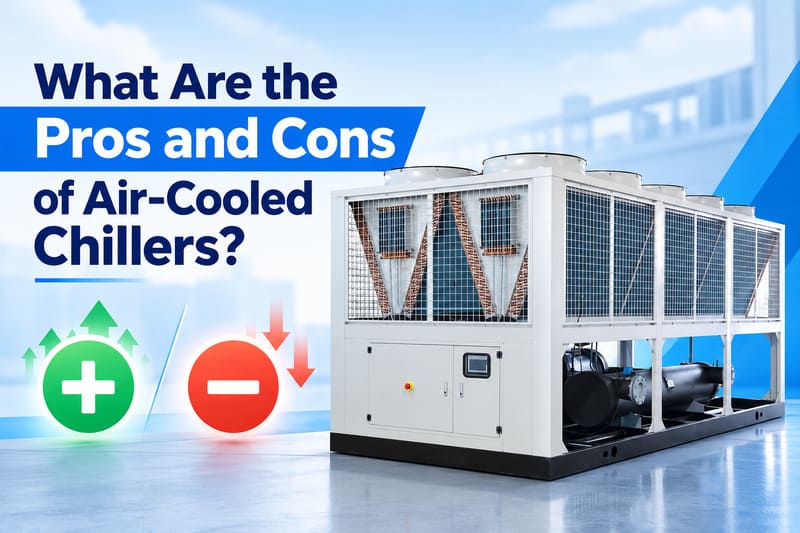
An air-cooled chiller typically includes:
- Refrigerant compressors
- Evaporators
- Air-cooled condenser coils
- Axial or centrifugal fans
- Expansion devices
- Water pumps and controls, depending on the package design
The condenser fans move ambient air across the coils. The refrigerant releases heat into that air, and the heated air leaves the unit. This design does not require a cooling tower or condenser-water loop.
I often consider air-cooled chillers for factories that lack reliable water infrastructure. They can also suit smaller facilities, temporary production areas, and sites where installation simplicity is important. However, high ambient temperatures can reduce condensing performance and increase compressor workload.1 Dust, oil mist, and blocked coils can create similar problems.
Water-cooled chiller operation
A water-cooled system normally includes:
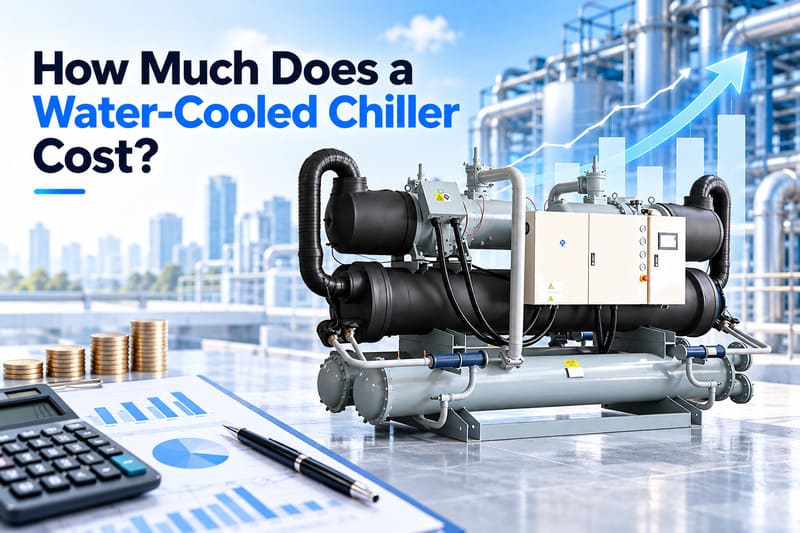
- Water-cooled chiller
- Cooling tower
- Condenser-water pumps
- Chilled-water pumps
- Expansion tanks and valves
- Water-treatment equipment
- Piping, strainers, and control systems
The cooling tower removes heat from the condenser water through evaporation and airflow. This arrangement can achieve favorable condensing conditions when the tower performs correctly. However, the tower and water loop introduce additional equipment and operating responsibilities.
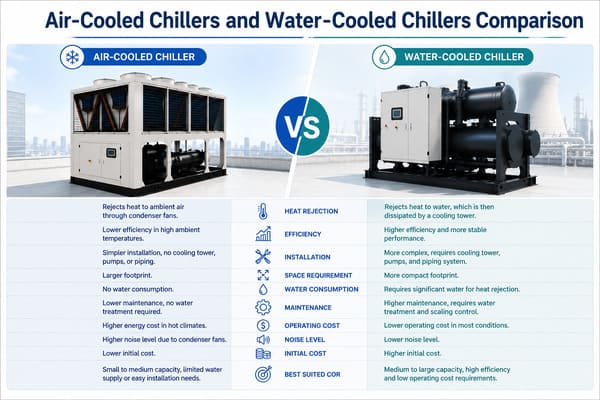
| Evaluation point | Air-cooled chiller | Water-cooled chiller |
|---|---|---|
| Heat-rejection medium | Ambient air | Condenser water |
| Cooling tower | Not required | Normally required |
| Water consumption | Generally low | Requires makeup water and evaporation management |
| Installation | More self-contained | More system infrastructure |
| Outdoor climate effect | Direct and significant | Still significant through tower performance |
| Water treatment | Usually limited to chilled-water side | Important for condenser-water side |
| Maintenance focus | Coils, fans, airflow | Tower, pumps, water quality, tubes, valves |
The two designs are therefore not direct substitutes. I ask whether the site can support the entire water system before I compare chiller efficiency or pricing.
Are Water-Cooled Chillers Always More Energy-Efficient Than Air-Cooled Chillers?
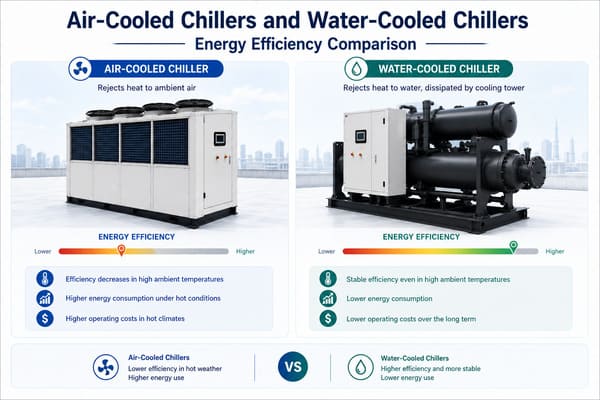
A common procurement assumption is that water-cooled chillers always consume less energy. That conclusion is incomplete because the system must include cooling-tower fans, condenser-water pumps, chilled-water pumps, and water-treatment equipment. I compare total system power under the actual operating profile rather than relying on one rated efficiency value.
Water-cooled chillers may operate more efficiently in suitable conditions because condenser water can provide a lower condensing temperature than hot outdoor air.2 Air-cooled chillers may be more practical and competitive when the climate is moderate, operating hours are limited, or water-system auxiliary loads and maintenance are significant.
What changes real-world efficiency?
I review several factors before making an energy judgment:
-
Ambient temperature and humidity
High outdoor temperatures can make air-cooled operation more demanding.3 A cooling tower also needs suitable wet-bulb conditions4, so hot and dry climates may perform differently from hot and humid climates. -
Leaving chilled-water temperature
Lower supply-water temperatures generally increase refrigeration lift.5 A process requiring 5°C water should not be evaluated in the same way as a process requiring 12°C water. -
Load profile
A plant that operates continuously at a high load has different priorities from a facility with seasonal or intermittent demand. Part-load compressor control can strongly affect annual consumption.6 -
Auxiliary power
Water-cooled systems use tower fans and condenser-water pumps. Air-cooled units use condenser fans. I include these components when comparing total operating power. -
Water quality and tower condition
Scale, fouling, biological growth, and poor airflow can reduce heat-transfer performance.7 A neglected tower may eliminate the expected efficiency advantage.
A practical lifecycle comparison
I normally ask the project team to compare:
- Chiller input power at required operating conditions
- Pump and fan power
- Expected annual operating hours
- Seasonal ambient conditions
- Cooling-tower approach temperature
- Water, treatment, and discharge costs
- Planned cleaning and inspection intervals
- Energy tariffs and demand charges
- The cost of reduced cooling or unexpected shutdown
I avoid promising a fixed percentage of savings without verified project data. A water-cooled system may be attractive for a large, continuously operating plant with skilled maintenance personnel and reliable water availability. An air-cooled system may create lower total risk for a smaller plant or a location where water is expensive, restricted, or unreliable.
For procurement, I recommend requesting performance data at the actual design conditions. The buyer should also ask whether the quoted efficiency includes pumps, fans, and tower equipment. These details make supplier quotations more comparable.
Which Chiller Is Better for Hot Climates, Limited Space, or Water-Restricted Sites?
Site conditions often determine the shortlist before the buyer compares brands. I have seen technically strong chiller proposals become unsuitable because the plant had no space for a cooling tower, no water-treatment plan, or insufficient airflow around an air-cooled condenser. The best configuration depends on the site’s constraints and the consequences of failure.
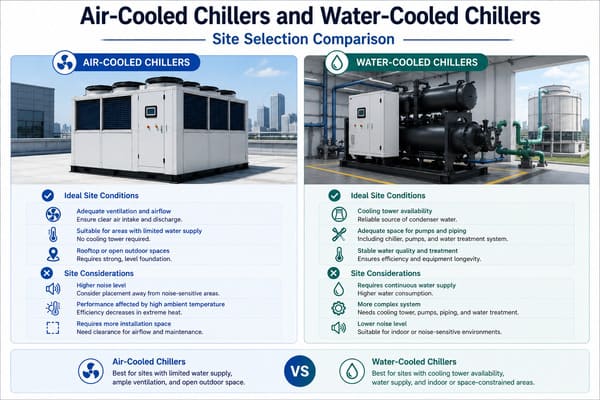
Air-cooled chillers can simplify installation where water is limited. Water-cooled chillers can offer strong performance where a properly maintained cooling-water system is already available. Hot climates require additional design review for either option.
Climate and airflow
Air-cooled equipment needs adequate clearance around condenser coils. Walls, neighboring equipment, recirculated hot air, dust, and solar exposure can reduce heat rejection. In Middle Eastern and African projects, I pay particular attention to design ambient temperature and coil cleanliness because high outdoor temperatures can affect available capacity.
Water-cooled equipment is less directly exposed to dry-bulb temperature, but cooling-tower performance depends on local wet-bulb conditions. High humidity, poor ventilation, or an undersized tower can limit the expected result. The tower also creates a plume, noise, and water-management considerations.
Space and infrastructure
| Site condition | Usually favors air-cooled | Usually favors water-cooled |
|---|---|---|
| Limited water availability | Yes | No |
| Existing cooling tower and pumps | No | Yes |
| Limited mechanical-room space | Often | Depends on system layout |
| Strict outdoor noise limits | Requires review | Requires tower review |
| High dust or oily atmosphere | Requires coil protection | Requires water-system protection |
| Large continuous process load | Depends on study | Often worth evaluating |
| Simple installation priority | Often | Less often |
The table provides a starting point, not a final engineering decision. I also review electrical standards, access for maintenance, lifting routes, drainage, ventilation, and local regulations.
Process risk and redundancy
A plant that loses cooling may lose product, damage equipment, or stop production. I therefore ask:
- What is the value of one hour of downtime?
- Can the process tolerate a temporary temperature increase?
- Is a standby chiller required?
- Can the system isolate one unit for maintenance?
- Is emergency rental capacity available?
- Does the supplier provide remote diagnosis and spare-parts support?
For pharmaceutical, chemical, lithium battery, food, and electronics applications, process stability may matter more than the lowest initial cost. I do not assume that one chiller type is automatically safer. Reliability depends on correct sizing, controls, installation quality, maintenance, and the availability of qualified service.
How Should Buyers Compare Chiller Suppliers and Specifications?
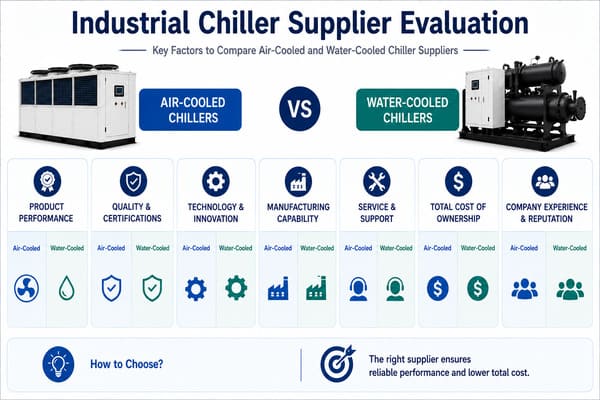
A buyer can select the right chiller type and still receive an unsuitable system if the supplier’s documentation is incomplete. I recommend evaluating the manufacturer’s engineering process, production quality, component configuration, testing records, and after-sales capability. A low quotation does not compensate for unclear responsibilities or difficult service access.
The supplier should demonstrate that the proposed chiller matches the required temperatures, climate, load profile, utilities, and installation conditions. Buyers should compare complete technical offers rather than single capacity or efficiency numbers.
Documents I request during evaluation
I usually ask for:
- Cooling capacity and power at specified design conditions
- Refrigerant type and compressor model
- Evaporator and condenser specifications
- Flow rate, pressure drop, and water temperatures
- Ambient-temperature operating range
- Electrical voltage, frequency, and protection requirements
- Noise data and installation clearances
- Control philosophy and communication protocols
- Factory test and inspection records
- Warranty terms and spare-parts recommendations
- Installation, commissioning, and maintenance instructions
- Applicable certifications and declarations
I treat certifications as documents that buyers should verify against the destination market and exact model. A supplier should explain the scope, validity, and issuing organization instead of using a certificate as a general quality promise.
Manufacturing and service capability
I work with industrial chiller projects where configuration details can affect long-term performance. At IceStar, the stated business context includes more than 20 years of industrial chiller experience, three production bases, an engineering team of more than 200 people, and annual capacity above 6,000 units. I present these figures as company information for buyer verification, not as a guarantee for every application.
I also look at whether the supplier can support:
- Customized cooling capacity and temperature ranges
- High-ambient or low-temperature operation
- Explosion-protection requirements where applicable
- International electrical standards
- Integrated pump and control packages
- Installation guidance and commissioning
- Remote diagnosis and lifecycle service
- Local partners or accessible spare parts
I once reviewed a typical selection discussion where the initial focus was only on the chiller’s nominal capacity. The conversation changed when we mapped the actual process load, summer ambient condition, available floor area, and maintenance team. That exercise showed why supplier selection must follow application analysis.
For EPC teams and system integrators, I recommend using a standardized comparison sheet. The sheet should separate guaranteed performance, design assumptions, optional features, buyer responsibilities, and exclusions. This format reduces disputes during installation and commissioning.
Frequently Asked Questions
What is the main difference between air-cooled chillers and water-cooled chillers?
Air-cooled chillers reject heat through outdoor air and condenser fans. Water-cooled chillers reject heat through condenser water connected to a cooling tower and pump system. The difference affects installation, water consumption, maintenance, efficiency, and site requirements.
Are air-cooled chillers cheaper to install?
Air-cooled chillers often require less supporting infrastructure because they do not normally need a cooling tower, condenser-water pumps, or water-treatment equipment. However, installation cost still depends on capacity, electrical work, ventilation, structural requirements, and local conditions.
Do water-cooled chillers use more maintenance?
Water-cooled systems usually require more maintenance tasks because operators must manage cooling-tower cleanliness, condenser-water quality, pumps, strainers, and heat-transfer surfaces. Air-cooled units still require coil cleaning, fan inspection, refrigerant checks, and control maintenance.
Which chiller is better for a factory with high ambient temperatures?
Neither configuration is automatically better. I evaluate design ambient temperature, local wet-bulb conditions, required chilled-water temperature, airflow, tower capacity, water availability, and operating hours. The supplier should provide performance data at the project’s actual design conditions.
What information should I send to a chiller manufacturer?
I recommend sending the required cooling capacity, process fluid, inlet and outlet temperatures, flow rate, ambient conditions, operating schedule, electrical supply, installation location, altitude, water availability, noise limits, and any special requirements such as low temperature or hazardous-area compliance.
Conclusion
The difference between air-cooled chillers and water-cooled chillers involves the complete cooling system, not only the method of heat rejection. I compare climate, water infrastructure, load profile, space, efficiency, maintenance, service capability, and downtime risk before recommending a direction. I also verify supplier documents, performance assumptions, and application-specific requirements. If you are planning an industrial cooling project, contact IceStar with your operating conditions and process data so our engineering team can help you develop a qualified shortlist and technical configuration.
"Efficiency Improvements of Air-Cooled Chillers Equipped With ...", https://docs.lib.purdue.edu/cgi/viewcontent.cgi?article=1748&context=iracc. A refrigeration-performance study reports that higher ambient temperatures increase air-cooled condenser operating temperatures and refrigeration lift, conditions that can raise compressor work and affect available capacity. Evidence role: mechanism; source type: paper. Supports: The source should show that higher outdoor dry-bulb temperatures raise condensing temperature or pressure and can increase compressor power or reduce capacity.. Scope note: The magnitude of the effect depends on refrigerant, condenser design, control strategy, and rated operating conditions. ↩
"Chillers: General Description and Uses | HVAC Resource Map", https://hvacresourcemap.nlr.gov/laboratories/central-plant/chiller. A comparative energy analysis finds that water-cooled chillers can operate at lower condensing temperatures and lower refrigeration energy use than air-cooled units under favorable tower and ambient conditions. Evidence role: general_support; source type: research. Supports: The source should compare chiller efficiency or condensing conditions for air-cooled and water-cooled systems under defined operating conditions.. Scope note: The finding is conditional and may not hold after including tower, pump, water, maintenance, and climate-related loads. ↩
"Efficiency Improvements of Air-Cooled Chillers Equipped With ...", https://docs.lib.purdue.edu/cgi/viewcontent.cgi?article=1748&context=iracc. An HVAC engineering standard explains that air-cooled chiller performance and equipment selection must account for design outdoor temperature because condenser heat rejection changes with ambient conditions. Evidence role: general_support; source type: institution. Supports: The source should explain how design outdoor temperature affects air-cooled condenser selection, capacity, efficiency, or operating limits.. Scope note: This supports the need for design review, not a universal ranking of air-cooled and water-cooled systems in hot climates. ↩
"Free Cooling Tower Water Treatment Technology", http://betterbuildingssolutioncenter.energy.gov/sites/default/files/DWT_NREL_LA_study.pdf. An HVAC engineering source explains that the ambient wet-bulb temperature constrains the lowest practical cooling-water temperature obtainable from an evaporative cooling tower. Evidence role: mechanism; source type: education. Supports: The source should define the relationship between ambient wet-bulb temperature, tower approach, and achievable condenser-water temperature.. Scope note: Wet-bulb temperature is not the only determinant; tower size, airflow, water flow, fouling, and control settings also affect performance. ↩
"Improved energy performance of air cooled centrifugal ...", https://www.sciencedirect.com/science/article/abs/pii/S019689040700413X. A refrigeration analysis shows that lowering the evaporating or chilled-water temperature increases the temperature lift between the evaporator and condenser, generally increasing compressor work. Evidence role: mechanism; source type: paper. Supports: The source should relate lower evaporator or leaving-chilled-water temperatures to increased temperature lift and compressor energy demand.. Scope note: The exact energy effect depends on compressor type, refrigerant, condenser conditions, heat-exchanger design, and control strategy. ↩
"Purchasing Energy-Efficient Electric Chillers", https://www.energy.gov/cmei/femp/purchasing-energy-efficient-electric-chillers. A government efficiency guide notes that chillers commonly operate at part load and that compressor modulation, sequencing, and controls can significantly affect seasonal energy consumption. Evidence role: general_support; source type: government. Supports: The source should explain why chiller efficiency ratings and annual energy use depend substantially on part-load operation and controls.. Scope note: The source supports the general importance of part-load behavior but does not predict annual savings for a particular plant. ↩
"Controlling Legionella in Cooling Towers", https://www.cdc.gov/control-legionella/php/toolkit/cooling-towers-module.html. A cooling-tower study reports that mineral deposition, surface fouling, microbial accumulation, and airflow limitations can increase thermal resistance or reduce effective heat rejection. Evidence role: mechanism; source type: research. Supports: The source should document how deposits, fouling, microbial growth, or restricted airflow reduce cooling-tower heat transfer and capacity.. Scope note: The extent of degradation depends on water chemistry, tower design, maintenance frequency, and the type and location of the impairment. ↩