When I discuss air-cooled chiller cost, I often find that buyers want one number before they have defined the application. That creates a problem because the same cooling capacity can require very different equipment. If the quotation is based on incomplete information, the buyer may receive an attractive price for a unit that cannot perform reliably on site.
An air-cooled chiller does not have one universal price. The final cost depends on cooling capacity, entering and leaving water temperatures, flow rate, ambient temperature, compressor and control configuration, electrical standard, accessories, delivery scope, and service requirements. I recommend using capacity only for an early budget estimate, then requesting a formal quotation after the operating conditions and supply scope are confirmed.

I have prepared many preliminary budgets and formal quotations for industrial end users, EPC companies, and equipment integrators. In my experience, the most useful question is not simply “What is the price?” It is “What specification and scope does this price represent?” The sections below explain how I connect the application to a comparable purchasing decision.
Why does air-cooled chiller cost vary so much?
Many buyers start with nominal cooling capacity because it is easy to compare. However, capacity alone does not describe the working conditions. A chiller selected for a moderate indoor process may need a different compressor, condenser, fan, and control strategy from a similar-capacity unit operating outdoors in a hot region.
Air-cooled chiller cost varies because suppliers price a complete operating solution, not only a refrigeration capacity. Water temperatures, ambient conditions, refrigerant circuit design, energy requirements, electrical standards, accessories, and project services can all change the equipment configuration and final quotation.
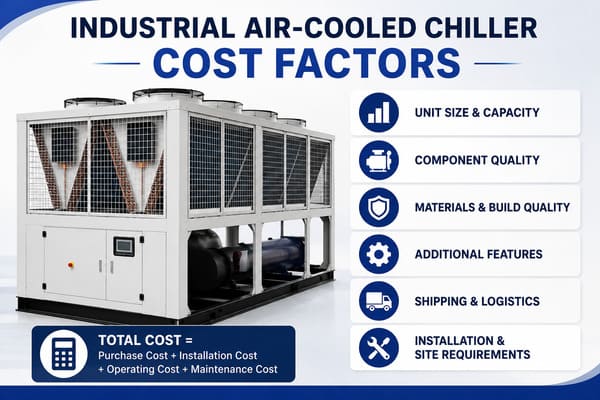
Cooling conditions influence the equipment selection
I normally ask for the following information before preparing a serious quotation:
- Required cooling capacity or process heat load
- Entering and leaving water or glycol temperature
- Required flow rate and allowable pressure drop
- Maximum ambient temperature
- Operating hours and annual duty cycle
- Load variation and process start-up conditions
- Site altitude and installation environment
- Power supply, frequency, and voltage
- Required refrigerant or environmental specification
- Delivery location and expected commissioning scope
A unit producing chilled water at a conventional temperature may not use the same design as a low-temperature chiller. Lower leaving-water temperatures can increase compression requirements and may affect compressor selection, insulation, controls, and system protection. A glycol application can also require different flow and heat-exchanger considerations.1
Maximum ambient temperature is especially important for an air-cooled system. When outdoor air becomes hotter, the condenser must reject heat against a smaller temperature difference.2 The supplier may need larger condenser coils, different fans, special controls, or high-ambient optimization. These changes can increase initial equipment cost, but they may reduce the risk of high-pressure trips and unstable operation.
Configuration and component choices affect quotation value
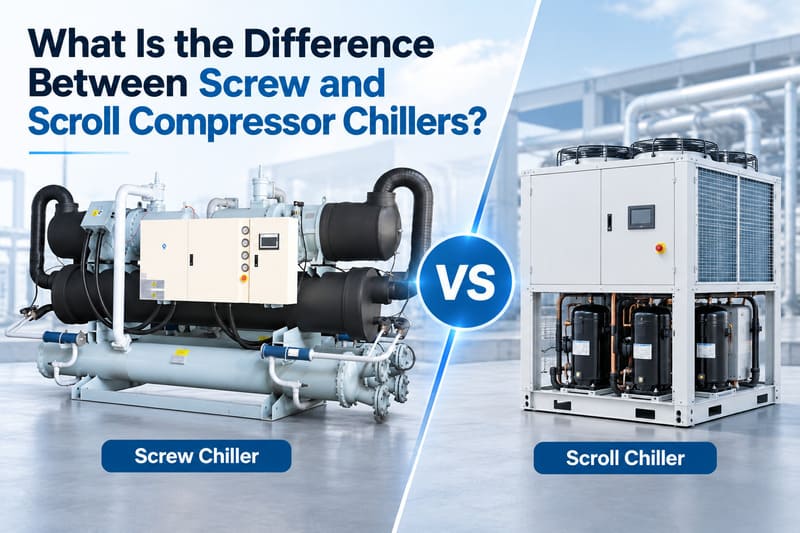
I also compare the proposed refrigeration architecture. A scroll chiller may be appropriate for certain smaller or modular applications, while a screw chiller may suit larger industrial loads or projects that require stronger capacity control.3 The correct choice depends on the load profile and operating conditions, not only on the equipment label.
The quotation may change according to:
| Cost factor | Possible effect on the quotation |
|---|---|
| Compressor type and brand | Changes efficiency, service access, and capital cost |
| Heat-exchanger design | Affects performance, fouling tolerance, and pressure drop |
| Number of refrigeration circuits | Influences redundancy and part-load operation |
| PLC and controls | Adds monitoring, communication, and integration functions |
| Electrical components | Depends on voltage, standards, enclosure, and protection |
| Low-temperature package | May require additional controls and protection |
| Stainless-steel or special materials | Increases cost for corrosive or hygienic applications |
| Noise or vibration requirements | May require acoustic treatment or structural changes |
| Factory testing | Adds inspection, documentation, and witness-test scope |
| Installation and commissioning | Expands the project price beyond equipment supply |
I have seen preliminary discussions change significantly when a customer added a high ambient temperature, a special power standard, or a request for remote monitoring. None of these changes was unusual. Each requirement simply moved the quotation from a basic equipment estimate toward a more complete engineered package.
Budget estimate and formal quotation are different
I use a capacity and target budget to discuss feasibility at an early stage. I do not treat that discussion as a final commercial offer. A formal quotation should identify the design basis, exclusions, delivery terms, warranty, documentation, and service responsibilities.
Buyers should also separate:
- Equipment purchase price — the chiller and stated accessories.
- Delivered project cost — freight, customs, unloading, installation, piping, pumps, and electrical work.
- Total cost of ownership — energy, maintenance, spare parts, downtime exposure, and expected service life.
A low equipment price may not represent a low project cost.4 I recommend that buyers ask every supplier to quote against the same technical schedule. This approach reduces misunderstandings and makes differences visible.
How can I compare air-cooled chiller cost quotations fairly?
A low total can look attractive when quotations use different scopes. One supplier may include a pump, controller, flow switch, and commissioning support, while another may exclude them. I have learned that a reliable comparison requires a line-by-line review of performance, components, documents, and responsibilities.
I can compare air-cooled chiller cost fairly only when competing suppliers use the same design conditions and scope of supply. I should check performance, component configuration, accessories, testing, delivery, warranty, commissioning, and technical support before deciding which quotation offers better value.
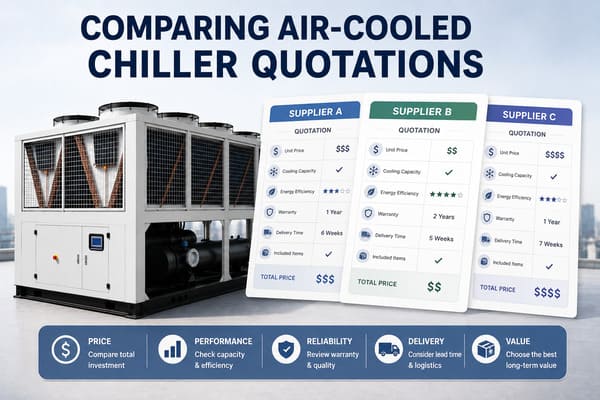
I start with the technical schedule
I first confirm whether each supplier has used the same basis. A quotation with a larger nominal capacity is not automatically better if it uses different water temperatures or ambient conditions.
I normally place these items in a comparison sheet:
- Cooling capacity at stated entering and leaving temperatures
- Flow rate and pressure-drop assumptions
- Maximum ambient temperature
- Compressor quantity, type, and brand
- Condenser and evaporator information
- Refrigerant and oil specification
- Part-load control method
- Electrical voltage, frequency, and protection
- Controller functions and communication protocol
- Noise data and physical dimensions
- Factory test requirements
- Warranty period and exclusions
I also check whether the supplier has clearly stated tolerances. Cooling capacity, power input, and efficiency should be connected to defined test conditions.5 Buyers should avoid comparing a guaranteed factory value with an informal estimated value.
I review the scope of supply
The equipment price may or may not include the following items:
| Scope item | Questions I recommend asking |
|---|---|
| Water pump | Is the pump included, and what head and flow does it provide? |
| Buffer tank | Is a tank required for load stability or minimum water volume? |
| Filters and valves | Are strainers, isolation valves, and balancing devices included? |
| Control integration | Can the chiller communicate with the plant or BMS system? |
| Remote support | Does the supplier provide remote diagnosis after commissioning? |
| Commissioning | Is site attendance included or quoted separately? |
| Documentation | Are wiring diagrams, manuals, test records, and certificates supplied? |
| Spare parts | Are start-up spares or recommended maintenance parts available? |
| Freight and packaging | Who manages transport, insurance, customs, and unloading? |
This review often explains why two apparently similar quotations have different totals. I do not regard exclusions as automatically negative. A local EPC contractor may already provide pumps and piping. However, the exclusion must be visible so that the buyer can calculate the complete project requirement.
I consider operating risk and total cost
Industrial buyers usually care about production continuity, not just initial purchase price. A chiller that stops during a plastic extrusion, chemical, pharmaceutical, or battery process can create costs that exceed the original equipment difference. I therefore examine reliability-related features alongside the purchase price.
Useful questions include:
- Does the system have multiple refrigeration circuits?
- Can it continue operating at reduced capacity after one circuit stops?
- Does the control system manage fluctuating process loads?
- Are service parts available in the destination region?
- Can the supplier provide remote troubleshooting?
- Does the design suit the local ambient temperature?
- Does the warranty define response time and customer responsibilities?
I also ask whether the proposed unit has been adapted for the site rather than selected from a generic catalogue. In many projects, a modest design adjustment can be more valuable than a small discount. Qualified engineers should verify the final selection, especially for hazardous, low-temperature, hygienic, or highly critical applications.
How specification clarity changes a quotation
I cannot publish customer names, project identities, or unsupported market averages. I can describe a common quotation pattern from my work. A buyer may initially provide only a required capacity and a target budget. I may then prepare a preliminary configuration for discussion.
Later, the buyer may confirm that:
- The unit will operate outdoors in a high-temperature region.
- The leaving water temperature must remain below the initial assumption.
- The site uses a nonstandard power supply.
- The process load changes rapidly during production.
- The buyer requires remote monitoring and commissioning support.
At that point, I may need to revise the compressor selection, condenser design, control panel, electrical components, and service scope. The revised price is not simply a markup. It reflects a more accurate solution to a clearer application.
For this reason, I encourage buyers to provide a short application data sheet at the beginning. The data sheet helps suppliers identify risks early and gives procurement teams a defensible basis for comparing offers.
Frequently Asked Questions
Can I estimate air-cooled chiller cost from cooling capacity alone?
I can use cooling capacity for a rough budget discussion, but I should not use it for supplier selection. Water temperatures, ambient conditions, flow, power supply, compressor type, accessories, delivery, and commissioning can all change the final price.
Is an air-cooled chiller cheaper than a water-cooled chiller?
An air-cooled chiller may reduce the need for cooling towers, condenser-water pumps, and water-treatment equipment. However, the best economic choice depends on climate, operating hours, energy prices, available space, maintenance resources, and required efficiency. I recommend comparing total project cost and lifecycle cost.
What information should I send when requesting a quotation?
I should provide the cooling load, entering and leaving water temperatures, flow rate, maximum ambient temperature, operating schedule, site location, power supply, cooling medium, installation conditions, and required delivery scope. I should also identify special requirements such as low temperature, redundancy, explosion protection, or communication protocols.
Does a cheaper quotation always mean lower value?
No. A cheaper quotation may exclude pumps, controls, testing, commissioning, spare parts, or technical support. I should compare the complete technical and commercial scope before judging value. I should also review expected energy use, maintenance requirements, and supplier response capability.
Should I choose a standard unit or a customized chiller?
I should choose a standard unit when its operating envelope matches the process and site conditions. I may need customization for high ambient operation, low-temperature fluid, unusual voltage, special materials, hazardous areas, or integration requirements. A qualified engineer should confirm the final design.
Conclusion
The most accurate way to evaluate air-cooled chiller cost is to treat price as the result of a defined specification and supply scope. I recommend separating early budget estimates from formal quotations, checking the same operating conditions across suppliers, and reviewing components, accessories, testing, delivery, warranty, and service. At IceStar, I support industrial users, EPC companies, and integrators with application review, customized design, quotation preparation, commissioning guidance, and lifecycle service. Contact our engineering team with your project data for a comparable evaluation.
"[PDF] Transport Coefficients of Ice Slurry in Plate Heat Exchanger", https://docs.lib.purdue.edu/cgi/viewcontent.cgi?article=1645&context=iracc. Thermophysical-property data for glycol-water mixtures show that glycol concentration changes viscosity and heat capacity, affecting heat transfer, pressure drop, and the flow conditions used in chilled-fluid system design. Evidence role: mechanism; source type: paper. Supports: Heat-transfer and fluid-property research should support how glycol concentration changes viscosity, heat capacity, heat-transfer coefficients, and pressure drop.. Scope note: The magnitude and direction of the required equipment changes depend on glycol type, concentration, temperature, piping design, and the selected heat exchanger. ↩
"A Survey of Alternate Methods for Cooling Condenser ...", https://nepis.epa.gov/Exe/ZyPURL.cgi?Dockey=910239X3.TXT. Heat-transfer and refrigeration texts describe the condenser temperature difference as a principal driver of heat rejection; as outdoor temperature rises, maintaining the required heat rejection generally requires a higher condensing temperature or greater condenser capacity. Evidence role: mechanism; source type: education. Supports: Thermodynamics and heat-transfer references should support the relationship between ambient temperature, condensing temperature, and the temperature difference driving condenser heat rejection.. Scope note: The practical response depends on condenser geometry, fan control, refrigerant, and operating load, so the principle does not by itself prove that every installation requires larger coils or different fans. ↩
""Comparative Studies of Scroll and Rotary Compressors for US Market ...", https://docs.lib.purdue.edu/icec/2664/. Comparative compressor literature generally distinguishes scroll and screw technologies by capacity range, modulation approach, and operating application, supporting their use in different chiller configurations. Evidence role: general_support; source type: paper. Supports: A comparative engineering source should describe typical application ranges and capacity-control characteristics of scroll and screw compressors.. Scope note: The distinction is not absolute: modern product designs overlap in capacity and control capability, so compressor type alone cannot determine suitability. ↩
"[PDF] LIFE CYCLE COST ANALYSIS GUIDELINES", https://dial.iowa.gov/media/7432/download?inline. Public-sector lifecycle-costing guidance treats acquisition, installation, operation, maintenance, and disposal or replacement expenses as components of a cost comparison, supporting the distinction between equipment price and total project cost. Evidence role: general_support; source type: government. Supports: Lifecycle-cost guidance should support evaluating acquisition, installation, operation, maintenance, and replacement costs rather than purchase price alone.. Scope note: Lifecycle-cost guidance provides an evaluation framework rather than evidence that one particular chiller quotation will be economically superior. ↩
"Purchasing Energy-Efficient Electric Chillers", https://www.energy.gov/cmei/femp/purchasing-energy-efficient-electric-chillers. Chiller rating standards specify reference test conditions and procedures for reporting cooling capacity, power input, and efficiency, demonstrating why performance figures must be compared on a common test basis. Evidence role: definition; source type: institution. Supports: A recognized chiller-rating standard should define the test conditions and reporting basis for capacity, input power, and efficiency.. Scope note: Standardized ratings are not direct predictions of every installation's field performance, which varies with weather, fouling, controls, and operating load. ↩