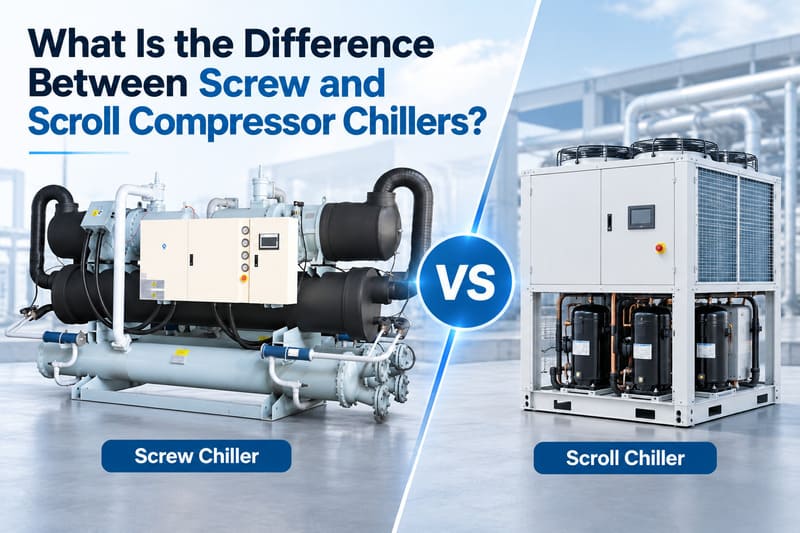
A screw chiller and an air-cooled chiller are often compared as if they were opposite choices. I have seen this terminology create confusion during industrial project discussions. The problem is that one term describes the compressor, while the other describes heat rejection. Understanding this distinction helps me evaluate capacity, ambient conditions, infrastructure, and lifecycle risk more accurately.
A screw chiller is defined by its compressor type, while an air-cooled chiller is defined by its condenser heat-rejection method.1 Therefore, they are not mutually exclusive: one unit can be an air-cooled screw chiller. A screw compressor may also be used in a water-cooled chiller. The correct selection depends on process load, ambient temperature, operating hours, leaving-water temperature, installation conditions, energy requirements, and maintenance priorities.
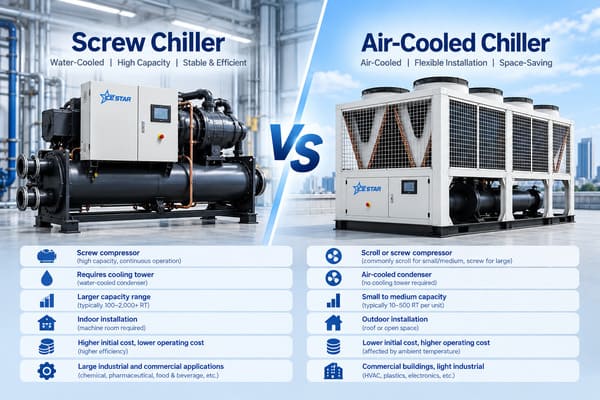
I use this distinction as the starting point when I evaluate customer operating conditions and configure industrial cooling systems. The real question is not simply which technology is better. The more useful question is which compressor and condenser arrangement fits the production process, site infrastructure, and acceptable operating risk.
What Does a Screw Chiller Describe?
Many buyers use “screw chiller” to describe a complete machine, but I first treat it as a compressor classification. This matters because the same screw compressor can appear in different chiller configurations. A buyer who compares categories incorrectly may request unsuitable equipment or overlook important system requirements.
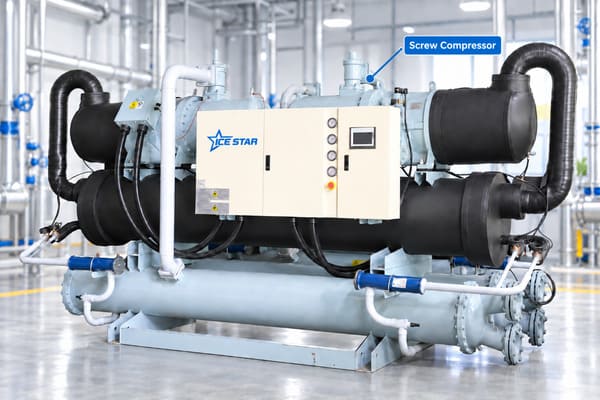
A screw chiller uses one or more rotary screw compressors to compress refrigerant continuously. The compressor type generally suits medium-to-large industrial cooling systems and applications that require stable operation over extended periods. The final machine may be air-cooled or water-cooled, depending on the condenser design.
Understanding the compressor classification
A screw compressor uses intermeshing rotors to compress refrigerant.2 Unlike a reciprocating compressor, it does not rely on piston movement. In procurement discussions, I normally examine the following points:
- Compressor brand and model
- Refrigerant type
- Part-load control method
- Number of compressor circuits
- Required leaving-water temperature
- Oil management and service access
- Availability of replacement parts
- Control-system compatibility
A screw compressor does not automatically define whether the chiller needs cooling towers or condenser-water pumps. The condenser arrangement determines that requirement.
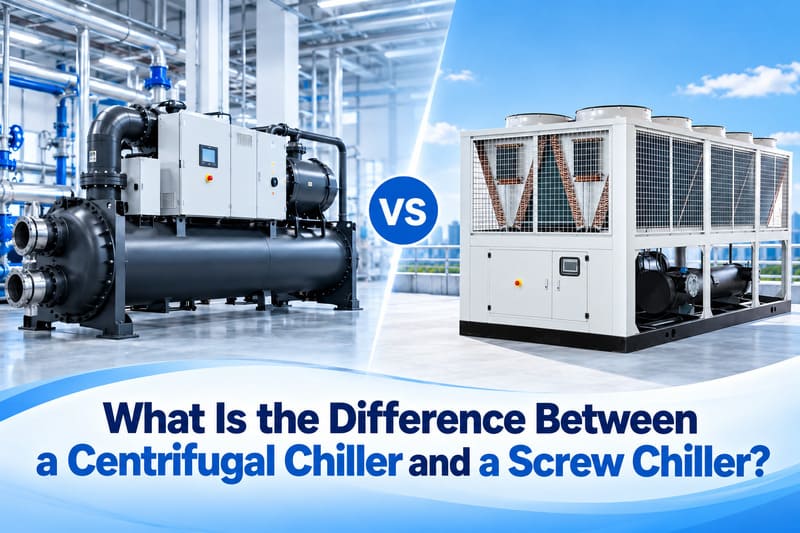
For example, a water-cooled screw chiller transfers heat from the refrigerant to condenser water. The system normally includes a cooling tower, condenser-water pump, water treatment, valves, and related controls. An air-cooled screw chiller transfers heat directly to outdoor air through condenser coils and fans.
This distinction affects both equipment selection and site planning. During my project reviews, I often ask customers whether they have reliable water resources, existing cooling-tower infrastructure, sufficient outdoor airflow, and trained maintenance personnel. These questions can be more important than the word “screw” in the product description.
Screw chiller and other compressor options
Industrial buyers may also compare screw compressors with scroll or centrifugal compressors. Each option has a suitable operating range, and the best choice depends on capacity, load pattern, temperature requirements, and redundancy expectations.
| Selection factor | Screw compressor | Scroll compressor | Centrifugal compressor |
|---|---|---|---|
| Typical application | Industrial and process cooling | Smaller modular systems | Larger water-cooled systems |
| Load control | Often suitable for variable loads | Usually staged or modular | Often efficient at suitable high loads |
| System scale | Medium to large | Small to medium | Large |
| Main review point | Part-load behavior and service | Number of modules | Operating range and water system |
I avoid presenting one compressor type as universally superior. I instead compare the complete system, including controls, pumps, fans, heat exchangers, and operating conditions.
How Does an Air-Cooled Screw Chiller Differ From a Water-Cooled Screw Chiller?
A buyer may already prefer a screw compressor but still need to choose the condenser method. This choice influences installation, water consumption, maintenance, noise, and high-ambient performance. I normally review the site before making a recommendation.
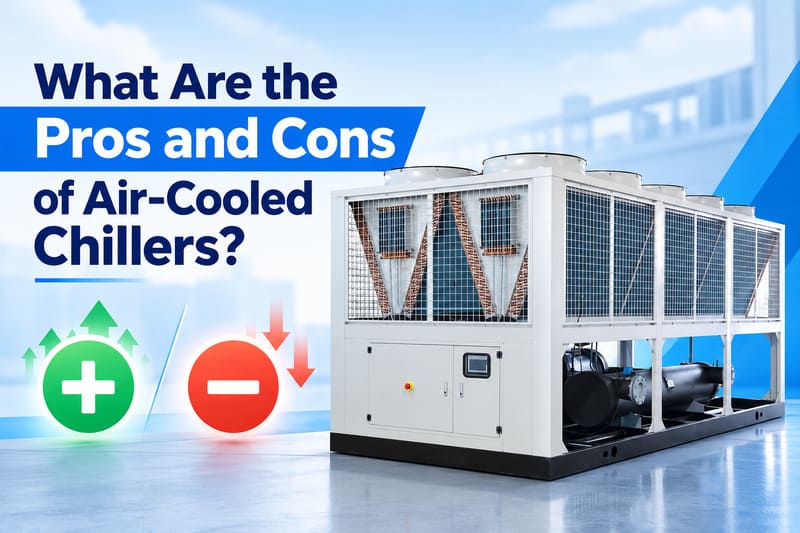
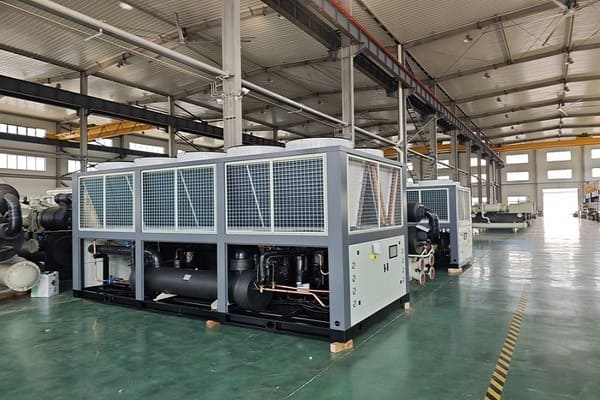
An air-cooled screw chiller rejects heat through refrigerant-to-air condenser coils and fans, while a water-cooled screw chiller rejects heat through condenser water and usually requires a cooling tower. Air-cooled systems can simplify installation and reduce water-system requirements.3 Water-cooled systems may suit facilities with established cooling-tower infrastructure, but they require water management and additional equipment.
Air-cooled configuration
An air-cooled screw chiller usually includes:
- Screw compressor
- Air-cooled condenser coils
- Axial fans
- Evaporator
- Expansion devices
- Control panel
- Water pump or pump package, when specified
The unit rejects heat directly to ambient air. I often consider this arrangement where a customer wants a packaged system, has limited water availability, or does not want to build a cooling-tower system. The installation can be simpler because the project may avoid condenser-water piping, tower basins, chemical dosing, and tower maintenance.
However, outdoor air temperature directly affects the condenser operating condition. A high-temperature site can increase condensing pressure and influence available cooling capacity, power consumption, and operating envelope. I therefore request design ambient temperature rather than relying only on average weather data.
Water-cooled configuration
A water-cooled screw chiller normally connects to a cooling tower or another heat-rejection system. I review:
- Cooling-tower capacity
- Condenser-water flow
- Water temperature range
- Water quality and treatment
- Pump energy
- Fouling and scaling risk
- Tower location and plume restrictions
- Maintenance access
The water system can create additional capital and maintenance requirements. At the same time, an existing facility may already have the necessary infrastructure and operating team. In that situation, a water-cooled arrangement may be practical.
A basic comparison
| Factor | Air-cooled screw chiller | Water-cooled screw chiller |
|---|---|---|
| Cooling tower | Usually not required | Usually required |
| Water consumption | Lower at the chiller | Tower water consumption applies |
| Installation | Often simpler | More system components |
| Ambient sensitivity | Directly exposed to outdoor air | Depends on condenser-water conditions |
| Maintenance | Coil and fan cleaning | Water treatment, tubes, tower, and pumps |
| Site suitability | Limited water or packaged installation | Existing central cooling-water system |
I do not use this table as a final selection tool. A detailed review should include local climate, annual running hours, energy tariffs, water costs, and production continuity requirements.
How Should Buyers Choose Between Screw Chiller Configurations?
A low purchase price or high nominal cooling capacity can appear attractive, but neither figure proves that a chiller suits a process. I have found that many procurement problems begin when the buyer sends only a target capacity and receives a quotation without a complete operating profile.
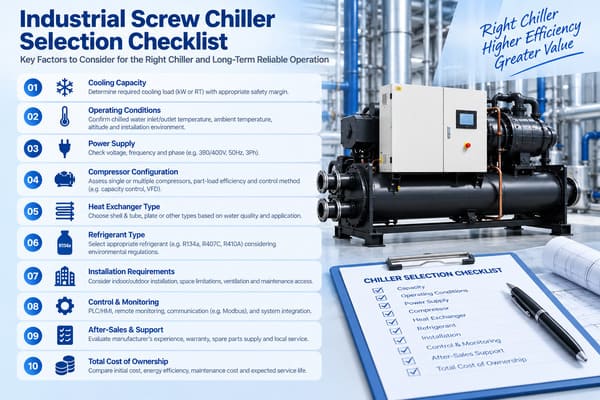
Buyers should select a screw chiller configuration by reviewing the actual heat load, leaving-water temperature, ambient conditions, annual operating hours, load variation, infrastructure, energy cost, maintenance capability, and consequences of downtime. The equipment should then be checked through a project-specific heat-load calculation and system design review.
Start with the process conditions
I normally request the following information before comparing suppliers:
- Required cooling capacity and safety margin
- Fluid type and concentration
- Entering and leaving fluid temperature
- Flow rate and allowable pressure drop
- Minimum and maximum process load
- Daily and seasonal operating pattern
- Design ambient temperature
- Available electrical supply
- Indoor or outdoor installation
- Required redundancy
- Site elevation and environmental conditions
The required leaving-water temperature is especially important. A system designed for standard chilled water may not suit a low-temperature process. Lower leaving-water temperatures can affect refrigerant selection, compressor operating conditions, evaporator design, and overall energy use.4
Consider lifecycle cost
I encourage buyers to compare total cost of ownership rather than only the initial quotation. A useful review includes:
| Cost area | Questions I ask |
|---|---|
| Purchase | Does the quotation include pumps, controls, filters, and accessories? |
| Installation | Are foundations, piping, towers, and electrical work included? |
| Energy | What is the expected operating profile at full and part load? |
| Water | Will treatment, makeup water, and discharge costs apply? |
| Maintenance | Are parts and qualified technicians available locally? |
| Downtime | What happens if the main compressor or control system stops? |
| Expansion | Can the system support future production increases? |
I also check whether supplier documentation clearly states test conditions, capacity tolerance, electrical requirements, sound data, and control functions. Buyers should verify certifications, laboratory documents, and compliance claims directly against the project requirements. A certificate should not replace engineering review.
Match the configuration to the site
An air-cooled screw chiller may be practical for a site with limited water, limited mechanical-room space, or a preference for packaged installation. A water-cooled screw chiller may fit a facility that already operates cooling towers and has experienced water-treatment personnel.
For high-ambient locations, such as parts of the Middle East or Africa, I ask suppliers to confirm the design condition and expected operating envelope. For continuous processes, I also review duty and standby arrangements, multiple circuits, alarm functions, spare-parts planning, and remote technical support.
IceStar Energy Technology can configure air-cooled, water-cooled, low-temperature, variable-frequency, explosion-proof, and other industrial chiller solutions according to the process. However, I would still treat any proposal as a starting point. Final equipment selection requires confirmed operating data, heat-load calculations, and qualified technical evaluation.
Frequently Asked Questions
Is a screw chiller always air-cooled?
No. “Screw” describes the compressor, not the condenser. A screw chiller can use an air-cooled condenser or a water-cooled condenser. Buyers should specify both dimensions when requesting quotations, such as “air-cooled screw chiller” or “water-cooled screw chiller.”
Is an air-cooled chiller always a screw chiller?
No. An air-cooled chiller may use screw, scroll, or other compressor technologies. The correct comparison should identify the compressor type, condenser method, cooling capacity, refrigerant, and operating conditions.
Which configuration is better for high ambient temperature?
The answer depends on the actual design ambient temperature, required leaving-water temperature, load profile, and site infrastructure. I recommend asking suppliers for performance data at the project’s real conditions rather than relying on standard catalog ratings.
Does an air-cooled screw chiller need a cooling tower?
Normally, no. An air-cooled screw chiller rejects heat through outdoor air and condenser fans. It may still require chilled-water pumps, expansion tanks, filters, and other hydronic components, depending on the system design.
What information should I send to a chiller supplier?
I recommend sending process fluid details, flow rate, entering and leaving temperatures, required capacity, ambient conditions, operating hours, electrical supply, installation location, altitude, redundancy requirements, and any certification or hazardous-area requirements.
Conclusion
The main difference between a screw chiller and an air-cooled chiller is that the terms describe different selection dimensions. “Screw” identifies the compressor, while “air-cooled” identifies the heat-rejection method. I recommend comparing the complete configuration against process load, climate, infrastructure, energy use, maintenance resources, and downtime risk. Contact IceStar Energy Technology with your operating data for a project-specific configuration review and industrial cooling proposal.
"Chiller - Wikipedia", https://en.wikipedia.org/wiki/Chiller. HVAC engineering references distinguish compressor configuration from condenser heat-rejection method, allowing a chiller to be described simultaneously by both characteristics. Evidence role: definition; source type: education. Supports: A technical HVAC source should define chillers by compressor technology and by the method used to reject condenser heat.. Scope note: This supports the terminology and classification, not the suitability of any particular configuration for a project. ↩
"Development and Optimization of Screw Engine Rotor Pairs ...", https://docs.lib.purdue.edu/cgi/viewcontent.cgi?article=1955&context=icec. Mechanical engineering references identify intermeshing helical rotors as the principal elements that transport and compress gas in a screw compressor. Evidence role: mechanism; source type: encyclopedia. Supports: An authoritative mechanical engineering reference should identify intermeshing helical rotors as the defining compression elements of a twin-screw compressor.. Scope note: The description is most directly applicable to twin-screw designs; individual compressor architectures can vary. ↩
"Integrated Chiller System Reduce Building Operation and ...", https://digitalcommons.unl.edu/cgi/viewcontent.cgi?article=1028&context=archengfacpub. Comparative HVAC assessments generally find that air-cooled chiller plants can avoid cooling towers and condenser-water pumps, reducing water-system infrastructure relative to typical water-cooled plants. Evidence role: general_support; source type: research. Supports: A comparative HVAC assessment should document the absence or reduction of cooling-tower and condenser-water components in typical air-cooled installations.. Scope note: Installation simplicity depends on the complete plant design, site constraints, and any required chilled-water pumping or auxiliary equipment. ↩
"Advanced Control of Vapor Compression Liquid Chillers", https://repository.rit.edu/cgi/viewcontent.cgi?params=/context/theses/article/12636/&path_info=SAwadThesis5_2023.pdf. Refrigeration analyses indicate that lower leaving-water requirements generally lower evaporating temperature or increase temperature lift, thereby affecting compressor operating conditions, heat-exchanger design, refrigerant suitability, and energy use. Evidence role: mechanism; source type: paper. Supports: A refrigeration study should explain how lower evaporating temperatures and greater temperature lift affect compressor operation, evaporator selection, refrigerant suitability, and energy demand.. Scope note: The effect is not uniform across all systems because control strategy, refrigerant properties, heat-exchanger design, and load conditions also determine performance. ↩