The pros and cons of water-cooled chillers matter most when I evaluate a factory with long operating hours, high ambient temperatures, or limited outdoor space. A water-cooled system can appear efficient and compact, but poor water quality, weak maintenance, or missing cooling-tower infrastructure can create costly operational risks. I reduce those risks by assessing the complete system before recommending it.
The pros and cons of water-cooled chillers depend on site conditions. These chillers can offer stable performance, compact installation, and good efficiency when a reliable cooling tower, pumps, water treatment, and maintenance team are available. However, they require more equipment, water management, and technical control than air-cooled systems. I recommend comparing lifecycle cost, operating conditions, installation limits, and downtime risk before selecting either option.
I have found that buyers often compare only the chiller package and quoted cooling capacity. That approach can hide the real cost and risk. The following evaluation focuses on the complete cooling system, including the cooling tower, condenser-water loop, pumps, piping, water treatment, and service requirements.
What Are the Main Pros and Cons of Water-Cooled Chillers?
A water-cooled chiller can provide strong performance for continuous industrial cooling, but I never treat it as a standalone machine. Its advantages usually come from the condenser-water system and operating environment. Its disadvantages also come from that same system.
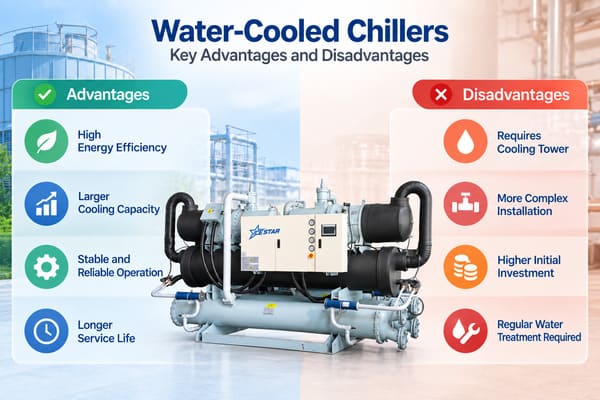
In practical terms, I usually see these main advantages:
- Potentially better performance in high ambient conditions
- Compact chiller installation compared with an equivalent air-cooled arrangement
- Stable heat rejection when the cooling tower is correctly selected
- Suitability for continuous production and large cooling loads
- More flexibility for indoor equipment-room installation
I also identify several important disadvantages:
- Higher system complexity
- Cooling-tower, pump, and water-treatment requirements
- Regular cleaning and maintenance
- Risk of corrosion, scaling, biological growth, or water shortage
- Greater consequences if condenser-water circulation fails
Why can water cooling help?
I often consider water-cooled chillers for plants that operate around the clock or face high outdoor temperatures. Water transfers heat effectively, and a cooling tower can reject heat without requiring a large air-cooled condenser exposed to the ambient environment. This can support a compact equipment layout.
However, I do not describe water-cooled equipment as automatically more efficient. Actual performance depends on condenser-water temperature, wet-bulb conditions, tower cleanliness, pump energy, water treatment, and part-load operation. A chiller with excellent catalog efficiency can perform poorly if the tower is undersized or the water loop is neglected.
Why can water cooling create risk?
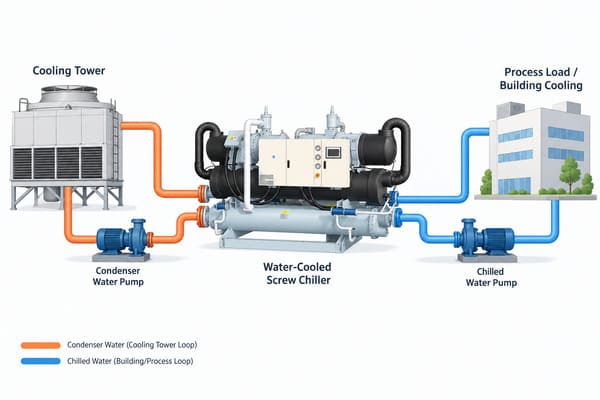
The system normally includes more components than an air-cooled package. A typical arrangement may contain:
- Water-cooled chiller
- Cooling tower
- Condenser-water pumps
- Chilled-water pumps
- Expansion and control components
- Water-treatment equipment
- Piping, valves, strainers, and sensors
Each component requires correct sizing and maintenance. During system-design discussions, I ask who will maintain the tower, who will test water quality, and what happens if the condenser-water pump stops. These questions often matter more than a small difference in the initial chiller quotation.
Can Water-Cooled Chillers Reduce Energy Use in Industrial Plants?
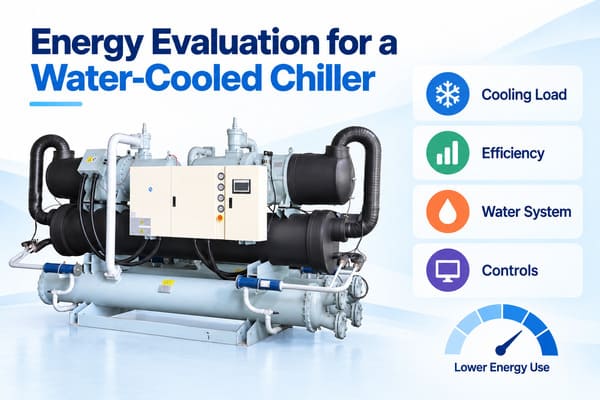
Water-cooled chillers can reduce chiller energy demand under suitable conditions, but I only make that assessment after reviewing the entire operating profile. The comparison should include the chiller compressor, condenser-water pumps, cooling-tower fan, water-treatment equipment, and seasonal operating conditions.
A water-cooled system may be attractive when:
- The factory runs for many hours each year.
- The site has a suitable cooling tower or central water system.
- High ambient temperatures affect air-cooled performance.
- The plant has qualified maintenance personnel.
- The available electrical capacity makes efficiency important.
The system may be less attractive when the plant operates intermittently or must install expensive new water infrastructure.
The real energy comparison
I compare water-cooled and air-cooled chillers using the total operating system rather than compressor data alone. A useful review includes:
| Evaluation item | Water-cooled system | Air-cooled system |
|---|---|---|
| Heat rejection | Cooling tower and condenser-water loop | Outdoor condenser fans and coils |
| Outdoor space | Usually lower chiller footprint | May require larger condenser area |
| Auxiliary power | Pumps and tower fan add load | Condenser fans add load |
| High ambient operation | Often suitable with correct tower design | May face higher condensing temperatures |
| Water requirement | Requires makeup water and treatment | Usually no condenser water |
| Maintenance | Tower, water loop, and chiller service | Coil cleaning, fans, and refrigerant circuit service |
I also examine part-load operation. A plant that operates at full load for long periods may justify a more complex cooling-water system. A facility with short production cycles may not use the potential advantage enough to offset tower and maintenance costs.
Why climate and water quality matter
Cooling towers depend on local wet-bulb conditions, not only dry-bulb temperature1. Water availability also matters. A site in a water-stressed region may face operating restrictions or higher treatment requirements. Poor water quality can increase scaling and corrosion2, which reduces heat-transfer performance and raises cleaning frequency.
I recommend requesting a realistic operating assessment that includes:
- Design and actual cooling load
- Chilled-water supply and return temperatures
- Condenser-water entering and leaving temperatures
- Annual operating hours
- Ambient and wet-bulb conditions
- Pump and tower energy
- Water and chemical-treatment costs
- Planned maintenance shutdowns
I do not recommend accepting unsupported claims such as “the system will save a fixed percentage.” A qualified engineer should calculate performance using the site’s actual conditions.
Are Water-Cooled Chillers Suitable for Space-Constrained or High-Ambient Sites?
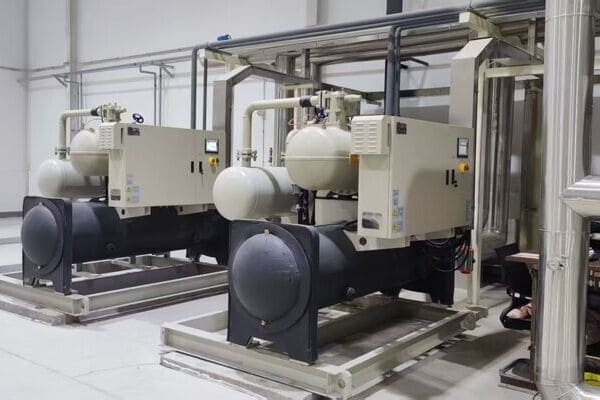
Water-cooled chillers can suit factories with limited outdoor space or high ambient temperatures, but I first confirm that the site can support the required cooling-water infrastructure. A compact chiller room does not mean a compact complete installation because the cooling tower, pumps, piping, and access areas still require space.
I usually investigate five practical questions:
- Is there a suitable location for the cooling tower?
- Can the structure support the tower and water-filled piping?
- Is makeup water available and reliable?
- Can the site control tower noise, plume, and drift?
- Can technicians safely access all maintenance points?
Space planning beyond the chiller room
I have seen projects where the equipment room appeared suitable, but the complete layout was not. The project team later needed additional space for tower access, chemical dosing, filtration, pumps, and pipe routing. I therefore request a general arrangement drawing before final equipment selection.
The layout should allow access to:
- Compressor and electrical panels
- Condenser and evaporator connections
- Cooling-tower fill and drift eliminators
- Pumps, strainers, and valves
- Water-treatment dosing points
- Sensors and control panels
- Drainage and chemical-handling areas
The buyer should also review the surrounding environment. Cooling-tower discharge can affect nearby air intakes, electrical equipment, and building surfaces. Noise and visible vapor may matter in urban or regulated industrial locations.
High ambient does not remove engineering limits
Water cooling can help reject heat in hot climates, but the tower still depends on local weather and correct design. An undersized tower, blocked fill, poor airflow, or excessive condenser-water temperature can reduce chiller capacity and increase compressor stress3.
For this reason, I ask suppliers to state the design conditions clearly. The technical offer should identify:
- Rated cooling capacity
- Chilled-water temperatures and flow
- Condenser-water temperatures and flow
- Refrigerant and compressor model
- Electrical supply
- Sound and installation requirements
- Control and safety functions
- Required water quality range
I also advise buyers to verify stated certifications, test reports, and component documentation directly. Documents should match the offered model and project configuration rather than a similar product family.
What Maintenance and Procurement Risks Should Buyers Check?
The main procurement risk is selecting a water-cooled chiller without assigning responsibility for the surrounding system. I evaluate the supplier’s technical scope, the buyer’s maintenance capability, and the availability of replacement parts before comparing prices.
A responsible procurement review should confirm:
- Who supplies the cooling tower and pumps
- Who designs the condenser-water loop
- Who performs water treatment
- Which alarms protect the chiller
- Which spare parts are recommended
- What response time the supplier can provide
- How shutdowns will affect production
Water quality is a reliability issue
I treat water treatment as part of the cooling system, not as an optional service. Scaling reduces heat transfer4. Corrosion can damage tubes and piping. Biological growth can restrict flow and create hygiene or environmental concerns5. The correct treatment method depends on local water chemistry, materials, tower design, and discharge requirements.
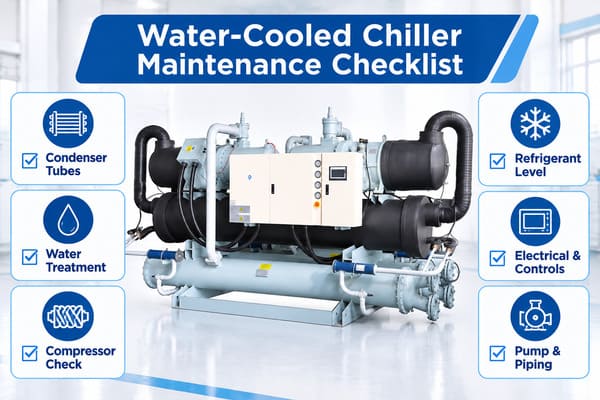
The buyer should establish a written maintenance plan covering:
- Conductivity and chemical monitoring
- Blowdown and makeup-water control
- Tower basin cleaning
- Strainer inspection
- Tube or heat-exchanger cleaning
- Vibration and electrical checks
- Pump seal and bearing inspection
- Sensor calibration
- Refrigerant and safety-system checks
Supplier selection should cover lifecycle support
I compare suppliers using more than purchase price. A useful evaluation matrix may include:
| Procurement factor | Questions I ask |
|---|---|
| Design responsibility | Does the supplier engineer the full water loop? |
| Core components | Are compressor, controls, and electrical brands documented? |
| Factory quality | Are pressure, electrical, and performance tests recorded? |
| Installation | Are commissioning and startup included? |
| Service | Is local technical support available? |
| Spare parts | Are critical parts identified and stocked? |
| Documentation | Are manuals, drawings, and certificates complete? |
| Customization | Can the unit handle special voltage, low temperature, or hazardous areas? |
I also distinguish between a manufacturer and a trading company. For industrial projects, direct access to design engineers can improve technical clarification and reduce communication delays. In my own supplier discussions, I focus on whether the manufacturer can explain the selection basis and limitations clearly.
A qualified professional should review the final design, especially for continuous production, explosive atmospheres, special fluids, or severe environmental conditions.
Frequently Asked Questions
Are water-cooled chillers better than air-cooled chillers?
Neither option is universally better. I usually consider water-cooled chillers when the plant has long operating hours, high ambient conditions, limited outdoor space, and reliable water infrastructure. I often prefer air-cooled equipment when water access, maintenance capability, or installation simplicity is more important.
Do water-cooled chillers require a cooling tower?
Most conventional water-cooled chillers require a cooling tower or another condenser-water heat-rejection system. The tower, pumps, piping, controls, and water treatment should be included in the project evaluation because they affect installation cost, energy use, reliability, and maintenance.
Are water-cooled chillers suitable for high-temperature climates?
They can be suitable for high-temperature climates when the cooling tower and condenser-water loop are correctly designed for local conditions. I recommend checking wet-bulb temperature, water availability, tower approach, equipment-room ventilation, and maintenance capability before making a final decision.
What is the biggest disadvantage of a water-cooled chiller?
I consider system complexity the biggest disadvantage. The chiller depends on pumps, tower operation, water quality, controls, and regular maintenance. If one part of the condenser-water system fails, the production cooling system may also be affected.
What should I request from a water-cooled chiller supplier?
I recommend requesting a complete technical proposal, performance data at actual design conditions, system drawings, component brands, water-quality requirements, factory test documents, commissioning scope, spare-parts recommendations, warranty terms, and service-response details.
Conclusion
The pros and cons of water-cooled chillers depend on the complete project rather than the chiller alone. I consider them carefully for continuous production, high ambient temperatures, large cooling loads, and space-constrained facilities. However, cooling towers, pumps, water treatment, piping, maintenance, and water availability can change the lifecycle result. Buyers should compare the complete system, verify supplier documents, and obtain qualified engineering advice. IceStar Energy Technology can help evaluate site conditions and develop a customized industrial cooling solution for your application.
"General equation for predicting cooling tower approach ...", https://ir.ua.edu/items/10b2cfc0-f5b1-4bdd-aa50-120d846c7ccf. Cooling-tower engineering literature identifies entering-air wet-bulb temperature as the principal climatic reference for evaporative heat rejection because it constrains the lowest practical temperature of the leaving condenser water. Evidence role: mechanism; source type: research. Supports: Cooling-tower design literature should establish the relationship between entering-air wet-bulb temperature, tower approach, and achievable leaving-water temperature.. Scope note: Wet-bulb temperature is not the only design variable; airflow, tower fill, water flow, fouling, and approach temperature also affect performance. ↩
"Best Management Practice #10: Cooling Tower Management", https://www.energy.gov/cmei/femp/best-management-practice-10-cooling-tower-management. Industrial cooling-water guidance recognizes that uncontrolled water chemistry can promote mineral deposition and corrosion, increasing heat-transfer resistance and threatening metallic components in condenser-water systems. Evidence role: mechanism; source type: government. Supports: Water-treatment guidance should link excessive dissolved minerals, unsuitable pH, and other water-chemistry conditions with scale formation and corrosion.. Scope note: The severity and treatment method depend on local water chemistry, materials of construction, concentration cycles, temperature, and operating practice. ↩
"Self-optimizing Control of Cooling Tower for Efficient ...", https://docs.lib.purdue.edu/cgi/viewcontent.cgi?article=1061&context=ihpbc. Chiller performance literature shows that elevated condenser-water temperature generally increases condensing pressure and compressor work, which can reduce efficiency and, at sufficiently severe conditions, constrain available cooling capacity. Evidence role: mechanism; source type: research. Supports: Chiller-performance research should explain how elevated condenser-water temperature raises condensing pressure and affects compressor power and available cooling capacity.. Scope note: The magnitude of the effect depends on refrigerant circuit design, compressor control, load, tower condition, and manufacturer operating limits. ↩
"Best Management Practice #10: Cooling Tower Management", https://www.energy.gov/cmei/femp/best-management-practice-10-cooling-tower-management. Heat-exchanger fouling studies establish that mineral scale adds thermal resistance to heat-transfer surfaces, thereby degrading exchanger performance and potentially increasing the temperature or energy required for a given duty. Evidence role: mechanism; source type: paper. Supports: Heat-exchanger research should show that mineral deposits add thermal resistance and can reduce heat-transfer coefficients or increase required temperature differences.. Scope note: The operational impact varies with deposit thickness, composition, surface location, flow velocity, and exchanger design. ↩
"The Systemic Effects of Blood Flow Restriction Training - PMC", https://pmc.ncbi.nlm.nih.gov/articles/PMC8329318/. Public-health guidance states that poorly maintained evaporative cooling systems can support microbial growth and aerosol generation, while biological deposits may also impair water flow and heat-transfer surfaces. Evidence role: mechanism; source type: government. Supports: Public-health and water-treatment guidance should support the relationship between microbial fouling, inadequate maintenance, and potential exposure risks in evaporative cooling systems.. Scope note: The presence of microbial growth does not by itself demonstrate a specific disease risk; that risk depends on organism, concentration, aerosolization, exposure, and maintenance conditions. ↩