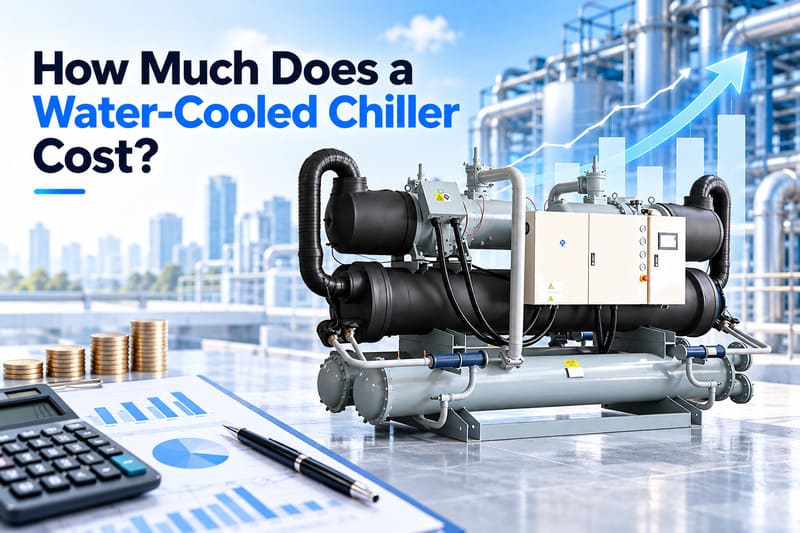
When I discuss water-cooled chiller cost, I often find that buyers want one simple number before defining the application. That creates a problem because capacity alone does not determine a quotation. If the specification is incomplete, a low initial price can lead to poor performance, missing auxiliaries, or higher operating costs. I recommend pricing the complete, correctly matched system instead.
A water-cooled chiller does not have one universal price. The final cost depends on cooling capacity, chilled-water temperatures, process conditions, compressor and heat-exchanger selection, controls, component brands, efficiency requirements, and included accessories. Buyers should compare technically complete quotations that clearly separate the chiller package, auxiliary equipment, installation, logistics, certification, and lifecycle costs.
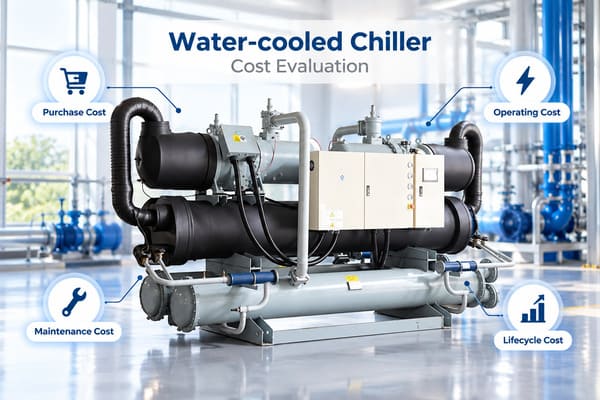
I have participated in many industrial chiller quotations and pre-sales discussions. I have seen similar-capacity units receive very different prices because their operating conditions and technical scopes were not the same. The following framework can help industrial users, EPC contractors, and system integrators build a more realistic procurement budget.
Why does water-cooled chiller cost vary so much?
Many buyers begin with a cooling-capacity figure and expect a predictable price. That approach can produce misleading comparisons. I usually ask for operating data first because the required specification may change significantly between a stable comfort-cooling load and a demanding continuous industrial process.
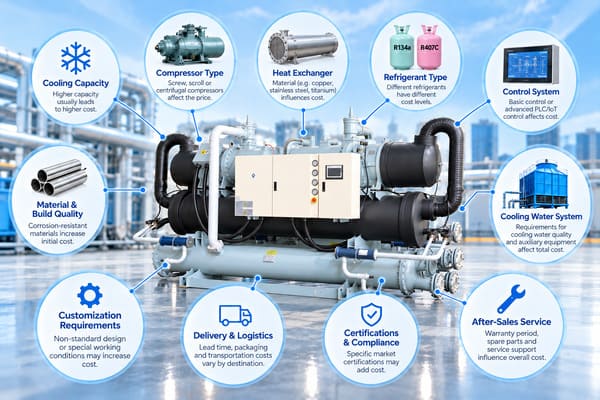
Water-cooled chiller cost varies because the equipment must match actual heat load, water temperatures, operating hours, ambient conditions, efficiency targets, and process requirements. Two chillers with similar nominal capacity can require different compressors, heat exchangers, controls, materials, and protection systems.
Cooling conditions affect the equipment selection
I normally request the following information before preparing or reviewing a quotation:
- Required cooling capacity and expected load profile
- Chilled-water inlet and outlet temperatures
- Condenser-water inlet and outlet temperatures
- Site ambient temperature and altitude
- Process fluid, flow rate, and allowable pressure drop
- Required temperature stability
- Daily and annual operating schedule
- Available electrical voltage, frequency, and phase
- Indoor or outdoor installation conditions
- Special requirements such as explosion protection or low-temperature operation
A chiller designed for ordinary chilled-water temperatures may not be suitable for a process requiring very low outlet temperatures.1 A unit operating in a high-temperature environment may need a different condenser design, larger heat-transfer surfaces, or more robust controls. These changes influence both equipment selection and water-cooled chiller cost.
Major specification variables
| Variable | Possible effect on quotation |
|---|---|
| Compressor type | Changes capacity control, efficiency, maintenance, and purchase cost |
| Heat exchanger design | Affects heat transfer, footprint, pressure drop, and material selection |
| Control system | Adds monitoring, communication, protection, and automation functions |
| Component brands | Influences availability, serviceability, and procurement cost |
| Efficiency requirement | May require larger or more advanced equipment |
| Special environment | May require corrosion protection, weather protection, or explosion-proof design |
| Redundancy | Adds additional equipment but can reduce production risk |
I avoid treating a higher-priced configuration as automatically better. A selected component should match the site, service network, maintenance skills, and project risk. I also recommend that buyers ask suppliers to state design assumptions clearly. That step makes quotations easier to compare.
What is included in a water-cooled chiller quotation?
A quotation can look attractive when it covers only the main chiller. However, the complete cooling system may also require pumps, a cooling tower, a water tank, valves, controls, pipework, installation, and commissioning. I have seen procurement discussions become difficult when these boundaries were not defined at the beginning.
A water-cooled chiller quotation may include only the chiller body, compressor, heat exchangers, controls, and standard electrical components. Buyers should confirm whether pumps, cooling towers, tanks, valves, control panels, transport, installation, commissioning, documentation, and certifications are included or priced separately.
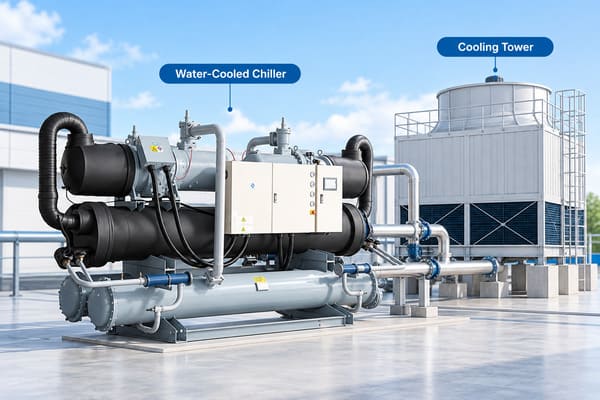
Chiller package versus complete system
I recommend dividing the budget into clear sections:
-
Main chiller package
This may include the compressor, evaporator, condenser, refrigerant circuit, control panel, sensors, and safety devices. -
Condenser-water system
A water-cooled system commonly needs a cooling tower, condenser-water pumps, strainers, chemical treatment, valves, and piping.2 -
Chilled-water system
The project may require chilled-water pumps, expansion provisions, buffer tanks, filters, valves, insulation, and distribution pipework. -
Electrical and automation scope
Buyers should identify whether the supplier provides starters, variable-frequency drives, communication interfaces, remote monitoring, and integration with a plant control system. -
Project services
Transport, unloading, installation, refrigerant work, commissioning, operator training, and after-sales support may be separate line items.
A buyer should not assume that “complete unit” means “complete cooling system.” I ask suppliers to provide an inclusion-and-exclusion list with every commercial offer. The list should also identify the delivery point, warranty conditions, recommended spare parts, and commissioning responsibilities.
Questions I use when checking scope
- Does the quoted capacity apply at the stated chilled-water and condenser-water temperatures?
- Does the price include the cooling tower and pumps?
- Are controls compatible with the customer’s existing automation system?
- Are taxes, export packing, transport, and insurance included?
- Who provides installation and startup supervision?
- Which certificates and test documents are available?
- Are certifications applicable to the exact model and project location?
Certifications should be treated as documents to verify, not as assumptions. I encourage buyers to request copies, check the issuing body, and confirm that the documents apply to the supplied configuration. This process prevents unexpected compliance issues during installation or acceptance.
How should buyers compare water-cooled chiller cost and lifecycle value?
A low purchase price can be attractive when a project has a strict capital budget. However, I believe the better comparison includes energy use, maintenance, service response, spare parts, and the financial effect of production downtime. The cheapest quotation may not be the lowest-cost choice over its useful life.
Buyers should compare water-cooled chiller cost by reviewing the purchase scope, guaranteed operating conditions, estimated energy consumption, maintenance requirements, service capability, spare-parts access, and downtime risk. A technically complete comparison is more useful than a simple price-per-ton calculation.
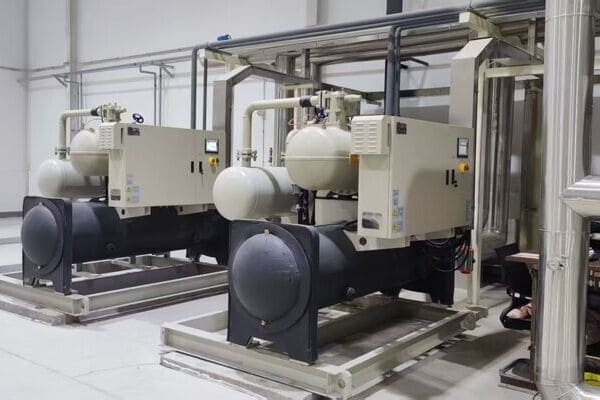
Why price per ton can mislead
“Price per ton of refrigeration” can be useful for an early internal estimate, but I do not treat it as a universal pricing formula. The figure can compare unlike products when one quotation includes auxiliaries and another does not. It can also hide differences in efficiency, temperature conditions, materials, controls, and quality requirements.
I suggest creating a technical comparison sheet with at least these fields:
| Comparison area | What I recommend checking |
|---|---|
| Capacity | Cooling capacity at identical design conditions |
| Efficiency | Input power, part-load behavior, and stated test conditions |
| Operating range | Chilled-water and condenser-water limits |
| Reliability | Protection functions, compressor configuration, and service history |
| Maintainability | Access to components, diagnostics, and spare parts |
| Scope | Included equipment, services, documents, and exclusions |
| Commercial terms | Lead time, warranty, payment terms, and delivery point |
Considering energy and downtime
Energy consumption can become a major part of the ownership cost for a chiller that operates continuously.3 I ask buyers to request power data at the expected operating points rather than relying only on a nominal efficiency value. Process loads often vary, so part-load performance may matter as much as full-load performance.
Maintenance also deserves attention. A buyer should understand:
- Recommended service intervals
- Refrigerant and oil requirements
- Cleaning procedures for heat exchangers
- Availability of local technicians
- Typical spare parts and delivery times
- Alarm history and remote diagnostic functions
- Warranty response and commissioning support
In my experience, supplier communication is an important procurement signal. A capable supplier should ask practical questions about the process instead of sending a generic model and price. At IceStar, I focus on matching the chiller, pumps, tanks, controls, and other equipment to the customer’s actual process. I also explain where a standard configuration is sufficient and where a customized design may reduce technical risk.
I do not recommend selecting equipment based on brand or country of origin alone. Buyers should evaluate documented performance, component availability, engineering quality, and service capability for the actual project. For application-specific decisions, I also recommend review by a qualified refrigeration or mechanical engineer.
Frequently Asked Questions
Is a water-cooled chiller cheaper than an air-cooled chiller?
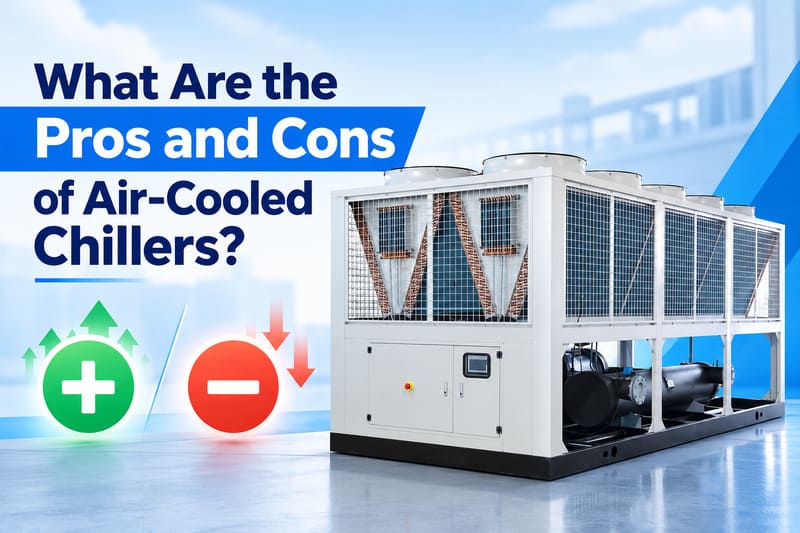
The answer depends on capacity, operating conditions, water infrastructure, energy prices, and local installation costs. A water-cooled system may offer advantages for large or continuously operating applications, but it requires cooling-tower equipment, water treatment, and additional maintenance. I recommend comparing total installed and operating costs.
What information should I send for a water-cooled chiller quotation?
I recommend sending the required cooling capacity, chilled-water temperatures, condenser-water conditions, process load details, operating schedule, site location, power supply, installation environment, and control requirements. Photos, process diagrams, and existing equipment data can also help a supplier avoid incorrect assumptions.
Does the chiller price include a cooling tower?
Not always. Some suppliers quote only the main water-cooled chiller, while others offer a package including a cooling tower, pumps, tank, and controls. I advise buyers to request a detailed bill of supply and an exclusions list before comparing quotations.
How can I reduce water-cooled chiller cost without sacrificing quality?
I first review the operating conditions, control requirements, redundancy, component selection, and auxiliary equipment. Correct sizing can prevent unnecessary capital cost, while efficient operation and maintainable components can reduce lifecycle expense. I do not recommend removing essential protection systems or selecting an undersized chiller.
Conclusion
The right water-cooled chiller cost depends on more than cooling capacity. I recommend defining the operating conditions, checking the compressor and heat-exchanger configuration, separating the chiller from the complete system budget, and comparing energy, maintenance, service, and downtime risks. Buyers should request technically complete quotations and verify certifications and performance documents. Contact IceStar Energy Technology to discuss your process conditions and receive a cooling-system proposal matched to your application.
"Chilled Water Plant Design Guide energydesignresources", https://datacenters.lbl.gov/sites/default/files/EDR_DesignGuidelines_CoolToolsChilledWater.pdf. Low leaving-water temperatures change evaporating conditions and may require refrigeration equipment configured for the corresponding pressure, control, and heat-transfer requirements. Evidence role: mechanism; source type: paper. Supports: The source should explain why low leaving-water temperatures affect refrigerant-cycle conditions, compressor operation, heat-exchanger selection, and controls.. Scope note: Suitability depends on the specific refrigerant, equipment design, load, and required temperature; the source may not define a single universal low-temperature threshold. ↩
"6.4 Chilled Water Systems", https://www.epa.gov/system/files/documents/2023-05/ws-commercial-watersense-at-work_Section_6.4_Chilled_Water_Systems.pdf. Descriptions of water-cooled chiller plants commonly include a condenser-water circuit linking the chiller to a cooling tower, pumps, piping, valves, and water-treatment equipment. Evidence role: definition; source type: education. Supports: The source should identify the cooling tower, condenser-water pumps, piping, valves, strainers, and water-treatment provisions as typical elements of a water-cooled chiller system.. Scope note: Actual auxiliary requirements vary with plant architecture, packaged equipment, condenser type, and project scope. ↩
"Purchasing Energy-Efficient Electric Chillers", https://www.energy.gov/cmei/femp/purchasing-energy-efficient-electric-chillers. Building-energy and life-cycle analyses identify chiller electricity consumption as a recurring operating cost that can become significant over long operating schedules. Evidence role: statistic; source type: government. Supports: The source should provide energy-use or operating-cost data showing the significance of chiller electricity consumption over its service life.. Scope note: The proportion of ownership cost varies with load factor, operating hours, electricity tariffs, climate, and maintenance costs. ↩