An air-cooled chiller can continue producing chilled water for years, but its actual service life depends on far more than age. High ambient temperatures, poor maintenance, frequent alarms, and rising energy use can make an older unit risky or uneconomical. I help customers evaluate these factors before they choose repair, continued operation, or replacement.
An air-cooled chiller does not have one guaranteed lifespan. Its practical life depends on design quality, operating hours, ambient temperature, load pattern, maintenance, component condition, and repair history. A unit may still produce chilled water while becoming unreliable or expensive to operate, so plant managers should assess condition, performance, safety, and total ownership cost before deciding what to do.
The most useful answer comes from separating design life, operating life, and economic life. I have seen relatively old chillers operate reliably because their owners controlled fouling, responded quickly to alarms, and maintained good airflow. I have also seen newer machines develop serious problems because of oversizing, harsh environments, or neglected maintenance. The following framework can help you make a more informed decision.
What Determines an Air-Cooled Chiller’s Service Life?
Many buyers focus on the manufacturing date, compressor brand, or original purchase price. Those details matter, but they do not provide a complete condition assessment. In my experience, the service life of an air-cooled chiller depends on the combined effect of design, operating conditions, maintenance, and component stress.
The most influential factors usually include:
- Ambient temperature and seasonal conditions
- Operating hours and annual start-stop frequency
- Average and peak cooling load
- Condenser coil cleanliness and airflow
- Refrigerant circuit condition
- Electrical quality and control-system stability
- Maintenance discipline and alarm response
- Original equipment selection and installation quality
How ambient temperature affects chiller aging
Air-cooled equipment rejects heat directly into the surrounding air. When outdoor temperature rises, the condenser must work harder to remove the same amount of heat.1 High condensing pressure can increase compressor load, reduce efficiency, and place additional stress on motors, bearings, valves, and electrical components.2
This issue becomes more important in regions such as the Middle East, Africa, and parts of Southeast Asia. A unit selected for a moderate climate may struggle if it operates regularly at high ambient temperatures. A properly engineered high-ambient configuration can include larger condenser coils, suitable fans, stronger electrical protection, and control adjustments.
I once reviewed a project where the customer initially compared machines only by nominal cooling capacity. The site, however, experienced very high summer temperatures and limited maintenance access. After we considered the actual design condition, the customer selected a more robust configuration. That decision increased the initial cost, but it reduced the risk of high-pressure trips and production interruptions.
How load profile affects operating life
A chiller that operates continuously near its design point may experience a different aging pattern from a unit that starts and stops many times each day. Frequent cycling can increase thermal and mechanical stress.3 Running constantly at very low load can also create control, oil-return, or efficiency issues, depending on the system design.4
I normally ask customers to provide:
- Required chilled-water supply and return temperatures
- Expected minimum, average, and maximum load
- Daily and seasonal operating hours
- Number of annual starts
- Process consequences of a shutdown
- Required standby or redundancy capacity
A unit that is badly oversized may appear powerful, but it may cycle excessively and operate inefficiently.5 A unit that is undersized may run continuously at maximum effort and fail to meet process requirements during peak conditions. Correct selection supports both reliability and long-term energy performance.
Why airflow and coil condition matter
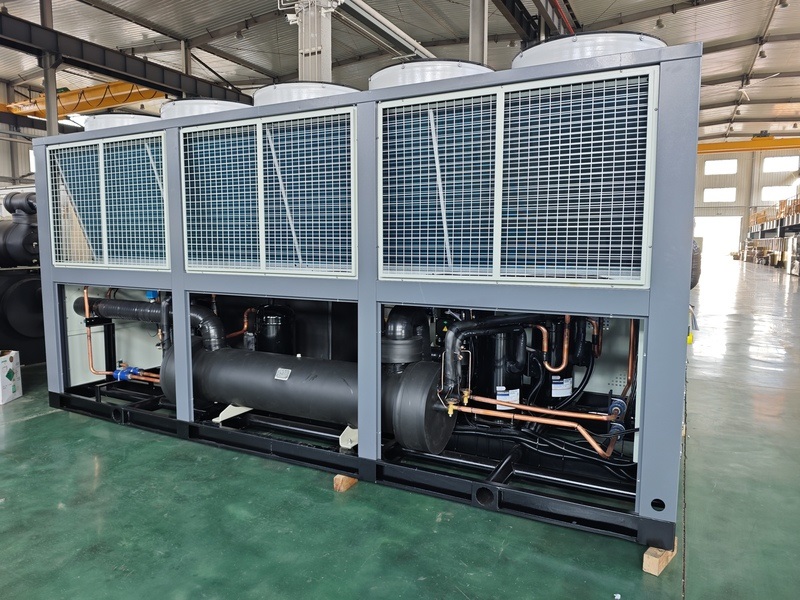
The condenser coil and fans must move enough air across the heat-transfer surface. Dust, fibers, oil mist, leaves, and chemical deposits can restrict airflow.6 The chiller then needs higher condensing pressure to reject heat, which increases energy consumption and compressor stress.
I have encountered this problem in plastics, food processing, chemical, and metalworking facilities. The chiller often received blame for “losing capacity,” but the main issue was a blocked condenser coil or poor clearance around the air outlet. Cleaning the coil and correcting the installation improved performance without replacing the compressor.
Does an Air-Cooled Chiller’s Age Tell Me Its Remaining Life?
Age provides useful context, but it cannot determine remaining life on its own.7 I treat age as one input among several. A newer chiller may have poor remaining reliability if it has suffered repeated high-pressure trips, refrigerant leaks, or electrical damage. An older chiller may remain serviceable if it has a strong maintenance record and operates in a suitable environment.
An air-cooled chiller’s remaining life should be evaluated through condition-based evidence. I recommend reviewing performance records, alarm history, energy use, component condition, and professional inspection results together rather than relying on one number.
Design life, operating life, and economic life
These three terms describe different questions:
| Life category | Main question | What it means |
|---|---|---|
| Design life | What period was the equipment engineered to support? | The expected period under defined design assumptions and maintenance conditions |
| Operating life | Can the unit still produce the required cooling? | The period during which the machine continues to function |
| Economic life | Does continued operation still make financial sense? | The period before energy, maintenance, downtime, and risk exceed replacement value |
A chiller can remain in its operating life while leaving its economic life. For example, it may still deliver cold water, but its power consumption may have increased, replacement parts may be difficult to source, and repeated failures may threaten production.
Components age at different rates
I never judge the entire machine only by compressor age. Each major component has its own failure modes and maintenance needs.
- Compressors: They can suffer from oil degradation, liquid return, overheating, frequent cycling, or poor refrigerant management.
- Condenser coils: They can corrode, foul, leak, or lose heat-transfer performance.
- Fans and motors: Bearings, belts, fan blades, variable-speed drives, and motor insulation can deteriorate.
- Electrical components: Contactors, relays, terminals, sensors, and circuit boards can fail because of heat, vibration, moisture, or unstable voltage.
- Controls: Older controllers may lack useful diagnostics, remote monitoring, or replacement availability.
- Water-side components: Pumps, strainers, valves, insulation, and flow switches can create problems that appear to originate in the chiller.
Replacing one compressor does not automatically restore the reliability of the whole system.8 The replacement may solve an immediate failure while older fans, coils, wiring, and controls remain vulnerable.
Warning signs that age is becoming a risk
I encourage plant managers to investigate when they observe several of these signs at the same time:
- More frequent high-pressure, low-pressure, overload, or flow alarms
- Longer operating hours to achieve the same chilled-water temperature
- Rising amperage or power consumption
- Repeated refrigerant charging
- Increasing oil contamination or abnormal vibration
- Visible condenser corrosion or coil damage
- Difficult-to-source control boards or electrical parts
- Reduced cooling capacity during peak production
- Increasing repair costs and longer downtime
- Unstable operation after every major maintenance event
One isolated alarm does not prove that a chiller needs replacement. A pattern of repeated alarms, declining performance, and rising repair costs provides stronger evidence.
Should I Repair or Replace an Air-Cooled Chiller?
A repair may be appropriate when the failure is isolated, the main heat-transfer surfaces remain sound, parts are available, and the machine still meets process requirements. Replacement becomes more attractive when failures are recurring, capacity is declining, energy costs are rising, or the equipment creates a serious production risk.
I use a structured comparison instead of making the decision from repair cost alone. The correct choice depends on both immediate expenditure and future operating risk.
A practical decision framework
I recommend collecting the following information before approving major work:
-
Maintenance and alarm records
Review at least the recent operating history. Look for repeated faults, emergency callouts, and unresolved alarms. -
Cooling performance
Compare entering and leaving water temperatures, flow rate, ambient temperature, and actual load. A professional technician can determine whether the unit still delivers its required capacity. -
Energy consumption
Track power use under comparable operating conditions. A gradual increase may indicate fouled coils, refrigerant problems, compressor wear, fan issues, or control defects.9 -
Physical condition
Inspect coils, piping, insulation, electrical cabinets, fans, vibration, corrosion, and refrigerant connections. -
Parts and service availability
Check whether the compressor, controller, sensors, drives, and protection devices remain available. A low-cost repair has limited value if the next failure requires a long shutdown. -
Production risk
Estimate the financial effect of an unplanned shutdown. A chiller that supports a critical pharmaceutical, chemical, lithium battery, or food process may justify replacement earlier than a non-critical comfort-cooling application.
Repair versus replacement comparison
| Condition | Repair may be suitable | Replacement may be better |
|---|---|---|
| Failure pattern | Single, identifiable failure | Multiple recurring failures |
| Cooling capacity | Meets process demand | Cannot meet peak demand |
| Energy performance | Stable and acceptable | Clearly worsening |
| Heat exchanger condition | Clean and structurally sound | Corroded, leaking, or badly damaged |
| Controls | Supported and reliable | Obsolete or unavailable |
| Parts | Readily available | Long lead time or discontinued |
| Downtime risk | Manageable | High production consequence |
| Total cost | Predictable repair cost | Rising repair and operating cost |
Why repair price alone can mislead
A compressor replacement may appear cheaper than a new chiller. However, I ask customers to include labor, refrigerant recovery, oil management, testing, crane access, production downtime, future failures, and energy consumption in the comparison.
For example, a repair may cost less initially but leave the customer with:
- An aging condenser coil
- Outdated control hardware
- Weak fan motors
- Limited spare-part availability
- Continued high electricity consumption
- No improvement in system redundancy
A new system may offer improved efficiency, standard integration, remote diagnostics, and a more predictable support plan. IceStar also works with customers on customized configurations, high-ambient operation, low-temperature applications, and system integration when a standard replacement does not fit the process.
Use lifecycle cost, not only capital cost
I usually compare the following five-year or project-specific cost categories:
- Purchase and installation
- Electricity consumption
- Planned maintenance
- Corrective repairs
- Spare parts
- Downtime exposure
- Financing or project-delay effects
- Disposal and refrigerant handling
The lowest purchase price does not always produce the lowest total cost of ownership.10 A reliable machine with suitable components, correct controls, and accessible service can create better long-term value.
How Can I Extend an Air-Cooled Chiller’s Operating Life?
I cannot guarantee a particular service life, but I can identify practices that reduce avoidable stress. Preventive maintenance, correct operating conditions, fast alarm response, and periodic performance checks help preserve reliability and efficiency.11
In my service experience, many premature failures begin with small issues. A dirty coil, loose terminal, abnormal vibration, or ignored alarm can develop into a compressor failure or an extended production shutdown.
Build a condition-based maintenance plan
A useful maintenance plan combines routine tasks with trend monitoring. The exact schedule should follow the manufacturer’s instructions and site conditions, but I normally recommend checking:
Regular operator checks
- Chilled-water supply and return temperatures
- Water flow and pump operation
- Ambient temperature
- Suction and discharge pressure trends
- Compressor and fan operating status
- Abnormal noise, vibration, or smell
- Active and historical alarms
- Visible refrigerant or oil leakage
Planned technical inspections
- Condenser coil cleanliness and corrosion
- Fan blades, motors, bearings, and guards
- Electrical terminals and control panels
- Refrigerant charge and leak-tightness
- Compressor oil condition where applicable
- Sensors, protection devices, and calibration
- Water-side strainers, valves, and flow switches
- Insulation and pipe support condition
Keep the condenser environment suitable
I advise customers to maintain sufficient clearance around air inlets and outlets. Walls, temporary storage, exhaust heat, and nearby equipment can recirculate hot air into the condenser. That condition can raise condensing temperature even when the coil is clean.
Facilities should also consider local contaminants. A food plant may release moisture and organic particles. A chemical plant may expose coils to corrosive substances. A dusty industrial site may require more frequent cleaning than a clean commercial environment.
Respond to alarms quickly
An alarm is not merely an inconvenience. It provides information about operating conditions. Repeatedly resetting a high-pressure or overload alarm without finding the cause can turn a manageable issue into a major failure.
I recommend recording:
- Date and time of each alarm
- Operating load and ambient temperature
- Which circuit or compressor was affected
- Whether the alarm reset automatically
- Corrective action taken
- Whether the same alarm returned
This record helps engineers identify patterns. It also improves communication between the plant team, service company, and chiller manufacturer.
Plan upgrades before a crisis
An owner does not need to wait for a catastrophic failure before evaluating replacement. I often suggest a formal condition review when the unit shows a combination of declining capacity, high energy use, obsolete controls, and repeated repairs.
A planned replacement allows the customer to compare:
- Air-cooled and water-cooled configurations
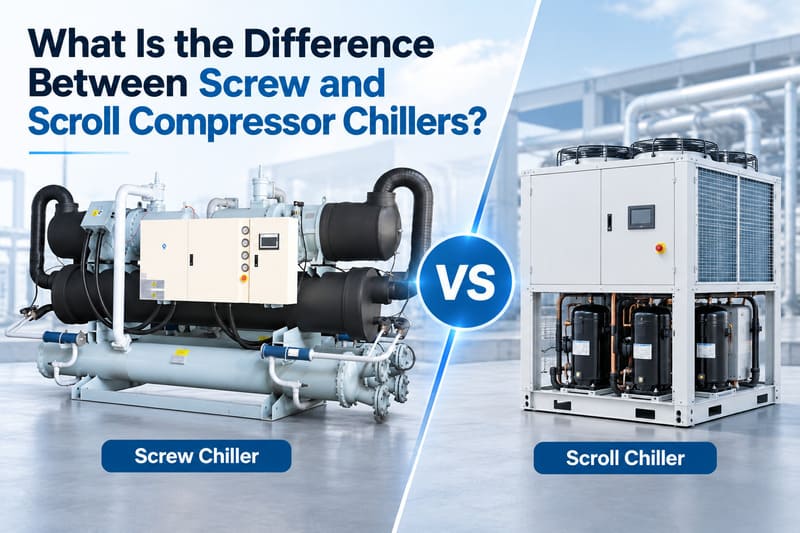
- Scroll and screw compressor arrangements
- Required cooling capacity and temperature range
- High-ambient or low-temperature options
- Redundancy and modular capacity
- Electrical standards and certifications
- Installation access and delivery schedule
- Remote monitoring and service requirements
IceStar supports industrial users, EPC companies, system integrators, and distributors with selection, system design, customized production, commissioning guidance, remote diagnosis, and lifecycle support. A planned project usually creates less disruption than an emergency replacement during peak production.
Frequently Asked Questions
What is the typical service life of an air-cooled chiller?
I do not recommend treating one fixed number as a guarantee. Actual service life depends on design conditions, climate, operating hours, maintenance, airflow, load profile, and component availability. The manufacturer’s documentation and a condition assessment provide more useful guidance than age alone.
Can an old air-cooled chiller still be efficient?
Yes, an older unit can remain reasonably efficient if it has clean coils, correct refrigerant conditions, healthy compressors, suitable controls, and proper water flow. However, efficiency may decline because of component wear, obsolete controls, or design limitations. I recommend comparing measured power and cooling output under similar conditions.
Is compressor replacement enough to restore a chiller?
Not always. A new compressor may resolve one failure, but the condenser coils, fans, electrical system, controls, sensors, and piping may remain old or damaged. I evaluate the complete refrigeration and control system before recommending compressor replacement as a long-term solution.
When should I replace an air-cooled chiller instead of repairing it?
Replacement deserves serious consideration when the unit has repeated failures, declining capacity, rising energy use, obsolete parts, severe corrosion, or high downtime consequences. I also compare the full lifecycle cost of repair with the cost and expected performance of a new system.
How can I reduce the risk of unplanned chiller downtime?
I recommend preventive maintenance, clean condenser coils, stable electrical supply, correct water flow, trend monitoring, fast alarm investigation, and planned spare parts. Industrial users should also evaluate redundancy when a chiller supports a critical production process.
Conclusion
An air-cooled chiller does not have one guaranteed lifespan that applies to every factory or climate. I evaluate three separate questions: whether the unit still operates, whether it remains reliable, and whether continued operation remains economical. Maintenance history, cooling performance, energy consumption, alarm frequency, component condition, environmental stress, and parts availability all matter. If you are deciding whether to repair, replace, or upgrade an industrial chiller, contact IceStar for a technical selection review and a customized lifecycle-cost assessment.
"The Future of Absorption Technology in America", https://www.energy.gov/sites/prod/files/2013/11/f4/absorption_future.pdf. ASHRAE refrigeration guidance describes the relationship between ambient temperature, condenser heat rejection, condensing pressure, and compressor energy in air-cooled refrigeration equipment. Evidence role: mechanism; source type: research. Supports: The source should explain that higher ambient air temperature reduces the temperature difference available for heat rejection and generally raises condensing temperature or pressure and compressor work.. Scope note: The magnitude of the effect depends on condenser design, control strategy, refrigerant, and operating load. ↩
"Refrigeration Control with Varying Condensing Pressures", https://docs.lib.purdue.edu/cgi/viewcontent.cgi?article=1191&context=iracc. Refrigeration-system studies associate elevated condensing pressure with increased compression work and reduced coefficient of performance, while identifying elevated discharge conditions as a potential source of compressor stress. Evidence role: mechanism; source type: paper. Supports: The source should document how elevated condensing pressure affects compression ratio, power demand, efficiency, discharge conditions, and compressor operating stress.. Scope note: Evidence for damage to particular motors, bearings, valves, or electrical parts is system-specific and should not be inferred uniformly for every chiller. ↩
"Effect of Shorter Compressor On/Off Cycle Times on A/C ...", https://www.ideals.illinois.edu/items/13488. HVAC and refrigeration reliability guidance identifies frequent compressor cycling as an operating condition that can increase starting stress and disrupt normal lubrication or thermal stabilization. Evidence role: mechanism; source type: research. Supports: The source should describe how repeated starts and stops affect compressor temperature, lubrication, electrical loading, pressure equalization, and mechanical components.. Scope note: The severity depends on compressor type, controls, minimum run-time settings, equalization behavior, and the number and duration of cycles. ↩
"Development of High-Side Shell Scroll Compressor with Novel Oil Return ...", https://docs.lib.purdue.edu/cgi/viewcontent.cgi?article=3022&context=icec. Technical literature on variable-load refrigeration systems reports that low-load operation can alter control stability, refrigerant and oil circulation, and part-load efficiency. Evidence role: mechanism; source type: paper. Supports: The source should discuss low-load control limits, compressor unloading, refrigerant mass flow, oil return, and efficiency behavior in chillers or refrigeration systems.. Scope note: These effects are not universal; compressor technology, oil-separation design, refrigerant circuit arrangement, and control logic determine the actual risk. ↩
"Purchasing Energy-Efficient Electric Chillers", https://www.energy.gov/cmei/femp/purchasing-energy-efficient-electric-chillers. Building-energy guidance emphasizes capacity matching and part-load performance because substantially oversized chillers may experience less stable operation and poorer seasonal efficiency than appropriately selected equipment. Evidence role: general_support; source type: government. Supports: The source should support the importance of matching chiller capacity to load and explain how oversized equipment may operate at unfavorable part-load conditions or cycle more frequently.. Scope note: Variable-speed drives, staged compressors, thermal storage, and modular equipment can reduce or eliminate some oversizing effects. ↩
"Ventilation Common Air Conditioner Problems Maintaining ...", https://www.energy.gov/sites/prod/files/2014/06/f16/HomeCooling101.pdf. Studies of air-cooled heat exchangers find that particulate and surface fouling can increase airflow resistance and thermal resistance, reducing heat-rejection performance and potentially increasing system power demand. Evidence role: mechanism; source type: research. Supports: The source should show that deposits or debris on air-cooled condenser surfaces impede airflow or heat transfer and can increase condensing temperature or energy use.. Scope note: The measured effect depends on contaminant type, deposit thickness, coil geometry, fan operation, and the baseline cleanliness of the equipment. ↩
"results from a pilot survey", https://tsapps.nist.gov/publication/get_pdf.cfm?pub_id=920084. Reliability and prognostics literature treats chronological age as one predictor among several and emphasizes condition indicators, operating history, and degradation trends when estimating remaining useful life. Evidence role: expert_consensus; source type: research. Supports: The source should support the use of operating condition, failure history, inspection data, and performance trends alongside age when estimating remaining useful life.. Scope note: Most evidence concerns industrial assets generally rather than air-cooled chillers specifically. ↩
"Reliability analysis and maintenance modeling of multi-component ...", https://rucore.libraries.rutgers.edu/rutgers-lib/49329/. Reliability engineering models treat a chiller as a system of interdependent components, so restoration of one compressor does not establish the condition or reliability of coils, fans, controls, electrical devices, and piping. Evidence role: general_support; source type: research. Supports: The source should support the principle that system reliability depends on multiple interacting components and that replacing one failed component does not remove failure risks elsewhere.. Scope note: The specific reliability improvement from compressor replacement requires an inspection and failure-history assessment for the individual installation. ↩
"Building fault detection and diagnostics: Achieved savings ...", https://betterbuildingssolutioncenter.energy.gov/sites/default/files/building_fault_detection_and_diagnostic-paper.pdf. Chiller fault-detection studies use normalized power, temperatures, pressures, and flow measurements to identify performance degradation associated with fouling, refrigerant faults, compressor problems, and control anomalies. Evidence role: case_reference; source type: research. Supports: The source should document that normalized power or efficiency trends can help identify fouling, refrigerant faults, compressor degradation, fan problems, or control faults.. Scope note: A power increase is not diagnostic by itself and must be normalized for load, ambient conditions, water temperatures, flow, and sensor accuracy. ↩
"Purchasing Energy-Efficient Electric Chillers", https://www.energy.gov/cmei/femp/purchasing-energy-efficient-electric-chillers. Life-cycle-cost guidance for HVAC equipment states that acquisition price alone is insufficient and that energy, maintenance, repair, replacement, and disposal costs should be evaluated over the asset's service period. Evidence role: general_support; source type: government. Supports: The source should support comparing acquisition cost with energy, maintenance, repair, downtime, and end-of-life costs over the relevant analysis period.. Scope note: The result is sensitive to assumed operating hours, energy prices, discount rate, maintenance regime, and equipment lifetime. ↩
"Hospitals Benefit by Improving Inefficient Chiller Systems", https://www1.eere.energy.gov/buildings/publications/pdfs/alliances/hea_chillers.fs.pdf. Institutional HVAC maintenance guidance identifies preventive inspection, cleaning, calibration, alarm review, and periodic performance verification as practices that can sustain equipment performance and reduce avoidable failures. Evidence role: expert_consensus; source type: institution. Supports: The source should recommend preventive inspection, operating-condition checks, alarm review, and performance measurement as practices for maintaining HVAC equipment.. Scope note: Guidance supports risk reduction rather than a guaranteed increase in service life, and the appropriate schedule depends on equipment and site conditions. ↩