The life expectancy of an air-cooled chiller is a concern I hear from factory utility managers and EPC teams before they approve a major investment. A chiller may continue operating while losing capacity, consuming more electricity, or creating downtime risk. I recommend evaluating its remaining service value through operating conditions, maintenance records, actual performance, and lifecycle cost—not age alone.
The life expectancy of an air-cooled chiller does not have one universal number. A properly selected, installed, and maintained unit may provide many years of service, but high ambient temperatures, dust, corrosion, heavy loading, and poor maintenance can shorten its useful life. Buyers should distinguish warranty period, design life, serviceable life, and economically worthwhile operating life, then verify expected performance with qualified professionals and documented supplier data.
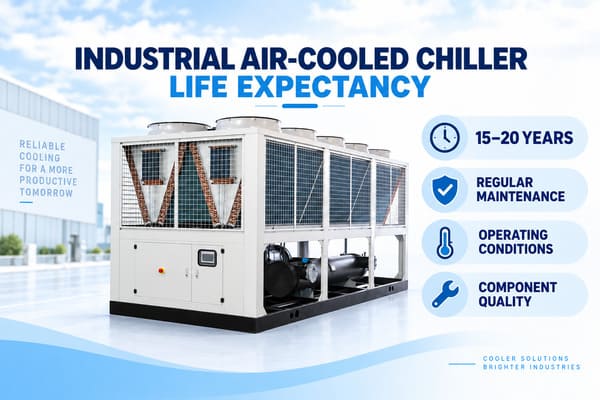
When I discuss chiller selection with industrial customers, I first ask how the equipment will operate rather than promising a fixed replacement year. The answers reveal whether the main risk is mechanical wear, heat-rejection difficulty, energy consumption, or inadequate maintenance access. The following criteria help buyers estimate lifecycle risk more realistically.
What Determines the Life Expectancy of an Air-Cooled Chiller?
A simple age-based estimate can mislead a buyer because two identical chillers may experience very different conditions. I have seen project discussions change significantly after the team reviewed ambient temperature, operating hours, water quality, and process criticality. These factors should form the starting point for a practical service-life assessment.
The life expectancy of an air-cooled chiller depends mainly on design quality, operating environment, load profile, maintenance, installation, and component condition. High outdoor temperatures, blocked condenser coils, frequent cycling, corrosive air, and continuous operation near full load can accelerate degradation. Correct sizing and planned maintenance can help preserve capacity and reduce avoidable failures.
Operating environment
Air-cooled chillers reject heat directly to outdoor air. Therefore, the environment strongly affects condenser performance and component durability. I recommend reviewing:
- Ambient temperature: High temperatures increase condensing pressure and compressor workload.1
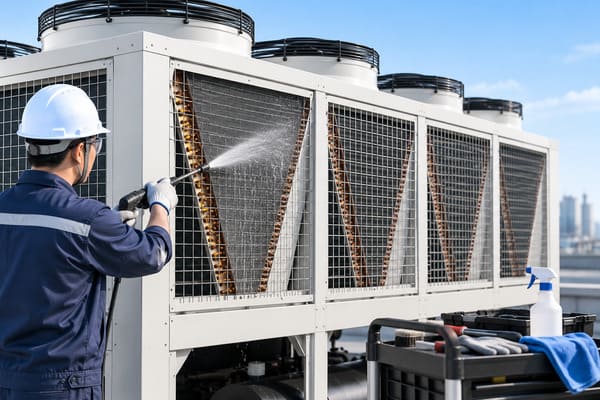
- Dust and fibers: Dirty coils restrict airflow and reduce heat transfer.2
- Salt mist: Coastal air can accelerate corrosion of coils, frames, fasteners, and electrical enclosures.3
- Chemical vapors: Chemical and petrochemical sites may require special materials or protective coatings.
- Installation clearance: Poor airflow recirculation can make the unit operate hotter than the design condition.
- Weather exposure: Rain, sunlight, freezing conditions, and humidity affect controls and electrical parts.
A unit selected for a mild climate may not provide the same operating margin in a hot Middle Eastern plant. I would ask the supplier to confirm rated cooling capacity at the actual summer design temperature, not only at a standard catalog condition.
Load profile and operating hours
A chiller serving a continuous process may run for thousands of hours each year. Another unit may operate intermittently but experience frequent starts and stops. Both patterns create different stresses.
High sustained load can increase compressor, fan motor, and electrical component wear. Frequent cycling can increase thermal and mechanical stress4 and may indicate oversizing, poor control logic, or unstable process demand. Variable-speed compressors and fans can help match output to demand, but the controls must be correctly configured.
Installation and maintenance
Even a well-designed chiller can underperform after poor installation. Incorrect refrigerant charging, inadequate water flow, restricted ventilation, vibration, or unsuitable electrical supply can create long-term problems. I also recommend checking whether technicians can safely access coils, filters, control panels, compressors, and pumps.
Maintenance should include condenser cleaning, electrical inspection, refrigerant and oil checks where applicable, vibration monitoring, alarm review, and water-side cleaning. The exact schedule should follow the manufacturer’s instructions and the application conditions.
How Should Buyers Measure Chiller Service Life?
Many buyers ask whether a chiller is “still working.” I believe that question is too narrow. A machine can run while failing to meet process temperature, consuming excessive power, or creating repeated production interruptions. A better assessment compares required output with actual performance and ownership cost.
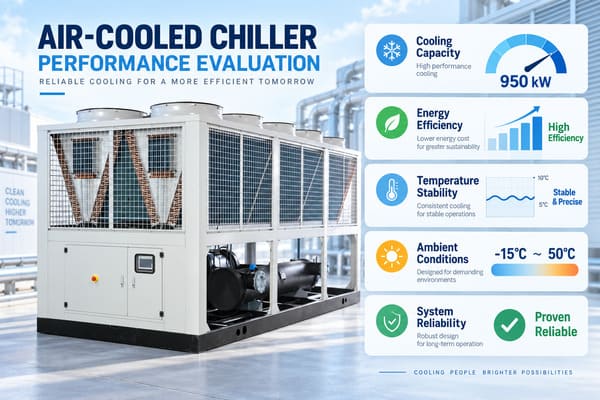
Buyers should measure chiller service life through cooling capacity, leaving-water temperature, power consumption, operating stability, fault frequency, maintenance cost, and replacement-part availability. A chiller may remain mechanically functional but no longer be economically suitable if it cannot meet process demand efficiently or requires frequent major repairs.
Four terms that buyers should separate
I recommend separating these terms in procurement documents:
| Term | Meaning | Why it matters |
|---|---|---|
| Warranty period | Supplier’s contractual coverage | It is not a guaranteed whole-unit lifespan |
| Design life | Engineering target used during design | It depends on stated conditions and assumptions |
| Serviceable life | Period when repair and operation remain practical | Parts, technicians, and condition are important |
| Economic life | Period when operation remains financially worthwhile | Energy and downtime can change the decision |
A supplier’s warranty or design statement should never be treated as proof of guaranteed replacement timing. Buyers should request the assumptions behind any design-life claim and verify certifications, test reports, and performance data for the proposed configuration.
Performance indicators I would track
For an operating plant, I would compare current data with commissioning records or the original acceptance test. Useful indicators include:
- Cooling capacity at defined entering and leaving water temperatures
- Electrical input and approximate kW per unit of cooling
- Compressor discharge and suction conditions
- Condenser approach temperature and airflow condition
- Number and type of alarms
- Unplanned maintenance hours
- Refrigerant leakage or recurring circuit faults
- Ability to maintain the required process temperature during peak ambient conditions
I would not make a replacement decision based only on compressor operation. A functioning compressor does not prove that the coil, fans, controls, refrigerant circuit, heat exchanger, or electrical system remain fit for production.
When replacement becomes reasonable
Replacement may deserve serious consideration when the unit has repeated failures, obsolete controls, unavailable parts, severe corrosion, or a large capacity shortfall. High energy use can also justify replacement, but I recommend measuring it before making a payback claim.
For critical production, I would include the financial effect of an unexpected shutdown. A lower-priced repair may be reasonable for a noncritical backup chiller. A new, more efficient system may be preferable when one failure could stop a continuous process.
How Can a New Air-Cooled Chiller Deliver Better Lifecycle Value?
A low purchase price does not automatically produce a low-cost cooling system. I encourage procurement teams to compare the full ownership period, especially when the chiller will operate continuously or under harsh conditions. The initial quotation should be the beginning of the evaluation, not the final decision.
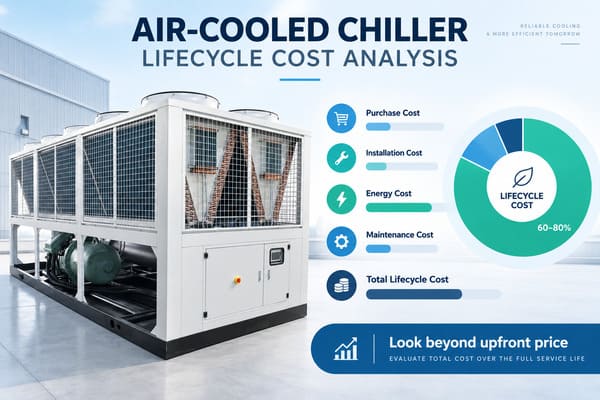
A new air-cooled chiller can deliver better lifecycle value when its capacity, efficiency, controls, materials, maintenance access, and service support match the application. Buyers should compare purchase price with energy use, preventive maintenance, major component replacement, downtime exposure, and eventual replacement cost. All savings estimates should use verified project data.
Build a project-specific evaluation
I would ask the supplier and EPC team to document the following:
- Required cooling capacity and safety margin
- Entering and leaving chilled-water temperatures
- Maximum and minimum ambient temperatures
- Annual operating hours and seasonal load pattern
- Site altitude, dust, salt, and chemical exposure
- Electrical voltage, frequency, and starting limitations
- Required redundancy and process criticality
- Refrigerant, controls, and major component brands
- Commissioning, training, spare parts, and response arrangements
- Local certification and code requirements
For projects in hot climates, I would request capacity and power data at the actual design ambient condition. For corrosive sites, I would ask about coil coatings, cabinet protection, fastener materials, and the maintenance method. For critical factories, I would evaluate lead time for compressors, fan motors, controllers, and replacement heat exchangers.
Compare cost categories
A lifecycle comparison can use this framework:
| Cost category | Questions for buyers |
|---|---|
| Capital cost | Does the quotation include pumps, controls, tanks, and installation requirements? |
| Energy cost | What is the expected power at actual load and ambient conditions? |
| Maintenance | Can local technicians perform routine service? |
| Major repairs | Which components have long lead times or high replacement cost? |
| Downtime | What production loss could result from a failure? |
| End-of-life | Can the unit be upgraded, refurbished, or responsibly replaced? |
I have found that a transparent comparison often favors a balanced specification rather than the cheapest equipment. However, I would not assume that a higher price guarantees longer life. Buyers should verify design documents, test evidence, references relevant to the same environment, and the supplier’s service capability.
Frequently Asked Questions
Does an air-cooled chiller have a fixed lifespan?
No. The useful life depends on ambient conditions, load, maintenance, installation quality, corrosion, component availability, and required performance. Any typical lifespan range should be treated as an indicative estimate requiring external verification and application-specific review.
Does high ambient temperature shorten chiller life?
High ambient temperature can increase condensing pressure, compressor workload, fan operation, and electrical stress. It may accelerate performance degradation if the unit lacks sufficient design margin. Buyers should evaluate rated capacity and power at the site’s actual peak summer condition.
Can regular maintenance extend chiller service life?
Regular maintenance can reduce avoidable failures and help preserve heat-transfer performance. Coil cleaning, electrical checks, alarm review, vibration inspection, and correct water treatment are important. Maintenance cannot fully reverse corrosion, obsolete controls, or severe mechanical wear.
Should I replace a chiller that is still running?
Not necessarily. I would first compare actual capacity, efficiency, repair frequency, parts availability, and downtime risk with the plant’s requirements. Replacement becomes more attractive when performance is inadequate or continued operation costs more than a reliable new system.
Conclusion
The life expectancy of an air-cooled chiller is a project-specific lifecycle question, not a universal calendar number. I recommend separating warranty, design life, serviceable life, and economic life. Buyers should assess ambient temperature, dust, corrosion, load pattern, maintenance quality, capacity retention, energy use, and downtime risk. IceStar Energy Technology can help industrial users, EPC contractors, and integrators define operating conditions and compare suitable air-cooled chiller configurations. Contact our technical team for a qualified application review and project-based quotation.
"What Is the Refrigeration Cycle? A Guide for HVAC Students", https://northbridge.edu/en/publications/things-hvac-students-should-know-about-refrigeration-cycle/. The reference explains that higher outdoor heat-rejection temperatures increase condensing pressure and the compressor work required by a vapor-compression refrigeration cycle. Evidence role: mechanism; source type: education. Supports: The source should explain how increased condensing temperature and pressure alter compressor work and power demand in vapor-compression systems.. Scope note: Thermodynamic support establishes the mechanism but does not by itself demonstrate a particular chiller's long-term degradation rate. ↩
"[PDF] A Literature Review On Heat Exchanger Air Side Fouling In ...", https://docs.lib.purdue.edu/cgi/viewcontent.cgi?article=2662&context=iracc. The study finds that particulate fouling on air-cooled condenser surfaces increases airflow resistance and reduces effective heat-transfer performance. Evidence role: mechanism; source type: paper. Supports: The source should measure or explain the effects of particulate fouling on airflow resistance, heat-transfer coefficient, condensing conditions, or cooling capacity.. Scope note: Results can depend on contaminant type, fouling thickness, coil geometry, airflow rate, and cleaning condition. ↩
"Marine Atmospheric Corrosion of Carbon Steel: A Review - PMC", https://pmc.ncbi.nlm.nih.gov/articles/PMC5506973/. The source documents the role of chloride-bearing marine atmospheres in accelerating atmospheric corrosion of exposed metallic components and coatings. Evidence role: mechanism; source type: paper. Supports: The source should establish that chloride-containing marine atmospheres increase corrosion rates for exposed metals and protective finishes used in outdoor equipment.. Scope note: Atmospheric corrosion rates vary with distance from the coast, humidity, pollutant concentration, material selection, and protective treatment. ↩
"Effect of Shorter Compressor On/Off Cycle Times on A/C ... - IDEALS", https://www.ideals.illinois.edu/items/13488. The study associates repeated compressor or refrigeration-system cycling with increased thermal transients, starting stresses, or component wear mechanisms. Evidence role: mechanism; source type: paper. Supports: The source should explain or measure how repeated cycling affects temperature gradients, lubrication, starting loads, fatigue, or component reliability.. Scope note: The magnitude of the effect depends on compressor technology, controls, cycle duration, start frequency, and operating temperatures. ↩